




How do you find the value of $\cos (\operatorname{arc} (tanx))$?
Answer
 Verified
600.9k+ views
Hint: Here basically we need to know that inverse of the trigonometric function can also be represented in the form by using the prefix $arc$ .Here we need to proceed by letting the value inside the bracket which is ${\tan ^{ - 1}}x$ to be any variable say $a$ and then we will get $\tan a = x$ and now we can easily find the value of $\cos a$ which is required by using Pythagoras theorem.
Complete step-by-step answer:
Here we are given to simplify the term which is given as $\cos (\operatorname{arc} (tanx)) = \cos \left( {{{\tan }^{ - 1}}x} \right)$
So let us consider the term inside the bracket which is ${\tan ^{ - 1}}x$ to be any variable say $a$
So we get ${\tan ^{ - 1}}x = a$
So we will get $\tan a = x$
We can also write it as $\tan a = \dfrac{x}{1}$
Now we need to find the value of $\cos \left( {{{\tan }^{ - 1}}x} \right)$ which can be written as $\cos a$according to the variable which we have let ${\tan ^{ - 1}}x = a$
So let us consider the triangle $ABC$in which we can let the angle $a$ as $\angle A$ and it is right angles at\[B\]
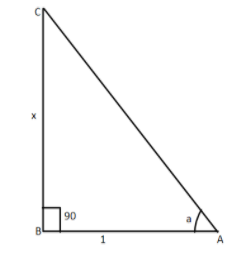
Now we are given:
$\tan a = \dfrac{x}{1}$$ - - - - (1)$
So we know that $\tan a = \dfrac{{{\text{perpendicular}}}}{{{\text{base}}}} = \dfrac{{BC}}{{AB}}$$ - - - - - (2)$
So by comparing the equation (1) and (2) we will get:
$
BC = x \\
AB = 1 \\
$
Now we know that by Pythagoras theorem we can say that in the right angles triangle:
$A{C^2} = A{B^2} + B{C^2}$
Now we can put in it:
$
BC = x \\
AB = 1 \\
$
We will get:
$
A{C^2} = A{B^2} + B{C^2} \\
A{C^2} = {1^2} + {x^2} \\
AC = \sqrt {1 + {x^2}} \\
$
Now we know that in the right angles triangle:
$\cos a = \dfrac{{{\text{base}}}}{{{\text{hypotenuse}}}} = \dfrac{{AB}}{{AC}}$
Now we can substitute the values of $AB,AC$ in the above equation of $\cos a$
$\cos a = \dfrac{{{\text{base}}}}{{{\text{hypotenuse}}}} = \dfrac{{AB}}{{AC}}$
$\cos a = \dfrac{1}{{\sqrt {1 + {x^2}} }}$
Now we can substitute the value of $a$ and get:
$\cos \left( {{{\tan }^{ - 1}}x} \right)$$ = \dfrac{1}{{\sqrt {1 + {x^2}} }}$
So we can write $\cos \left( {{{\tan }^{ - 1}}x} \right) = \cos (\operatorname{arc} (tanx))$$ = \dfrac{1}{{\sqrt {1 + {x^2}} }}$
Hence in this way by the use of Pythagoras theorem we can easily solve such types of problems where we need to find the trigonometric function of the inverse function.
Note: In such types of problems the student must keep in mind the basic trigonometric formula and the properties and also the use of Pythagoras theorem. We must know that $\cos \left( {{{\sin }^{ - 1}}x} \right) = \sin \left( {{{\cos }^{ - 1}}x} \right)$ because:
$\cos \left( {\dfrac{\pi }{2} - {{\cos }^{ - 1}}x} \right) = \sin \left( {{{\cos }^{ - 1}}x} \right)$
Complete step-by-step answer:
Here we are given to simplify the term which is given as $\cos (\operatorname{arc} (tanx)) = \cos \left( {{{\tan }^{ - 1}}x} \right)$
So let us consider the term inside the bracket which is ${\tan ^{ - 1}}x$ to be any variable say $a$
So we get ${\tan ^{ - 1}}x = a$
So we will get $\tan a = x$
We can also write it as $\tan a = \dfrac{x}{1}$
Now we need to find the value of $\cos \left( {{{\tan }^{ - 1}}x} \right)$ which can be written as $\cos a$according to the variable which we have let ${\tan ^{ - 1}}x = a$
So let us consider the triangle $ABC$in which we can let the angle $a$ as $\angle A$ and it is right angles at\[B\]
Now we are given:
$\tan a = \dfrac{x}{1}$$ - - - - (1)$
So we know that $\tan a = \dfrac{{{\text{perpendicular}}}}{{{\text{base}}}} = \dfrac{{BC}}{{AB}}$$ - - - - - (2)$
So by comparing the equation (1) and (2) we will get:
$
BC = x \\
AB = 1 \\
$
Now we know that by Pythagoras theorem we can say that in the right angles triangle:
$A{C^2} = A{B^2} + B{C^2}$
Now we can put in it:
$
BC = x \\
AB = 1 \\
$
We will get:
$
A{C^2} = A{B^2} + B{C^2} \\
A{C^2} = {1^2} + {x^2} \\
AC = \sqrt {1 + {x^2}} \\
$
Now we know that in the right angles triangle:
$\cos a = \dfrac{{{\text{base}}}}{{{\text{hypotenuse}}}} = \dfrac{{AB}}{{AC}}$
Now we can substitute the values of $AB,AC$ in the above equation of $\cos a$
$\cos a = \dfrac{{{\text{base}}}}{{{\text{hypotenuse}}}} = \dfrac{{AB}}{{AC}}$
$\cos a = \dfrac{1}{{\sqrt {1 + {x^2}} }}$
Now we can substitute the value of $a$ and get:
$\cos \left( {{{\tan }^{ - 1}}x} \right)$$ = \dfrac{1}{{\sqrt {1 + {x^2}} }}$
So we can write $\cos \left( {{{\tan }^{ - 1}}x} \right) = \cos (\operatorname{arc} (tanx))$$ = \dfrac{1}{{\sqrt {1 + {x^2}} }}$
Hence in this way by the use of Pythagoras theorem we can easily solve such types of problems where we need to find the trigonometric function of the inverse function.
Note: In such types of problems the student must keep in mind the basic trigonometric formula and the properties and also the use of Pythagoras theorem. We must know that $\cos \left( {{{\sin }^{ - 1}}x} \right) = \sin \left( {{{\cos }^{ - 1}}x} \right)$ because:
$\cos \left( {\dfrac{\pi }{2} - {{\cos }^{ - 1}}x} \right) = \sin \left( {{{\cos }^{ - 1}}x} \right)$
Recently Updated Pages
Master Class 11 English: Engaging Questions & Answers for Success

Master Class 11 Social Science: Engaging Questions & Answers for Success
Master Class 11 Maths: Engaging Questions & Answers for Success
Master Class 11 Biology: Engaging Questions & Answers for Success
Master Class 11 Physics: Engaging Questions & Answers for Success
Master Class 11 Chemistry: Engaging Questions & Answers for Success
Trending doubts
One Metric ton is equal to kg A 10000 B 1000 C 100 class 11 physics CBSE
What is cell theory Who formulated it class 11 biology CBSE
Phyllotaxy is the arrangement of ALeaflets BLeaves class 11 biology CBSE
Difference Between Prokaryotic Cells and Eukaryotic Cells
The symbiotic association of fungi and algae is called class 11 biology CBSE
Cell theory was formulated by A Schleiden and Schwann class 11 biology CBSE