



How do you find the supplement of a radian measure?
Answer
 Verified
573.3k+ views
Hint: Here we will use the total of all the angles of a triangle and then compare it to its radian measurement.
Also, we will use the concept of supplement. Finally we get the required answer
Formula used: In a triangle there are three angles that coincide the sides of a triangle and the sum of all the angles is \[ = {180^ \circ }\].
Let's say, following \[ABC\] is a triangle.

Then \[\angle ABC + \angle BCA + \angle BAC = {180^ \circ }\].
Two angles are called supplementary when summation of those two angles are equal to \[{180^ \circ }\].
Suppose one angle is measured as \[{140^ \circ }\], then its supplementary angle will be\[ = {180^ \circ } - {40^ \circ } = {140^ \circ }\].
In a triangle sum of all the angles can be represented in the form of degree as well as in the form of radians.
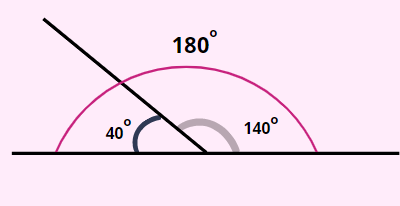
In a triangle, Sum of all angles \[ = {180^ \circ } = {\pi ^c}\], where \[{\pi ^c}\] is called \[\pi \] radian.
Complete step-by-step solution:
So, if any angle is given as a degree form then we will try to convert it into radian first, and then will try to find its supplementary angle.
Let's say, one angle is given as \[{60^ \circ }\].
So, if we convert \[{60^ \circ }\] into its radian, then we will perform the following steps:
\[{180^ \circ } = {\pi ^c}\]
Or, \[{1^ \circ } = {\left( {\dfrac{\pi }{{180}}} \right)^c}\]
So, \[{60^ \circ } = {\left( {60 \times \dfrac{\pi }{{180}}} \right)^c}\]
Or, \[{60^ \circ } = {\left( {\dfrac{\pi }{3}} \right)^c}\].
Now, to find the Supplementary of \[{60^ \circ }\] in radian, we will have to simply subtract it from\[{\pi ^c}\].
So, supplementary of \[{60^ \circ }\] in radian will be \[\left( {\pi - \dfrac{\pi }{3}} \right) = \dfrac{{3\pi - \pi }}{3} = \dfrac{{2\pi }}{3}\] radian.
So, the general rule to find any supplementary angle of any angle is:
If it is given in degree form, then we have to convert it into its radian first and then we will subtract it from \[\pi \] radian.
Or, if it is given radian itself, then we will simply subtract it from \[\pi \] radian.
So, Supplementary of two angles means that:
\[\angle 1 + \angle 2 = {180^ \circ } = {\pi ^c}\].
Note: On the other hand complementary of two angles means that the sum of these two angles is equal to \[{90^ \circ }\] or \[\dfrac{\pi }{2}\] radian.
In that case we have to subtract the given angle’s radian value from \[\dfrac{\pi }{2}\] to get the complementary angle in radian form.
Also, we will use the concept of supplement. Finally we get the required answer
Formula used: In a triangle there are three angles that coincide the sides of a triangle and the sum of all the angles is \[ = {180^ \circ }\].
Let's say, following \[ABC\] is a triangle.
Then \[\angle ABC + \angle BCA + \angle BAC = {180^ \circ }\].
Two angles are called supplementary when summation of those two angles are equal to \[{180^ \circ }\].
Suppose one angle is measured as \[{140^ \circ }\], then its supplementary angle will be\[ = {180^ \circ } - {40^ \circ } = {140^ \circ }\].
In a triangle sum of all the angles can be represented in the form of degree as well as in the form of radians.
In a triangle, Sum of all angles \[ = {180^ \circ } = {\pi ^c}\], where \[{\pi ^c}\] is called \[\pi \] radian.
Complete step-by-step solution:
So, if any angle is given as a degree form then we will try to convert it into radian first, and then will try to find its supplementary angle.
Let's say, one angle is given as \[{60^ \circ }\].
So, if we convert \[{60^ \circ }\] into its radian, then we will perform the following steps:
\[{180^ \circ } = {\pi ^c}\]
Or, \[{1^ \circ } = {\left( {\dfrac{\pi }{{180}}} \right)^c}\]
So, \[{60^ \circ } = {\left( {60 \times \dfrac{\pi }{{180}}} \right)^c}\]
Or, \[{60^ \circ } = {\left( {\dfrac{\pi }{3}} \right)^c}\].
Now, to find the Supplementary of \[{60^ \circ }\] in radian, we will have to simply subtract it from\[{\pi ^c}\].
So, supplementary of \[{60^ \circ }\] in radian will be \[\left( {\pi - \dfrac{\pi }{3}} \right) = \dfrac{{3\pi - \pi }}{3} = \dfrac{{2\pi }}{3}\] radian.
So, the general rule to find any supplementary angle of any angle is:
If it is given in degree form, then we have to convert it into its radian first and then we will subtract it from \[\pi \] radian.
Or, if it is given radian itself, then we will simply subtract it from \[\pi \] radian.
So, Supplementary of two angles means that:
\[\angle 1 + \angle 2 = {180^ \circ } = {\pi ^c}\].
Note: On the other hand complementary of two angles means that the sum of these two angles is equal to \[{90^ \circ }\] or \[\dfrac{\pi }{2}\] radian.
In that case we have to subtract the given angle’s radian value from \[\dfrac{\pi }{2}\] to get the complementary angle in radian form.
Recently Updated Pages
Basicity of sulphurous acid and sulphuric acid are

Master Class 11 Business Studies: Engaging Questions & Answers for Success
Master Class 11 Computer Science: Engaging Questions & Answers for Success
Master Class 11 Economics: Engaging Questions & Answers for Success
Master Class 12 English: Engaging Questions & Answers for Success
Master Class 12 Social Science: Engaging Questions & Answers for Success
Trending doubts
What are gulf countries and why they are called Gulf class 8 social science CBSE
Name the states through which the Tropic of Cancer class 8 social science CBSE
What is BLO What is the full form of BLO class 8 social science CBSE
What are the 12 elements of nature class 8 chemistry CBSE
In Indian rupees 1 trillion is equal to how many c class 8 maths CBSE
Citizens of India can vote at the age of A 18 years class 8 social science CBSE