




Find the quadrant or axis on/in which the following point lies.
(5, 2)
(a) $\operatorname{I}$
(b) $\operatorname{II}$
(c) $\operatorname{III}$
(d) none of these
Answer
 Verified
647.4k+ views
Hint: For this problem first we have to know about the quadrants, when we draw a horizontal line and then a vertical line intersecting the horizontal line that intersection point we named as origin and then from the reference of origin and those two lines we define quadrants, the horizontal line is called x-axis and the vertical line is called y-axis. Now if the part above x-axis and to the right of y axis is quadrant $\operatorname{I}$, and above x-axis and left of y-axis is quadrant $\operatorname{II}$, left of y axis and below x axis is quadrant $\operatorname{III}$ and left portion is quadrant $\operatorname{IV}$. Now observe where the given point lies and find the answer.
Complete step-by-step answer:
We are given the point
(5, 2),
And we have to find that out of which four quadrants does this point lies,
So if we see the below figure,
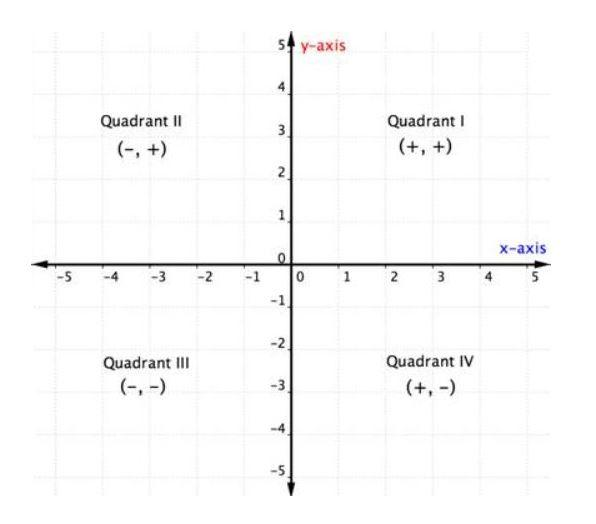
All the four quadrants are mentioned and also the two coordinate axes, x-axis and y-axis.
So in the first quadrant we have both the coordinates i.e. x coordinate and the y coordinate as positive,
In the second quadrant x is negative and y is positive,
In the third quadrant we have x negative and y also negative,
And in the last quadrant i.e. fourth quadrant x is positive and y is negative.
So in the given question we have point,
(5, 2)
So in this point x coordinate is positive i.e. 5,
And y coordinate is also positive i.e. 2,
Hence according to the above mentioned definitions we can say that the point (5, 2) lies in the first quadrant.
So, the correct answer is “Option A”.
Note: Whenever only the number is mentioned and not any sign then, it is automatically understood that the number is positive like in this question we were given the coordinate as (5, 2) and not as (+5, +2). And also you should keep in mind the above mentioned definitions for future problems. We can solve many problems just by plotting their figures on the coordinate plane so do remember the given diagram also.
Complete step-by-step answer:
We are given the point
(5, 2),
And we have to find that out of which four quadrants does this point lies,
So if we see the below figure,
All the four quadrants are mentioned and also the two coordinate axes, x-axis and y-axis.
So in the first quadrant we have both the coordinates i.e. x coordinate and the y coordinate as positive,
In the second quadrant x is negative and y is positive,
In the third quadrant we have x negative and y also negative,
And in the last quadrant i.e. fourth quadrant x is positive and y is negative.
So in the given question we have point,
(5, 2)
So in this point x coordinate is positive i.e. 5,
And y coordinate is also positive i.e. 2,
Hence according to the above mentioned definitions we can say that the point (5, 2) lies in the first quadrant.
So, the correct answer is “Option A”.
Note: Whenever only the number is mentioned and not any sign then, it is automatically understood that the number is positive like in this question we were given the coordinate as (5, 2) and not as (+5, +2). And also you should keep in mind the above mentioned definitions for future problems. We can solve many problems just by plotting their figures on the coordinate plane so do remember the given diagram also.
Recently Updated Pages
Master Class 11 Social Science: Engaging Questions & Answers for Success

Master Class 11 English: Engaging Questions & Answers for Success
Master Class 11 Accountancy: Engaging Questions & Answers for Success
Master Class 11 Physics: Engaging Questions & Answers for Success
Master Class 11 Computer Science: Engaging Questions & Answers for Success
Master Class 11 Business Studies: Engaging Questions & Answers for Success
Trending doubts
One Metric ton is equal to kg A 10000 B 1000 C 100 class 11 physics CBSE
Find the value of the expression given below sin 30circ class 11 maths CBSE
Draw a diagram of nephron and explain its structur class 11 biology CBSE
10 examples of friction in our daily life
Proton was discovered by A Thomson B Rutherford C Chadwick class 11 chemistry CBSE
The teeth used for biting and cutting food are called class 11 biology CBSE