




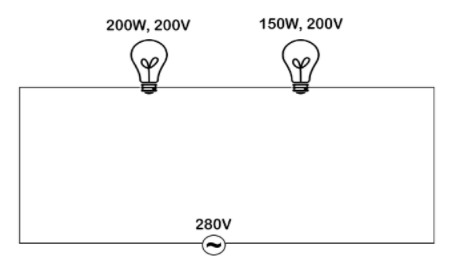
Find the power of each bulb and which bulb will glow brighter in the circuit shown below. If the power source is replaced by a 440V supply which bulb will fuse first.
Answer
 Verified
595.8k+ views
Hint: When two bulbs are connected in series, the voltage drop across them is different for each but the current through each bulb is the same. The bulb whose power rating is less will fuse before the bulb whose power rating is higher in comparison.
Complete step by step answer:
Consider the circuit below, the voltage drop across bulb ${{B}_{1}}$ is ${{V}_{1}}$ and the voltage drop across bulb ${{B}_{2}}$ is ${{V}_{2}}$. The current through the circuit is I and the voltage source is 280V.
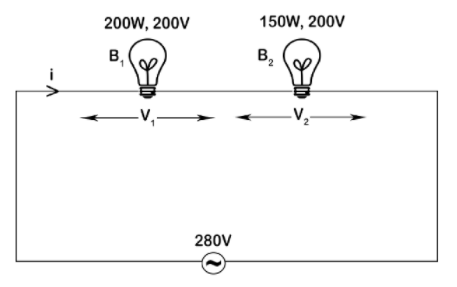
Let us calculate the resistances due to the bulbs in the circuit,
For bulb ${{B}_{1}}$,
${{R}_{1}}=\dfrac{{{V}_{1}}^{2}}{{{P}_{1}}}$ ….(i)
Putting the values in above equation we get,
${{R}_{1}}=\dfrac{{{200}^{2}}}{200}\Omega $
$\Rightarrow {{R}_{1}}=200\Omega $
For bulb ${{B}_{2}}$,
${{R}_{2}}=\dfrac{{{V}_{2}}^{2}}{{{P}_{2}}}$ ….(ii)
Putting the values in above equation we get,
${{R}_{2}}=\dfrac{{{200}^{2}}}{150}\Omega $
$\Rightarrow {{R}_{2}}=266.67\Omega $
(I) Now, calculating the voltages across each bulb:
For bulb ${{B}_{1}}$,
${{V}_{1}}={{V}_{s}}\times \dfrac{{{R}_{1}}}{{{R}_{1}}+{{R}_{2}}}=280\times \dfrac{200}{200+266.67}=119.99V$
$\Rightarrow {{V}_{1}}=120V$ on rounding it.
Where, ${{V}_{s}}$ is the source voltage.
For bulb ${{B}_{2}}$,
${{V}_{2}}={{V}_{s}}\times \dfrac{{{R}_{2}}}{{{R}_{1}}+{{R}_{2}}}=280\times \dfrac{266.76}{200+266.67}=160V$
Therefore, the bulb ${{B}_{2}}$with greater voltage drop in the circuit will grow brighter than bulb ${{B}_{1}}$.
(II) Now, calculating the power consumed by both bulbs,
For bulb ${{B}_{1}}$,
${{P}_{1}}=\dfrac{V_{1}^{2}}{{{R}_{1}}}=\dfrac{{{199.99}^{2}}}{200}W=199.98W=200W$
For bulb ${{B}_{2}}$,
${{P}_{2}}=\dfrac{V_{2}^{2}}{{{R}_{2}}}=\dfrac{{{160}^{2}}}{266.67}W=95.99W=100W$
(III) If the source is replaced by 440V then,
For bulb ${{B}_{1}}$,
${{V}_{1}}={{V}_{s}}\times \dfrac{{{R}_{1}}}{{{R}_{1}}+{{R}_{2}}}=440\times \dfrac{200}{200+266.67}=188.57V=189V$
For bulb ${{B}_{2}}$,
${{V}_{2}}={{V}_{s}}\times \dfrac{{{R}_{2}}}{{{R}_{1}}+{{R}_{2}}}=440\times \dfrac{266.76}{200+266.67}=251.43V=251V$
Therefore, bulb ${{B}_{2}}$ will fuse first as the voltage across ${{B}_{2}}$ is more than the allowed i.e. its rating voltage 200V.
Additional Information:
When two bulbs are connected in series, the voltage drop across them is different for each but the current through each bulb is the same and when two bulbs are connected in parallel, the voltage drop across them is same for each but the current through each bulb is different.
Note:
Bulbs when connected in series do not glow to their maximum brightness and if one of the bulbs in series if fused then the circuit becomes an open circuit and none of the bulbs glow. Thus, in everyday use the bulbs are connected in parallel connection to avoid such problems.
Complete step by step answer:
Consider the circuit below, the voltage drop across bulb ${{B}_{1}}$ is ${{V}_{1}}$ and the voltage drop across bulb ${{B}_{2}}$ is ${{V}_{2}}$. The current through the circuit is I and the voltage source is 280V.
Let us calculate the resistances due to the bulbs in the circuit,
For bulb ${{B}_{1}}$,
${{R}_{1}}=\dfrac{{{V}_{1}}^{2}}{{{P}_{1}}}$ ….(i)
Putting the values in above equation we get,
${{R}_{1}}=\dfrac{{{200}^{2}}}{200}\Omega $
$\Rightarrow {{R}_{1}}=200\Omega $
For bulb ${{B}_{2}}$,
${{R}_{2}}=\dfrac{{{V}_{2}}^{2}}{{{P}_{2}}}$ ….(ii)
Putting the values in above equation we get,
${{R}_{2}}=\dfrac{{{200}^{2}}}{150}\Omega $
$\Rightarrow {{R}_{2}}=266.67\Omega $
(I) Now, calculating the voltages across each bulb:
For bulb ${{B}_{1}}$,
${{V}_{1}}={{V}_{s}}\times \dfrac{{{R}_{1}}}{{{R}_{1}}+{{R}_{2}}}=280\times \dfrac{200}{200+266.67}=119.99V$
$\Rightarrow {{V}_{1}}=120V$ on rounding it.
Where, ${{V}_{s}}$ is the source voltage.
For bulb ${{B}_{2}}$,
${{V}_{2}}={{V}_{s}}\times \dfrac{{{R}_{2}}}{{{R}_{1}}+{{R}_{2}}}=280\times \dfrac{266.76}{200+266.67}=160V$
Therefore, the bulb ${{B}_{2}}$with greater voltage drop in the circuit will grow brighter than bulb ${{B}_{1}}$.
(II) Now, calculating the power consumed by both bulbs,
For bulb ${{B}_{1}}$,
${{P}_{1}}=\dfrac{V_{1}^{2}}{{{R}_{1}}}=\dfrac{{{199.99}^{2}}}{200}W=199.98W=200W$
For bulb ${{B}_{2}}$,
${{P}_{2}}=\dfrac{V_{2}^{2}}{{{R}_{2}}}=\dfrac{{{160}^{2}}}{266.67}W=95.99W=100W$
(III) If the source is replaced by 440V then,
For bulb ${{B}_{1}}$,
${{V}_{1}}={{V}_{s}}\times \dfrac{{{R}_{1}}}{{{R}_{1}}+{{R}_{2}}}=440\times \dfrac{200}{200+266.67}=188.57V=189V$
For bulb ${{B}_{2}}$,
${{V}_{2}}={{V}_{s}}\times \dfrac{{{R}_{2}}}{{{R}_{1}}+{{R}_{2}}}=440\times \dfrac{266.76}{200+266.67}=251.43V=251V$
Therefore, bulb ${{B}_{2}}$ will fuse first as the voltage across ${{B}_{2}}$ is more than the allowed i.e. its rating voltage 200V.
Additional Information:
When two bulbs are connected in series, the voltage drop across them is different for each but the current through each bulb is the same and when two bulbs are connected in parallel, the voltage drop across them is same for each but the current through each bulb is different.
Note:
Bulbs when connected in series do not glow to their maximum brightness and if one of the bulbs in series if fused then the circuit becomes an open circuit and none of the bulbs glow. Thus, in everyday use the bulbs are connected in parallel connection to avoid such problems.
Recently Updated Pages
Master Class 12 Business Studies: Engaging Questions & Answers for Success

Master Class 12 Chemistry: Engaging Questions & Answers for Success
Master Class 12 Biology: Engaging Questions & Answers for Success
Class 12 Question and Answer - Your Ultimate Solutions Guide
Master Class 11 English: Engaging Questions & Answers for Success
Master Class 11 Social Science: Engaging Questions & Answers for Success
Trending doubts
Which are the Top 10 Largest Countries of the World?
Draw a labelled sketch of the human eye class 12 physics CBSE
The end of compass needle which points towards north class 12 physics CBSE
Differentiate between homogeneous and heterogeneous class 12 chemistry CBSE
In order to find out the different types of gametes class 12 biology NEET_UG
Why is the cell called the structural and functional class 12 biology CBSE