




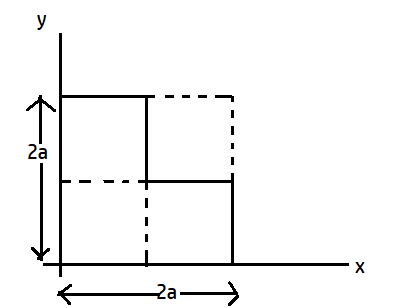
Find the position of centre of mass of the uniform planner section shown in figure with respect to the origin (O)
Answer
 Verified
605.7k+ views
Hint: The centre of mass is a point defined relative to an object or system of objects. It is the aggregate position of all the parts of the system, weighted according to their masses and at this point, it is assumed that the entire mass of the system is contained.
Complete step by step answer:The shape is a square of side 2a and it can be further visualized into 4 smaller squares each of side a. Now, the figure can be divided into 3 smaller segments.
The (x,y) coordinates of the segments can be written as \[(\dfrac{a}{2},\dfrac{3a}{2})\], \[\begin{align}
& (\dfrac{a}{2},\dfrac{a}{2}) \\
& \\
\end{align}\], \[(\dfrac{3a}{2},\dfrac{a}{2})\]for the first, second and third segment respectively. These are the coordinates that we usually write in geometry and mathematics. Since the mass is equally divided and the total mass of the system is M so the mass of each segment will be \[\dfrac{M}{3}\]
The moment of inertia of a system whose coordinates are given is given as
\[{{X}_{cm}}=\dfrac{{{M}_{1}}{{x}_{1}}+{{M}_{2}}{{x}_{2}}+{{M}_{3}}{{x}_{3}}}{{{M}_{1}}+{{M}_{2}}+{{M}_{3}}}\]
\[{{Y}_{cm}}=\dfrac{{{M}_{1}}{{y}_{1}}+{{M}_{2}}{{y}_{2}}+{{M}_{3}}{{y}_{3}}}{{{M}_{1}}+{{M}_{2}}+{{M}_{3}}}\]
Here there is z coordinate of the system, putting the values we get,
Since the values of \[{{M}_{1,}}{{M}_{2}},{{M}_{3}}\]are equal, we can write it as each segment will be having a mass of M/3
\[{{X}_{cm}}=\dfrac{\dfrac{M}{3}(\dfrac{a}{2}+\dfrac{a}{2}+\dfrac{3a}{2})}{M}=\dfrac{5a}{6}\]
\[{{Y}_{cm}}=\dfrac{\dfrac{M}{3}(\dfrac{3a}{2}+\dfrac{a}{2}+\dfrac{a}{2})}{M}=\dfrac{5a}{6}\]
So, the coordinates of the centre of mass come out to be \[(\dfrac{5a}{6}'\dfrac{5a}{6})\]
Note:
For simple rigid objects with uniform density, the centre of mass is located at the geometrical centre, for example, the centre of mass of a ring for example is located at its centre.
Complete step by step answer:The shape is a square of side 2a and it can be further visualized into 4 smaller squares each of side a. Now, the figure can be divided into 3 smaller segments.
The (x,y) coordinates of the segments can be written as \[(\dfrac{a}{2},\dfrac{3a}{2})\], \[\begin{align}
& (\dfrac{a}{2},\dfrac{a}{2}) \\
& \\
\end{align}\], \[(\dfrac{3a}{2},\dfrac{a}{2})\]for the first, second and third segment respectively. These are the coordinates that we usually write in geometry and mathematics. Since the mass is equally divided and the total mass of the system is M so the mass of each segment will be \[\dfrac{M}{3}\]
The moment of inertia of a system whose coordinates are given is given as
\[{{X}_{cm}}=\dfrac{{{M}_{1}}{{x}_{1}}+{{M}_{2}}{{x}_{2}}+{{M}_{3}}{{x}_{3}}}{{{M}_{1}}+{{M}_{2}}+{{M}_{3}}}\]
\[{{Y}_{cm}}=\dfrac{{{M}_{1}}{{y}_{1}}+{{M}_{2}}{{y}_{2}}+{{M}_{3}}{{y}_{3}}}{{{M}_{1}}+{{M}_{2}}+{{M}_{3}}}\]
Here there is z coordinate of the system, putting the values we get,
Since the values of \[{{M}_{1,}}{{M}_{2}},{{M}_{3}}\]are equal, we can write it as each segment will be having a mass of M/3
\[{{X}_{cm}}=\dfrac{\dfrac{M}{3}(\dfrac{a}{2}+\dfrac{a}{2}+\dfrac{3a}{2})}{M}=\dfrac{5a}{6}\]
\[{{Y}_{cm}}=\dfrac{\dfrac{M}{3}(\dfrac{3a}{2}+\dfrac{a}{2}+\dfrac{a}{2})}{M}=\dfrac{5a}{6}\]
So, the coordinates of the centre of mass come out to be \[(\dfrac{5a}{6}'\dfrac{5a}{6})\]
Note:
For simple rigid objects with uniform density, the centre of mass is located at the geometrical centre, for example, the centre of mass of a ring for example is located at its centre.
Recently Updated Pages
Master Class 12 Business Studies: Engaging Questions & Answers for Success

Master Class 12 Chemistry: Engaging Questions & Answers for Success
Master Class 12 Biology: Engaging Questions & Answers for Success
Class 12 Question and Answer - Your Ultimate Solutions Guide
Master Class 11 English: Engaging Questions & Answers for Success
Master Class 11 Maths: Engaging Questions & Answers for Success
Trending doubts
Which is more stable and why class 12 chemistry CBSE
Which are the Top 10 Largest Countries of the World?
Draw a labelled sketch of the human eye class 12 physics CBSE
Differentiate between homogeneous and heterogeneous class 12 chemistry CBSE
What are the major means of transport Explain each class 12 social science CBSE
Sulphuric acid is known as the king of acids State class 12 chemistry CBSE