




Find the number of points of non-differentiability of \[f\left( x \right)=\max \{\sin x,\cos x,0\}\] in $x\in \left( 0,2\pi \right)$
Answer
 Verified
642.9k+ views
Hint: To solve this question we will draw graph of sin x and cos x. Then we will combine the graph and delete the minimum part so that we get the graph of \[f\left( x \right)=\max \{\sin x,\cos x,0\}\] .
Now we will check the points where the function is non-differentiable as at that point the curve will not be smooth.
Complete step-by-step solution:
Now let us first understand the concept of differentiability.
A function is called differentiable at a point if its derivative exists at a point.
Now a function is called differentiable if it is differentiable at each point in its domain.
Now let us see the condition for which the function is differentiable.
A function f is said to be differentiable at point c if $\underset{h\to 0}{\mathop{\lim }}\,\dfrac{f\left( c+h \right)-f\left( c \right)}{h}$ exists.
Now to check if the limits exist we will check if the left-hand limit is equal to the right-hand limit.
Now let us understand this geometrically.
Now geometrically we know that derivative at a point is nothing but the slope of the curve at that point.
For this derivative to exist we need the curve to be smooth at that point.
Hence if a curve is smooth at a point then we can say it is differentiable
If a curve has sharp point on the curve then the point will be non-differentiable.
Now for example consider $\left| x \right|$ .
We know that the graph of $\left| x \right|$ is
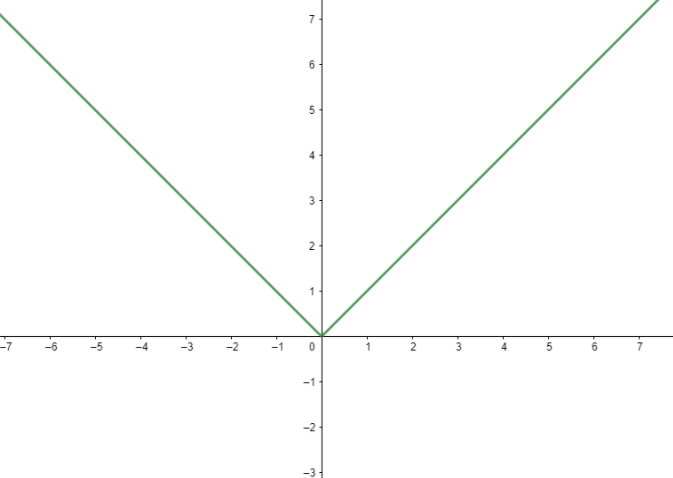
Now we can see from the graph that the graph has a sharp point at $x = 0. $
Hence by looking at the graph we can say that the function is not differentiable at $x = 0.$
Now consider the given function \[f\left( x \right)=\max \{\sin x,\cos x,0\}\] in $x\in \left( 0,2\pi \right)$
Now let us first check the graph of sin x for $x\in \left( 0,2\pi \right)$ .
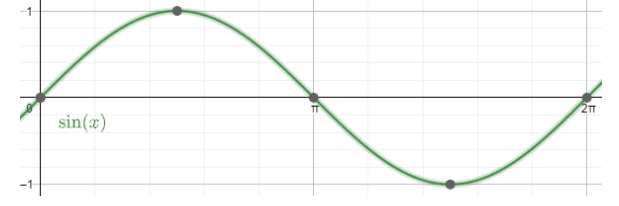
Now let us also check the graph of cos x for $x\in \left( 0,2\pi \right)$ .
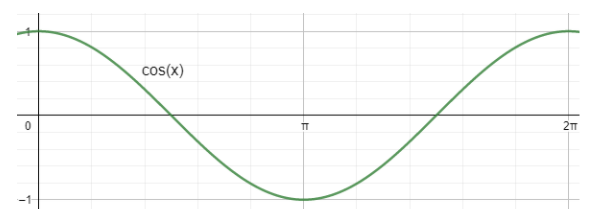
Now we will merge the graph and just consider the maximum part. That means if $\cos x > \sin x$ then we will consider cos x. Similarly, if $\sin x \text{ is } > \cos x$, then we will consider sin x. Now if we have both negative then we will take 0. Hence we will get the graph for \[f\left( x \right)=\max \{\sin x,\cos x,0\}\]
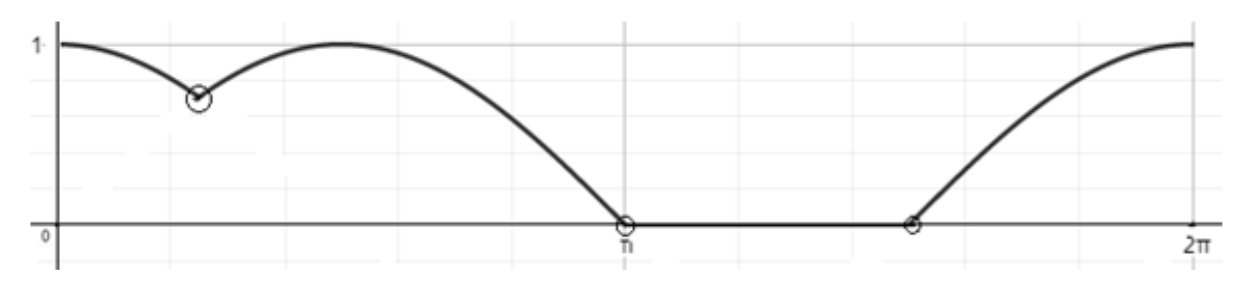
Hence as we can see that the function is sharp at three points and hence is non-differentiable at three points.
Note: Note that whenever the function is defined as a maximum or minimum of two or more functions, we use a geometrical approach to the question as we can easily draw graphs for such functions. Also here we can ask that the function is also not differentiable at point x = 0 and x = $2\pi $ but we have not counted these points as they are not in our domain. The domain of given function is $x\in \left( 0,2\pi \right)$ . Hence if the domain would have been $x\in \left[ 0,2\pi \right]$ then we would get 5 non-differentiable points.
Now we will check the points where the function is non-differentiable as at that point the curve will not be smooth.
Complete step-by-step solution:
Now let us first understand the concept of differentiability.
A function is called differentiable at a point if its derivative exists at a point.
Now a function is called differentiable if it is differentiable at each point in its domain.
Now let us see the condition for which the function is differentiable.
A function f is said to be differentiable at point c if $\underset{h\to 0}{\mathop{\lim }}\,\dfrac{f\left( c+h \right)-f\left( c \right)}{h}$ exists.
Now to check if the limits exist we will check if the left-hand limit is equal to the right-hand limit.
Now let us understand this geometrically.
Now geometrically we know that derivative at a point is nothing but the slope of the curve at that point.
For this derivative to exist we need the curve to be smooth at that point.
Hence if a curve is smooth at a point then we can say it is differentiable
If a curve has sharp point on the curve then the point will be non-differentiable.
Now for example consider $\left| x \right|$ .
We know that the graph of $\left| x \right|$ is
Now we can see from the graph that the graph has a sharp point at $x = 0. $
Hence by looking at the graph we can say that the function is not differentiable at $x = 0.$
Now consider the given function \[f\left( x \right)=\max \{\sin x,\cos x,0\}\] in $x\in \left( 0,2\pi \right)$
Now let us first check the graph of sin x for $x\in \left( 0,2\pi \right)$ .
Now let us also check the graph of cos x for $x\in \left( 0,2\pi \right)$ .
Now we will merge the graph and just consider the maximum part. That means if $\cos x > \sin x$ then we will consider cos x. Similarly, if $\sin x \text{ is } > \cos x$, then we will consider sin x. Now if we have both negative then we will take 0. Hence we will get the graph for \[f\left( x \right)=\max \{\sin x,\cos x,0\}\]
Hence as we can see that the function is sharp at three points and hence is non-differentiable at three points.
Note: Note that whenever the function is defined as a maximum or minimum of two or more functions, we use a geometrical approach to the question as we can easily draw graphs for such functions. Also here we can ask that the function is also not differentiable at point x = 0 and x = $2\pi $ but we have not counted these points as they are not in our domain. The domain of given function is $x\in \left( 0,2\pi \right)$ . Hence if the domain would have been $x\in \left[ 0,2\pi \right]$ then we would get 5 non-differentiable points.
Recently Updated Pages
Master Class 12 Economics: Engaging Questions & Answers for Success

Master Class 12 Social Science: Engaging Questions & Answers for Success
Master Class 12 English: Engaging Questions & Answers for Success
Master Class 12 Maths: Engaging Questions & Answers for Success
Master Class 12 Physics: Engaging Questions & Answers for Success
Master Class 12 Biology: Engaging Questions & Answers for Success
Trending doubts
Draw a labelled sketch of the human eye class 12 physics CBSE
Which are the Top 10 Largest Countries of the World?
Draw ray diagrams each showing i myopic eye and ii class 12 physics CBSE
Which is the correct genotypic ratio of mendel dihybrid class 12 biology CBSE
Differentiate between homogeneous and heterogeneous class 12 chemistry CBSE
Give 10 examples of unisexual and bisexual flowers