




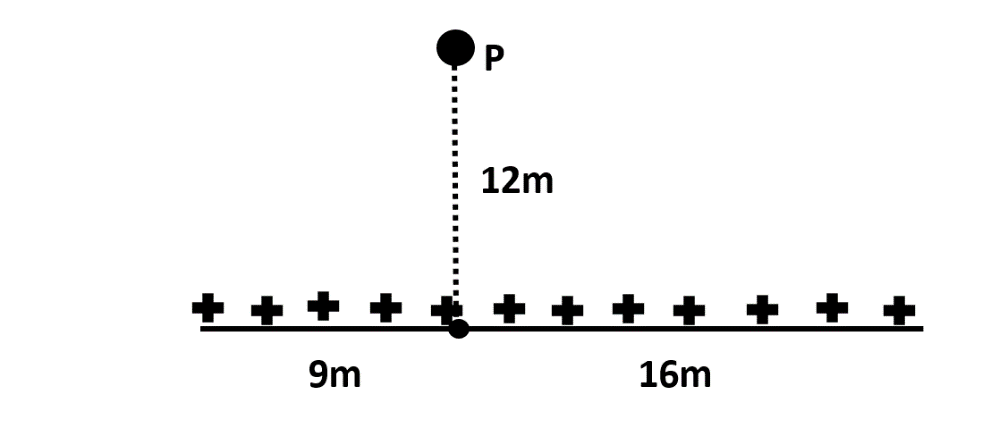
Find the magnitude of electric field (in $N{{C}^{-1}}$ ) due to a line charge of ,$\lambda =2\sqrt{2}nC{{m}^{-1}}$ at a point P as shown:
Answer
 Verified
549.6k+ views
Hint: As we can see the length of the line charge is finite, therefore we will use formula of electric field at a point due to a finite line charge having a constant charge per unit length subtending two different(or same) angles at the point.
Complete answer:
At the point P, let the angle subtended by the smaller length of wire be $\alpha $ and the angle subtended by the larger piece of wire be $\beta $ .
Then, we can say that:
$\begin{align}
& \Rightarrow \tan \alpha =\dfrac{9}{12} \\
& \Rightarrow \tan \alpha =\dfrac{3}{4} \\
\end{align}$
Therefore we can write for other trigonometric identities as:
$\begin{align}
& \Rightarrow \sin \alpha =\dfrac{3}{5} \\
& \Rightarrow \cos \alpha =\dfrac{4}{5} \\
\end{align}$ [Let these expressions combined be termed as equation number(1)]
Now, for the triangle made by the wire of larger length:
$\begin{align}
& \Rightarrow \tan \beta =\dfrac{16}{12} \\
& \Rightarrow \tan \beta =\dfrac{4}{3} \\
\end{align}$
Therefore we can write for other trigonometric identities as:
$\begin{align}
& \Rightarrow \sin \alpha =\dfrac{4}{5} \\
& \Rightarrow \cos \alpha =\dfrac{3}{5} \\
\end{align}$ [Let these expressions combined be termed as equation number(2)]
Now, the formula for electric field at a point whose perpendicular distance is ‘a’ from the linear line charge of charge density $\lambda $ is given by:
$\Rightarrow E=\dfrac{k\lambda }{a}\left( -\cos \alpha +\cos \beta \right)\widehat{i}+\dfrac{k\lambda }{a}\left( \sin \alpha +\sin \beta \right)\widehat{j}$ [Let this expression be equation number (3)]
Here, we have been given the value of distance ‘a’ and line charge density ‘$\lambda $’ in the question as follows:
$\Rightarrow a=12m$
$\begin{align}
& \Rightarrow \lambda =2\sqrt{2}nC{{m}^{-1}} \\
& \Rightarrow \lambda =2\sqrt{2}\times {{10}^{-9}}C{{m}^{-1}} \\
\end{align}$
Putting the values of all the respective terms in equation number (3), we get:
$\Rightarrow E=\dfrac{9\times {{10}^{9}}\times 2\times 1.414\times {{10}^{-9}}}{12}\left( -\dfrac{4}{5}+\dfrac{3}{5} \right)\widehat{i}+\dfrac{9\times {{10}^{9}}\times 2\times 1.414\times {{10}^{-9}}}{12}\left( \dfrac{3}{5}+\dfrac{4}{5} \right)\widehat{j}$
On simplifying our equation, we get:
$\Rightarrow E=-0.424\widehat{i}+2.968\widehat{j}$
$\Rightarrow \left| E \right|=2.998N{{C}^{-1}}$
Hence, the magnitude of the net electric field at point P comes out to be $2.998N{{C}^{-1}}$.
Note:
Here, the negative sign in the X-component of the electric field means that the Electric field is in opposite to the direction assumed (that was positive X-direction). Also one should be very careful in lengthy problems like these, as they take too much time to solve and the calculations should be tricky, unless specific values of terms are provided.
Complete answer:
At the point P, let the angle subtended by the smaller length of wire be $\alpha $ and the angle subtended by the larger piece of wire be $\beta $ .
Then, we can say that:
$\begin{align}
& \Rightarrow \tan \alpha =\dfrac{9}{12} \\
& \Rightarrow \tan \alpha =\dfrac{3}{4} \\
\end{align}$
Therefore we can write for other trigonometric identities as:
$\begin{align}
& \Rightarrow \sin \alpha =\dfrac{3}{5} \\
& \Rightarrow \cos \alpha =\dfrac{4}{5} \\
\end{align}$ [Let these expressions combined be termed as equation number(1)]
Now, for the triangle made by the wire of larger length:
$\begin{align}
& \Rightarrow \tan \beta =\dfrac{16}{12} \\
& \Rightarrow \tan \beta =\dfrac{4}{3} \\
\end{align}$
Therefore we can write for other trigonometric identities as:
$\begin{align}
& \Rightarrow \sin \alpha =\dfrac{4}{5} \\
& \Rightarrow \cos \alpha =\dfrac{3}{5} \\
\end{align}$ [Let these expressions combined be termed as equation number(2)]
Now, the formula for electric field at a point whose perpendicular distance is ‘a’ from the linear line charge of charge density $\lambda $ is given by:
$\Rightarrow E=\dfrac{k\lambda }{a}\left( -\cos \alpha +\cos \beta \right)\widehat{i}+\dfrac{k\lambda }{a}\left( \sin \alpha +\sin \beta \right)\widehat{j}$ [Let this expression be equation number (3)]
Here, we have been given the value of distance ‘a’ and line charge density ‘$\lambda $’ in the question as follows:
$\Rightarrow a=12m$
$\begin{align}
& \Rightarrow \lambda =2\sqrt{2}nC{{m}^{-1}} \\
& \Rightarrow \lambda =2\sqrt{2}\times {{10}^{-9}}C{{m}^{-1}} \\
\end{align}$
Putting the values of all the respective terms in equation number (3), we get:
$\Rightarrow E=\dfrac{9\times {{10}^{9}}\times 2\times 1.414\times {{10}^{-9}}}{12}\left( -\dfrac{4}{5}+\dfrac{3}{5} \right)\widehat{i}+\dfrac{9\times {{10}^{9}}\times 2\times 1.414\times {{10}^{-9}}}{12}\left( \dfrac{3}{5}+\dfrac{4}{5} \right)\widehat{j}$
On simplifying our equation, we get:
$\Rightarrow E=-0.424\widehat{i}+2.968\widehat{j}$
$\Rightarrow \left| E \right|=2.998N{{C}^{-1}}$
Hence, the magnitude of the net electric field at point P comes out to be $2.998N{{C}^{-1}}$.
Note:
Here, the negative sign in the X-component of the electric field means that the Electric field is in opposite to the direction assumed (that was positive X-direction). Also one should be very careful in lengthy problems like these, as they take too much time to solve and the calculations should be tricky, unless specific values of terms are provided.
Recently Updated Pages
Master Class 12 Social Science: Engaging Questions & Answers for Success

Master Class 12 Physics: Engaging Questions & Answers for Success
Master Class 12 Maths: Engaging Questions & Answers for Success
Master Class 12 Economics: Engaging Questions & Answers for Success
Master Class 12 Chemistry: Engaging Questions & Answers for Success
Master Class 12 Business Studies: Engaging Questions & Answers for Success
Trending doubts
Which are the Top 10 Largest Countries of the World?
Draw a labelled sketch of the human eye class 12 physics CBSE
Explain the structure of megasporangium class 12 biology CBSE
What are the major means of transport Explain each class 12 social science CBSE
How many chromosomes are found in human ovum a 46 b class 12 biology CBSE
The diagram of the section of a maize grain is given class 12 biology CBSE