




How do you find the factor tree of $128$?
Answer
 Verified
626.7k+ views
Hint:To draw the factor tree of $128$,start separating the number $128$ into the factors and repeat this process until no factor can be possible to obtain your desired factor tree.
Complete step by step solution:
A factor tree is an extraordinary graph where we discover the factors of a number and afterward factors of those numbers until we can factor them no more. Eventually, what we get are for the most part the prime factors of the first number.
The number $128$ is a composite number on the grounds that $128$can be divided by 1, without anyone else and in any event by 2. In this way, it is conceivable to draw its prime tree.
Factor Tree of $128$ is the rundown of prime numbers when multiplied together outcomes in Actual number $128$.
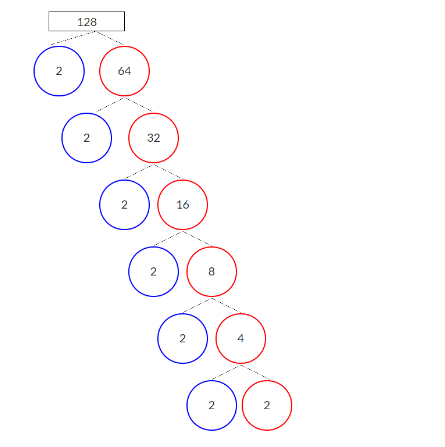
If we try to write $128$into multiples it would be 64 x 2
On parting $64$ further and composing it as multiples of numbers it would be $32 \times 2$
On parting $32$further and composing it as multiples of numbers it would be $16 \times 2$
On parting $16$ further and composing it as multiples of numbers it would be $8 \times 2$
On parting $8$ further and composing it as multiples of numbers it would be $4 \times 2$.
On parting $4$ further and composing it as multiples of numbers it would be $2 \times 2$.
Out and out Expressing the number in the terms of only prime factors would be $2 \times 2 \times 2 \times 2 \times 2 \times 2 \times 2$ or we can simple say $128 = {2^7}$
Note: 1.Carefully factorise the number such that no factor can be made in the end .
2.Don’t forgot to cross-check your factor tree once to make sure that you have factored every level
properly.
Complete step by step solution:
A factor tree is an extraordinary graph where we discover the factors of a number and afterward factors of those numbers until we can factor them no more. Eventually, what we get are for the most part the prime factors of the first number.
The number $128$ is a composite number on the grounds that $128$can be divided by 1, without anyone else and in any event by 2. In this way, it is conceivable to draw its prime tree.
Factor Tree of $128$ is the rundown of prime numbers when multiplied together outcomes in Actual number $128$.
If we try to write $128$into multiples it would be 64 x 2
On parting $64$ further and composing it as multiples of numbers it would be $32 \times 2$
On parting $32$further and composing it as multiples of numbers it would be $16 \times 2$
On parting $16$ further and composing it as multiples of numbers it would be $8 \times 2$
On parting $8$ further and composing it as multiples of numbers it would be $4 \times 2$.
On parting $4$ further and composing it as multiples of numbers it would be $2 \times 2$.
Out and out Expressing the number in the terms of only prime factors would be $2 \times 2 \times 2 \times 2 \times 2 \times 2 \times 2$ or we can simple say $128 = {2^7}$
Note: 1.Carefully factorise the number such that no factor can be made in the end .
2.Don’t forgot to cross-check your factor tree once to make sure that you have factored every level
properly.
Recently Updated Pages
If x a + bt + ct2 where x is in meters and t is in class 11 physics CBSE

A car covers the first half distance between two places class 11 physics CBSE
The resultant of two vectors overrightarrow P and overrightarrow class 11 physics CBSE
Find the value of cos 135 class 11 maths CBSE
A mass M is held in place by an applied force F and class 11 physics CBSE
A solution of glucose in water is labelled as 10 dfracwv class 11 chemistry CBSE
Trending doubts
Find the value of the expression given below sin 30circ class 11 maths CBSE
One Metric ton is equal to kg A 10000 B 1000 C 100 class 11 physics CBSE
Draw a diagram of nephron and explain its structur class 11 biology CBSE
10 examples of friction in our daily life
Proton was discovered by A Thomson B Rutherford C Chadwick class 11 chemistry CBSE
Bond order ofO2 O2+ O2 and O22 is in order A O2 langle class 11 chemistry CBSE