




How do you find the exact value of $arc\cos \left( -\dfrac{1}{\sqrt{2}} \right)$?
Answer
 Verified
580.8k+ views
Hint: We explain the function $\arccos \left( x \right)$. We express the inverse function of cos in the form of $\arccos \left( x \right)={{\cos }^{-1}}x$. We draw the graph of $\arccos \left( x \right)$ and the line $x=-\dfrac{1}{\sqrt{2}}$ to find the intersection point as the solution.
Complete step by step answer:
The given expression is the inverse function of trigonometric ratio cos.
The arcus function represents the angle which on ratio cos gives the value.
So, $\arccos \left( x \right)={{\cos }^{-1}}x$. If \[\arccos \left( x \right)={{\cos }^{-1}}x=\alpha \] then we can say $\cos \alpha =x$.
Each of the trigonometric functions is periodic in the real part of its argument, running through all its values twice in each interval of $2\pi $.
The general solution for that value where $\cos \alpha =x$ will be $2n\pi \pm \alpha ,n\in \mathbb{Z}$.
But for $\arccos \left( x \right)$, we won’t find the general solution. We use the principal value. For ratio tan we have $0\le \arccos \left( x \right)\le \pi $.
The graph of the function is
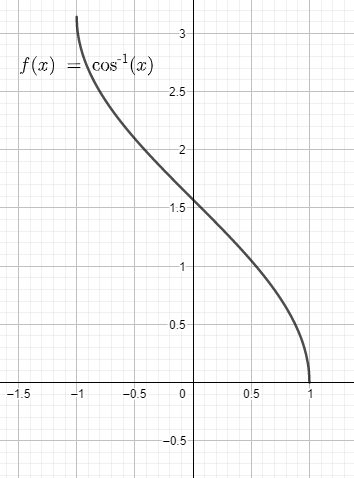
\[\arccos \left( x \right)={{\cos }^{-1}}x=\alpha \] gives the angle $\alpha $ behind the ratio.
We now place the value of $x=-\dfrac{1}{\sqrt{2}}$ in the function of \[\arccos \left( x \right)\].
Let the angle be $\theta $ for which $arc\cos \left( -\dfrac{1}{\sqrt{2}} \right)=\theta $. This gives $\cos \theta =-\dfrac{1}{\sqrt{2}}$.
We know that $\cos \theta =-\dfrac{1}{\sqrt{2}}=\cos \left( \dfrac{\pi }{2}+\dfrac{\pi }{4} \right)$ which gives $\theta =\left( \dfrac{\pi }{2}+\dfrac{\pi }{4} \right)=\dfrac{3\pi }{4}$
For this we take the line of $x=-\dfrac{1}{\sqrt{2}}$ and see the intersection of the line with the graph $\arccos \left( x \right)$.
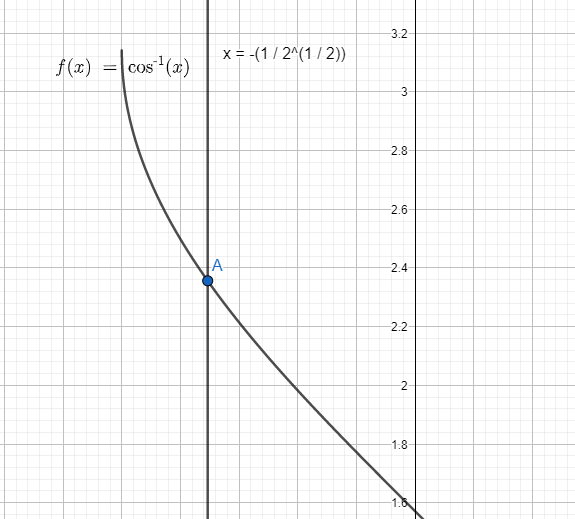
We get the value of y coordinates as $\dfrac{3\pi }{4}$
Note: If we are finding an $\arccos \left( x \right)$ of a positive value, the answer is between $0\le \arccos \left( x \right)\le \dfrac{\pi }{2}$. If we are finding the $\arccos \left( x \right)$ of a negative value, the answer is between $\dfrac{\pi }{2}\le \arccos \left( x \right)\le \pi $.
Complete step by step answer:
The given expression is the inverse function of trigonometric ratio cos.
The arcus function represents the angle which on ratio cos gives the value.
So, $\arccos \left( x \right)={{\cos }^{-1}}x$. If \[\arccos \left( x \right)={{\cos }^{-1}}x=\alpha \] then we can say $\cos \alpha =x$.
Each of the trigonometric functions is periodic in the real part of its argument, running through all its values twice in each interval of $2\pi $.
The general solution for that value where $\cos \alpha =x$ will be $2n\pi \pm \alpha ,n\in \mathbb{Z}$.
But for $\arccos \left( x \right)$, we won’t find the general solution. We use the principal value. For ratio tan we have $0\le \arccos \left( x \right)\le \pi $.
The graph of the function is
\[\arccos \left( x \right)={{\cos }^{-1}}x=\alpha \] gives the angle $\alpha $ behind the ratio.
We now place the value of $x=-\dfrac{1}{\sqrt{2}}$ in the function of \[\arccos \left( x \right)\].
Let the angle be $\theta $ for which $arc\cos \left( -\dfrac{1}{\sqrt{2}} \right)=\theta $. This gives $\cos \theta =-\dfrac{1}{\sqrt{2}}$.
We know that $\cos \theta =-\dfrac{1}{\sqrt{2}}=\cos \left( \dfrac{\pi }{2}+\dfrac{\pi }{4} \right)$ which gives $\theta =\left( \dfrac{\pi }{2}+\dfrac{\pi }{4} \right)=\dfrac{3\pi }{4}$
For this we take the line of $x=-\dfrac{1}{\sqrt{2}}$ and see the intersection of the line with the graph $\arccos \left( x \right)$.
We get the value of y coordinates as $\dfrac{3\pi }{4}$
Note: If we are finding an $\arccos \left( x \right)$ of a positive value, the answer is between $0\le \arccos \left( x \right)\le \dfrac{\pi }{2}$. If we are finding the $\arccos \left( x \right)$ of a negative value, the answer is between $\dfrac{\pi }{2}\le \arccos \left( x \right)\le \pi $.
Recently Updated Pages
Master Class 12 Social Science: Engaging Questions & Answers for Success

Master Class 12 Physics: Engaging Questions & Answers for Success
Master Class 12 Maths: Engaging Questions & Answers for Success
Master Class 12 Economics: Engaging Questions & Answers for Success
Master Class 12 Chemistry: Engaging Questions & Answers for Success
Master Class 12 Business Studies: Engaging Questions & Answers for Success
Trending doubts
Which are the Top 10 Largest Countries of the World?
Draw a labelled sketch of the human eye class 12 physics CBSE
Explain the structure of megasporangium class 12 biology CBSE
What are the major means of transport Explain each class 12 social science CBSE
How many chromosomes are found in human ovum a 46 b class 12 biology CBSE
The diagram of the section of a maize grain is given class 12 biology CBSE