




How do you find the domain and range of a natural log?
Answer
 Verified
590.1k+ views
Hint: Logarithmic functions are the inverse of exponential functions. Therefore, the input argument to this function (the domain of the function) is equal to the logarithmic base power of a number. For natural log, the base is $e$ ,where $e$ is the Euler’s number. $\left( {e \approx 2.72} \right)$.
Formula used:
$\ln x = y$
$ \Rightarrow {\log _e}x = y$
$ \Rightarrow x = {e^y}$
Complete step-by-step solution:
We have $\ln x = y$ or $x = {e^y}$.
Since $e$ is a positive number, ${e^y}$ should be a positive number as well for any values of $y$.
That is, $x > 0$
Therefore, the domain of the natural log is:
$0 < x < \infty $
Or $x \in \left( {0,\infty } \right)$ .
Now,
$\mathop {\lim }\limits_{x \to 0} \ln x = - \infty $ and $\mathop {\lim }\limits_{x \to \infty } \ln x = \infty $ --------(1)
Given, $y = \ln x$
$ \Rightarrow \dfrac{{dy}}{{dx}} = \dfrac{1}{x} > 0$ for all $x \in \left( {0,\infty } \right)$
Therefore, we can say that the natural log function is a monotonically increasing function. Thus, from equation (1), we can say that the range of the natural log function is:
$ - \infty < y < \infty $
Or $y \in \left( { - \infty ,\infty } \right)$.
Thus, the domain of the natural log function is $\left( {0,\infty } \right)$ while its range is $\left( { - \infty ,\infty } \right)$ .
Additional information:
The graph of natural log function has a vertical asymptote as $x \to 0$ but does not have a horizontal asymptote.
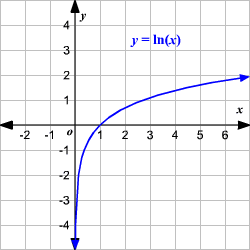
For logarithmic function to any base, as \[x = 0,\ln x = 1\] .
Also, all logarithms have the property of mapping multiplication into addition as:
$\ln xy = \ln x + \ln y$
Note: Natural log functions are found very useful in integration problems involving certain types of integrands. Much of the power of logarithms is their usefulness in solving exponential equations
Formula used:
$\ln x = y$
$ \Rightarrow {\log _e}x = y$
$ \Rightarrow x = {e^y}$
Complete step-by-step solution:
We have $\ln x = y$ or $x = {e^y}$.
Since $e$ is a positive number, ${e^y}$ should be a positive number as well for any values of $y$.
That is, $x > 0$
Therefore, the domain of the natural log is:
$0 < x < \infty $
Or $x \in \left( {0,\infty } \right)$ .
Now,
$\mathop {\lim }\limits_{x \to 0} \ln x = - \infty $ and $\mathop {\lim }\limits_{x \to \infty } \ln x = \infty $ --------(1)
Given, $y = \ln x$
$ \Rightarrow \dfrac{{dy}}{{dx}} = \dfrac{1}{x} > 0$ for all $x \in \left( {0,\infty } \right)$
Therefore, we can say that the natural log function is a monotonically increasing function. Thus, from equation (1), we can say that the range of the natural log function is:
$ - \infty < y < \infty $
Or $y \in \left( { - \infty ,\infty } \right)$.
Thus, the domain of the natural log function is $\left( {0,\infty } \right)$ while its range is $\left( { - \infty ,\infty } \right)$ .
Additional information:
The graph of natural log function has a vertical asymptote as $x \to 0$ but does not have a horizontal asymptote.
For logarithmic function to any base, as \[x = 0,\ln x = 1\] .
Also, all logarithms have the property of mapping multiplication into addition as:
$\ln xy = \ln x + \ln y$
Note: Natural log functions are found very useful in integration problems involving certain types of integrands. Much of the power of logarithms is their usefulness in solving exponential equations
Recently Updated Pages
Master Class 9 General Knowledge: Engaging Questions & Answers for Success

Master Class 9 Maths: Engaging Questions & Answers for Success
Master Class 9 Science: Engaging Questions & Answers for Success
Master Class 9 English: Engaging Questions & Answers for Success
Master Class 9 Social Science: Engaging Questions & Answers for Success
Class 9 Question and Answer - Your Ultimate Solutions Guide
Trending doubts
Find the sum of series 1 + 2 + 3 + 4 + 5 + + 100 class 9 maths CBSE
Difference Between Plant Cell and Animal Cell
Fill the blanks with the suitable prepositions 1 The class 9 english CBSE
What is pollution? How many types of pollution? Define it
What is the Full Form of ICSE / ISC ?
Name 10 Living and Non living things class 9 biology CBSE