




Find the area of the region bounded by the curve $y={{x}^{2}}$, the x-axis and the ordinates x = 1 and x= 3.
Answer
 Verified
657.9k+ views
Hint: Plot the graph on a graph. Identify the region whose area is to be found. Use the fact that the area of the region bounded by y=f(x), the x-axis and the ordinates x = a and x= b is given by
$y=\int_{a}^{b}{\left| f\left( x \right) \right|dx}$. Hence argue that the required area is given by $A=\int_{1}^{2}{{{x}^{2}}}dx$. Integrate and hence find the required area.
Complete step-by-step answer:
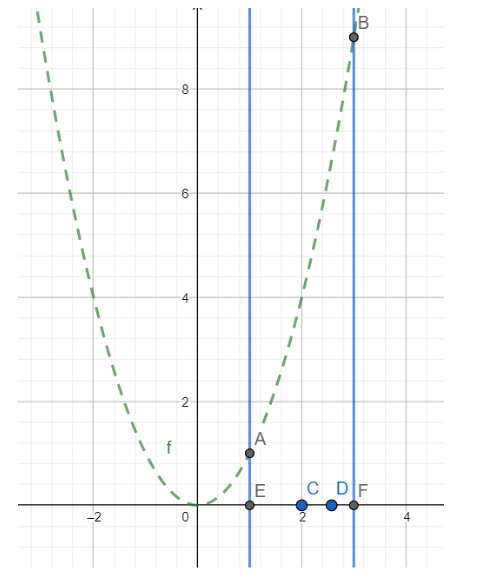
Hence the area bounded by the curve $y={{x}^{2}}$, the x-axis and the ordinates x= 1 and x= 2 is the area of the region AECDFBA.
We know that the area of the region bounded by y=f(x), the x-axis and the ordinates x = a and x= b is given by
$y=\int_{a}^{b}{\left| f\left( x \right) \right|dx}$.
Hence the required area $=\int_{1}^{3}{\left| {{x}^{2}} \right|dx}$
We know that $\forall x\in R,\left| {{x}^{2}} \right|={{x}^{2}}$
Hence, we have
Required area $=\int_{1}^{3}{{{x}^{2}}dx}$
We know that $\int{{{x}^{n}}dx=\dfrac{{{x}^{n+1}}}{n+1}}$ and according to the first fundamental theorem of calculus if F’(x) = f(x), then $\int_{a}^{b}{f\left( x \right)dx}=F\left( b \right)-F\left( a \right)$
Hence, we have
Required area $=\left. \dfrac{{{x}^{3}}}{3} \right|_{1}^{3}=\dfrac{27}{3}-\dfrac{1}{3}=\dfrac{26}{3}$
Hence the required area is $\dfrac{26}{3}$ square units.
Note: Alternative Solution:
The area bounded by the curve $y={{x}^{n}}$, the x-axis and the ordinates x= a, and x= b, $a,b\ge 0$ is given by
$\dfrac{{{b}^{n+1}}-{{a}^{n+1}}}{n+1}$
Hence the required area $=\dfrac{{{3}^{3}}-{{1}^{3}}}{3}=\dfrac{26}{3}$ square units.
$y=\int_{a}^{b}{\left| f\left( x \right) \right|dx}$. Hence argue that the required area is given by $A=\int_{1}^{2}{{{x}^{2}}}dx$. Integrate and hence find the required area.
Complete step-by-step answer:
Hence the area bounded by the curve $y={{x}^{2}}$, the x-axis and the ordinates x= 1 and x= 2 is the area of the region AECDFBA.
We know that the area of the region bounded by y=f(x), the x-axis and the ordinates x = a and x= b is given by
$y=\int_{a}^{b}{\left| f\left( x \right) \right|dx}$.
Hence the required area $=\int_{1}^{3}{\left| {{x}^{2}} \right|dx}$
We know that $\forall x\in R,\left| {{x}^{2}} \right|={{x}^{2}}$
Hence, we have
Required area $=\int_{1}^{3}{{{x}^{2}}dx}$
We know that $\int{{{x}^{n}}dx=\dfrac{{{x}^{n+1}}}{n+1}}$ and according to the first fundamental theorem of calculus if F’(x) = f(x), then $\int_{a}^{b}{f\left( x \right)dx}=F\left( b \right)-F\left( a \right)$
Hence, we have
Required area $=\left. \dfrac{{{x}^{3}}}{3} \right|_{1}^{3}=\dfrac{27}{3}-\dfrac{1}{3}=\dfrac{26}{3}$
Hence the required area is $\dfrac{26}{3}$ square units.
Note: Alternative Solution:
The area bounded by the curve $y={{x}^{n}}$, the x-axis and the ordinates x= a, and x= b, $a,b\ge 0$ is given by
$\dfrac{{{b}^{n+1}}-{{a}^{n+1}}}{n+1}$
Hence the required area $=\dfrac{{{3}^{3}}-{{1}^{3}}}{3}=\dfrac{26}{3}$ square units.
Recently Updated Pages
Basicity of sulphurous acid and sulphuric acid are

Master Class 12 Economics: Engaging Questions & Answers for Success
Master Class 12 Biology: Engaging Questions & Answers for Success
Master Class 11 English: Engaging Questions & Answers for Success
Master Class 11 Physics: Engaging Questions & Answers for Success
Master Class 11 Computer Science: Engaging Questions & Answers for Success
Trending doubts
Draw a labelled sketch of the human eye class 12 physics CBSE
The chemical formula of tear gas is A CO Cl 2 B C 10 class 12 chemistry CBSE
Draw ray diagrams each showing i myopic eye and ii class 12 physics CBSE
Which are the Top 10 Largest Countries of the World?
Differentiate between homogeneous and heterogeneous class 12 chemistry CBSE
Which is the correct genotypic ratio of mendel dihybrid class 12 biology CBSE