



Find the area of the parallelogram with a base of $200\,cm$ and height $2.5\,cm$.
A. $500\,c{m^2}$
B. $510\,c{m^2}$
C. $520\,c{m^2}$
D. $300\,c{m^2}$
Answer
 Verified
520.8k+ views
Hint: As we know, a parallelogram is a type of a quadrilateral. In parallelogram the two opposite are always parallel to each other and with equal measures.The parallelogram is a two dimensional figure, Therefore the area of the parallelogram is base $ \times $height. Now by comparing the above question we will find the answer.
Complete step by step answer:
Let us draw the diagram first according to the question:
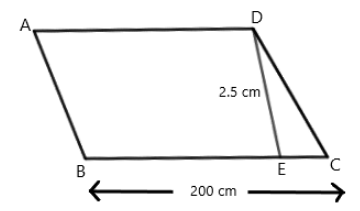
In the above figure we have ABCD is a parallelogram and DE is the height.
We have base $BC = 200\,cm$ and height $DE = 2.5\,cm$.
By comparing from the above question we have base$ = 200\,cm$ and height $ = 2.5\,cm$.
Now the area of the parallelogram is base$ \times $height i.e.$A = BC \times DE$.
So by putting values we can write $Area = 200 \times 2.5 = 500\,c{m^2}$.
Hence the correct option is A.
Note: We should note that the formula of the perimeter of the parallelogram is $2(l + b)$, where $l$ is the length of the parallelogram and $b$ is the base of the parallelogram. We should know that all parallelograms are quadrilateral but all quadrilaterals are not parallelograms. We know that parallelogram is a two dimensional shape so its volume cannot be determined.
Complete step by step answer:
Let us draw the diagram first according to the question:
In the above figure we have ABCD is a parallelogram and DE is the height.
We have base $BC = 200\,cm$ and height $DE = 2.5\,cm$.
By comparing from the above question we have base$ = 200\,cm$ and height $ = 2.5\,cm$.
Now the area of the parallelogram is base$ \times $height i.e.$A = BC \times DE$.
So by putting values we can write $Area = 200 \times 2.5 = 500\,c{m^2}$.
Hence the correct option is A.
Note: We should note that the formula of the perimeter of the parallelogram is $2(l + b)$, where $l$ is the length of the parallelogram and $b$ is the base of the parallelogram. We should know that all parallelograms are quadrilateral but all quadrilaterals are not parallelograms. We know that parallelogram is a two dimensional shape so its volume cannot be determined.

Recently Updated Pages
Basicity of sulphurous acid and sulphuric acid are

Master Class 11 Business Studies: Engaging Questions & Answers for Success
Master Class 11 Computer Science: Engaging Questions & Answers for Success
Master Class 11 Economics: Engaging Questions & Answers for Success
Master Class 12 English: Engaging Questions & Answers for Success
Master Class 12 Social Science: Engaging Questions & Answers for Success
Trending doubts
Fill the blanks with the suitable prepositions 1 The class 9 english CBSE
Difference Between Plant Cell and Animal Cell
What is the color of ferrous sulphate crystals? How does this color change after heating? Name the products formed on strongly heating ferrous sulphate crystals. What type of chemical reaction occurs in this type of change.
What is the Full Form of ICSE / ISC ?
What is pollution? How many types of pollution? Define it
Explain the importance of pH in everyday life class 9 chemistry CBSE
Fill the blanks with the suitable prepositions 1 The class 9 english CBSE
Difference Between Plant Cell and Animal Cell
What is the color of ferrous sulphate crystals? How does this color change after heating? Name the products formed on strongly heating ferrous sulphate crystals. What type of chemical reaction occurs in this type of change.