




How do you find the area of the equilateral triangle inscribed in a circle?
Answer
 Verified
529.5k+ views
Hint: We will consider a circle with a radius r and an equilateral triangle inscribed in it. We are going to use the sine rule to get the area of the triangle. Area of the triangle is the half of the product of base and height, so with the help of the rule we will obtain the value of base and height. Then the area of the triangle.
Complete step-by-step answer:
First let’s draw the given scenario,
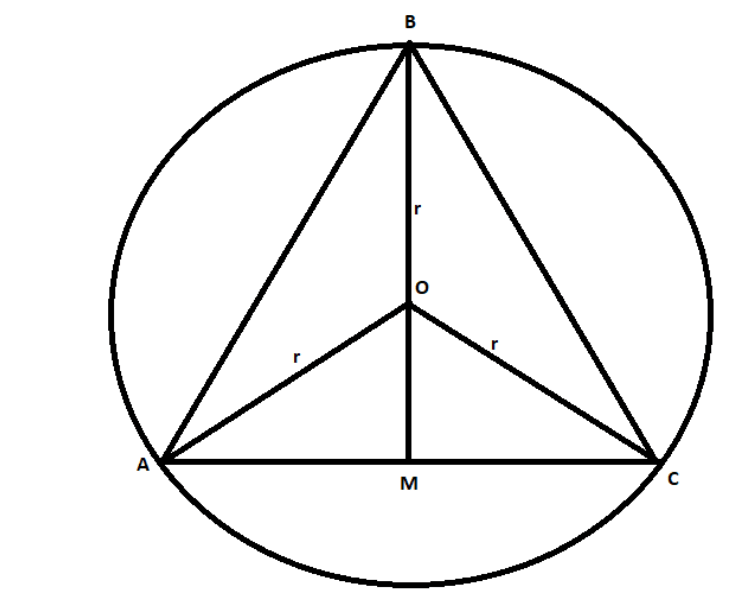
This is the overall situation. Now we know that \[\vartriangle ABC\] is inscribed in the circle with radius r and center O. also that the given triangle is equilateral that has all angles measuring \[{60^ \circ }\].
Now the formula to calculate the area of the triangle is,
\[area\vartriangle = \dfrac{1}{2} \times base \times height\]
Now in the triangle above we will take AC as the base and BM as the height of the triangle. But we need to find the dimensions of the base and height.
For that we will take the help of sine rule that relates the lengths of the sides of the triangle with the sines of the angles opposite to the side. That is in the above case;
\[\dfrac{{AC}}{{\sin {{60}^ \circ }}} = \dfrac{{OA}}{{\sin {{30}^ \circ }}}\]
So the value of AC is,
\[AC = OA\dfrac{{\sin {{60}^ \circ }}}{{\sin {{30}^ \circ }}}\]
Now we know that,
\[\sin {60^ \circ } = \dfrac{{\sqrt 3 }}{2}\& \sin {30^ \circ } = \dfrac{1}{2}\]
So substituting these values we get,
\[AC = OA\dfrac{{\dfrac{{\sqrt 3 }}{2}}}{{\dfrac{1}{2}}}\]
On calculating further,
\[AC = OA\sqrt 3 \]
\[AC = r\sqrt 3 \] this is the value of base in the above case.
Now we need to find the value of BM.
We can observe from the figure above that, \[BM = BO + OM\]
Here BO is clearly visible as r but for OM;
In \[\vartriangle OAM\],
\[\sin {30^ \circ } = \dfrac{{{\text{Opposite}}}}{{{\text{Hypotenuse}}}} = \dfrac{{OM}}{r}\]
So the value of OM is,
\[OM = r.\sin {30^ \circ }\]
Now putting both the values in the equation of BM,
\[BM = r + r.\sin {30^ \circ }\]
\[BM = r + \dfrac{r}{2}\]
Taking the LCM,
\[BM = \dfrac{3}{2}r\]
Now using the formula of area;
\[A\left( {\vartriangle ABC} \right) = \dfrac{1}{2} \times \left( {\sqrt 3 r} \right) \times \dfrac{3}{2}r\]
On calculating we get,
\[A\left( {\vartriangle ABC} \right) = \dfrac{{3\sqrt 3 }}{4}{r^2}\]
This is the answer.
So, the correct answer is “\[A\left( {\vartriangle ABC} \right) = \dfrac{{3\sqrt 3 }}{4}{r^2}\]”.
Note: Note that use of sine formula is the way to get the dimensions of the base and height. We use the sin formula since it is a case of a triangle and the triangle is an equilateral triangle. But it is applicable to any other triangle also.
If a, b and c are the three sides of the \[\vartriangle ABC\]
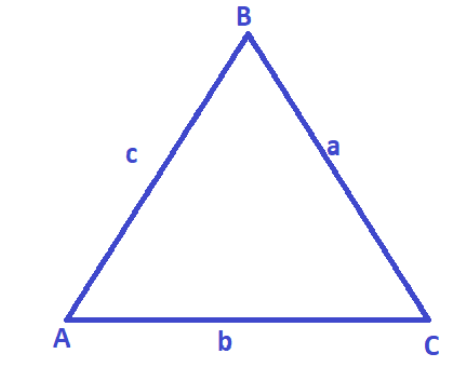
then we can say that \[\dfrac{a}{{\sin A}} = \dfrac{b}{{\sin B}} = \dfrac{c}{{\sin C}}\]
Complete step-by-step answer:
First let’s draw the given scenario,
This is the overall situation. Now we know that \[\vartriangle ABC\] is inscribed in the circle with radius r and center O. also that the given triangle is equilateral that has all angles measuring \[{60^ \circ }\].
Now the formula to calculate the area of the triangle is,
\[area\vartriangle = \dfrac{1}{2} \times base \times height\]
Now in the triangle above we will take AC as the base and BM as the height of the triangle. But we need to find the dimensions of the base and height.
For that we will take the help of sine rule that relates the lengths of the sides of the triangle with the sines of the angles opposite to the side. That is in the above case;
\[\dfrac{{AC}}{{\sin {{60}^ \circ }}} = \dfrac{{OA}}{{\sin {{30}^ \circ }}}\]
So the value of AC is,
\[AC = OA\dfrac{{\sin {{60}^ \circ }}}{{\sin {{30}^ \circ }}}\]
Now we know that,
\[\sin {60^ \circ } = \dfrac{{\sqrt 3 }}{2}\& \sin {30^ \circ } = \dfrac{1}{2}\]
So substituting these values we get,
\[AC = OA\dfrac{{\dfrac{{\sqrt 3 }}{2}}}{{\dfrac{1}{2}}}\]
On calculating further,
\[AC = OA\sqrt 3 \]
\[AC = r\sqrt 3 \] this is the value of base in the above case.
Now we need to find the value of BM.
We can observe from the figure above that, \[BM = BO + OM\]
Here BO is clearly visible as r but for OM;
In \[\vartriangle OAM\],
\[\sin {30^ \circ } = \dfrac{{{\text{Opposite}}}}{{{\text{Hypotenuse}}}} = \dfrac{{OM}}{r}\]
So the value of OM is,
\[OM = r.\sin {30^ \circ }\]
Now putting both the values in the equation of BM,
\[BM = r + r.\sin {30^ \circ }\]
\[BM = r + \dfrac{r}{2}\]
Taking the LCM,
\[BM = \dfrac{3}{2}r\]
Now using the formula of area;
\[A\left( {\vartriangle ABC} \right) = \dfrac{1}{2} \times \left( {\sqrt 3 r} \right) \times \dfrac{3}{2}r\]
On calculating we get,
\[A\left( {\vartriangle ABC} \right) = \dfrac{{3\sqrt 3 }}{4}{r^2}\]
This is the answer.
So, the correct answer is “\[A\left( {\vartriangle ABC} \right) = \dfrac{{3\sqrt 3 }}{4}{r^2}\]”.
Note: Note that use of sine formula is the way to get the dimensions of the base and height. We use the sin formula since it is a case of a triangle and the triangle is an equilateral triangle. But it is applicable to any other triangle also.
If a, b and c are the three sides of the \[\vartriangle ABC\]
then we can say that \[\dfrac{a}{{\sin A}} = \dfrac{b}{{\sin B}} = \dfrac{c}{{\sin C}}\]
Recently Updated Pages
Basicity of sulphurous acid and sulphuric acid are

Master Class 11 Business Studies: Engaging Questions & Answers for Success
Master Class 11 Computer Science: Engaging Questions & Answers for Success
Master Class 11 Economics: Engaging Questions & Answers for Success
Master Class 11 Social Science: Engaging Questions & Answers for Success
Master Class 11 English: Engaging Questions & Answers for Success
Trending doubts
One Metric ton is equal to kg A 10000 B 1000 C 100 class 11 physics CBSE
State and prove Bernoullis theorem class 11 physics CBSE
Actinoid contraction is more than lanthanoid contraction class 11 chemistry CBSE
The transition element that has lowest enthalpy of class 11 chemistry CBSE
Can anyone list 10 advantages and disadvantages of friction
State the laws of reflection of light