



How do you find the area of one petal of \[r = 2\cos (3\theta )\] ?
Answer
 Verified
601.8k+ views
Hint: Here in this we have to find the area of one petal of \[r = 2\cos (3\theta )\] . To find the area we use formula \[A = \dfrac{1}{2}\int_\alpha ^\beta {{{(r(\theta ))}^2}d\theta } \] , where \[\alpha \] and \[\beta \] are the limit points. Hence by substituting all the values in the formula and then by simplifying we obtain the area of one petal.
Complete step-by-step answer:
In general let us consider \[r = a\sin (n\theta )\] or \[r = a\sin (n\theta )\] where \[a \ne 0\] and n is a positive number greater than 1. For the graph of rose if the value of n is odd then rose will have n petals or if the value of n is even then the rose will have 2n petals. Here “a” represents the radius of the circle where the rose petals lie.
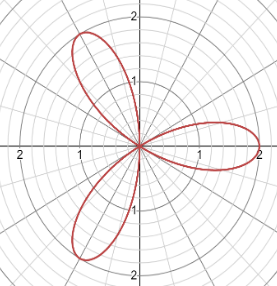
Now consider the given equation \[r = 2\cos (3\theta )\] . Here a=2, the radius of the circle is 2 and n=3, the number is odd so we have 3 petals for the rose.
The figure is as shown
To find the area we use the formula \[A = \dfrac{1}{2}\int_\alpha ^\beta {{{(r(\theta ))}^2}d\theta } \] ------- (1)
Here the limits points are not given. Therefore, we have to find the value of \[\alpha \] and \[\beta \]
Now consider the given equation \[r = 2\cos (3\theta )\] ------- (2)
Substitute r=0 in equation (2) we have
\[ \Rightarrow 0 = 2\cos (3\theta )\]
This is written as
\[ \Rightarrow 0 = \cos (3\theta )\]
By taking the inverse we have
\[ \Rightarrow {\cos ^{ - 1}}(0) = 3\theta \]
By the table of trigonometry ratios for standard angles in radians we have \[\cos \left( {\dfrac{\pi }{2}} \right) = 1\] so we have
\[ \Rightarrow \dfrac{\pi }{2} = 3\theta \]
Dividing by 3 on the both sides we have
\[ \Rightarrow \theta = \dfrac{\pi }{6}\]
Therefore \[\left( {\alpha ,\beta } \right) = \left( {r,\theta } \right) = \left( {0,\dfrac{\pi }{6}} \right)\] ----------- (3)
Substituting equation (2) and equation (3) in equation (1) we have
\[A = 2 \times \dfrac{1}{2}\int_0^{\dfrac{\pi }{6}} {{{(2\cos (3\theta ))}^2}d\theta } \]
Applying square, we have
\[ \Rightarrow A = 2 \times \dfrac{1}{2}\int_0^{\dfrac{\pi }{6}} {\left( {4{{\cos }^2}(3\theta )} \right)d\theta } \]
On simplifying we have
\[ \Rightarrow A = 4\int_0^{\dfrac{\pi }{6}} {\left( {{{\cos }^2}(3\theta )} \right)d\theta } \]
Apply the half angle formula for the cosine function we have
\[ \Rightarrow A = 4\int_0^{\dfrac{\pi }{6}} {\left( {\dfrac{{1 + \cos (6\theta )}}{2}} \right)d\theta } \]
On simplifying we have
\[ \Rightarrow A = 4 \times \dfrac{1}{2}\int_0^{\dfrac{\pi }{6}} {\left( {1 + \cos (6\theta )} \right)d\theta } \]
Take integral to each term we have
\[ \Rightarrow A = 2\left( {\int_0^{\dfrac{\pi }{6}} {d\theta } + \int_0^{\dfrac{\pi }{6}} {\cos (6\theta )d\theta } } \right)\]
On applying the integration, we have
\[ \Rightarrow A = 2\mathop {[\theta ] }\nolimits_0^{\dfrac{\pi }{6}} + 2\left[ {\dfrac{{\sin (6\theta )}}{6}} \right] _0^{\dfrac{\pi }{6}}\]
Applying the limit points, we get
\[ \Rightarrow A = 2\left[ {\dfrac{\pi }{6} - 0} \right] + \dfrac{2}{6}\left[ {\sin 6\left( {\dfrac{\pi }{6}} \right) - \sin (0)} \right] \]
On simplifying we get
\[
\Rightarrow A = \dfrac{\pi }{3} + \dfrac{1}{3}\left[ {0 - 0} \right] \\
\Rightarrow A = \dfrac{\pi }{3}sq.units \;
\]
Therefore, the area of one petal of \[r = 2\cos (3\theta )\] is \[\dfrac{\pi }{3}\;sq.units\]
So, the correct answer is “ \[\dfrac{\pi }{3}\;sq.units\] ”.
Note: The area of a petal for the circle for the polar coordinates is given by \[A = \dfrac{1}{2}\int_\alpha ^\beta {{{(r(\theta ))}^2}d\theta } \] . The unit for the area is given as a square unit. In the polar form the coordinates are represented in the form of \[\left( {r,\theta } \right)\] where r represents the radius of the circle and the \[\theta \] represents the angle.
Complete step-by-step answer:
In general let us consider \[r = a\sin (n\theta )\] or \[r = a\sin (n\theta )\] where \[a \ne 0\] and n is a positive number greater than 1. For the graph of rose if the value of n is odd then rose will have n petals or if the value of n is even then the rose will have 2n petals. Here “a” represents the radius of the circle where the rose petals lie.
Now consider the given equation \[r = 2\cos (3\theta )\] . Here a=2, the radius of the circle is 2 and n=3, the number is odd so we have 3 petals for the rose.
The figure is as shown
To find the area we use the formula \[A = \dfrac{1}{2}\int_\alpha ^\beta {{{(r(\theta ))}^2}d\theta } \] ------- (1)
Here the limits points are not given. Therefore, we have to find the value of \[\alpha \] and \[\beta \]
Now consider the given equation \[r = 2\cos (3\theta )\] ------- (2)
Substitute r=0 in equation (2) we have
\[ \Rightarrow 0 = 2\cos (3\theta )\]
This is written as
\[ \Rightarrow 0 = \cos (3\theta )\]
By taking the inverse we have
\[ \Rightarrow {\cos ^{ - 1}}(0) = 3\theta \]
By the table of trigonometry ratios for standard angles in radians we have \[\cos \left( {\dfrac{\pi }{2}} \right) = 1\] so we have
\[ \Rightarrow \dfrac{\pi }{2} = 3\theta \]
Dividing by 3 on the both sides we have
\[ \Rightarrow \theta = \dfrac{\pi }{6}\]
Therefore \[\left( {\alpha ,\beta } \right) = \left( {r,\theta } \right) = \left( {0,\dfrac{\pi }{6}} \right)\] ----------- (3)
Substituting equation (2) and equation (3) in equation (1) we have
\[A = 2 \times \dfrac{1}{2}\int_0^{\dfrac{\pi }{6}} {{{(2\cos (3\theta ))}^2}d\theta } \]
Applying square, we have
\[ \Rightarrow A = 2 \times \dfrac{1}{2}\int_0^{\dfrac{\pi }{6}} {\left( {4{{\cos }^2}(3\theta )} \right)d\theta } \]
On simplifying we have
\[ \Rightarrow A = 4\int_0^{\dfrac{\pi }{6}} {\left( {{{\cos }^2}(3\theta )} \right)d\theta } \]
Apply the half angle formula for the cosine function we have
\[ \Rightarrow A = 4\int_0^{\dfrac{\pi }{6}} {\left( {\dfrac{{1 + \cos (6\theta )}}{2}} \right)d\theta } \]
On simplifying we have
\[ \Rightarrow A = 4 \times \dfrac{1}{2}\int_0^{\dfrac{\pi }{6}} {\left( {1 + \cos (6\theta )} \right)d\theta } \]
Take integral to each term we have
\[ \Rightarrow A = 2\left( {\int_0^{\dfrac{\pi }{6}} {d\theta } + \int_0^{\dfrac{\pi }{6}} {\cos (6\theta )d\theta } } \right)\]
On applying the integration, we have
\[ \Rightarrow A = 2\mathop {[\theta ] }\nolimits_0^{\dfrac{\pi }{6}} + 2\left[ {\dfrac{{\sin (6\theta )}}{6}} \right] _0^{\dfrac{\pi }{6}}\]
Applying the limit points, we get
\[ \Rightarrow A = 2\left[ {\dfrac{\pi }{6} - 0} \right] + \dfrac{2}{6}\left[ {\sin 6\left( {\dfrac{\pi }{6}} \right) - \sin (0)} \right] \]
On simplifying we get
\[
\Rightarrow A = \dfrac{\pi }{3} + \dfrac{1}{3}\left[ {0 - 0} \right] \\
\Rightarrow A = \dfrac{\pi }{3}sq.units \;
\]
Therefore, the area of one petal of \[r = 2\cos (3\theta )\] is \[\dfrac{\pi }{3}\;sq.units\]
So, the correct answer is “ \[\dfrac{\pi }{3}\;sq.units\] ”.
Note: The area of a petal for the circle for the polar coordinates is given by \[A = \dfrac{1}{2}\int_\alpha ^\beta {{{(r(\theta ))}^2}d\theta } \] . The unit for the area is given as a square unit. In the polar form the coordinates are represented in the form of \[\left( {r,\theta } \right)\] where r represents the radius of the circle and the \[\theta \] represents the angle.
Recently Updated Pages
Master Class 12 Business Studies: Engaging Questions & Answers for Success

Master Class 12 Chemistry: Engaging Questions & Answers for Success
Master Class 12 Biology: Engaging Questions & Answers for Success
Class 12 Question and Answer - Your Ultimate Solutions Guide
Master Class 11 English: Engaging Questions & Answers for Success
Master Class 11 Social Science: Engaging Questions & Answers for Success
Trending doubts
Differentiate between Pyramid of energy and pyramid class 12 biology CBSE
Draw the diagram of the pyramid of energy Explain In class 12 biology CBSE
What is the Full Form of PVC, PET, HDPE, LDPE, PP and PS ?
The first microscope was invented by A Leeuwenhoek class 12 biology CBSE
Suicide bags of cells are aEndoplasmic reticulum bLysosome class 12 biology CBSE
Loss of upper fertile layer of soil is known as APedogenesis class 12 biology CBSE