




How do you find the amplitude, period, and phase shift of \[y=3\sin x\] ?
Answer
 Verified
624.9k+ views
Hint: These types of trigonometric problems are pretty easy to solve and they are very straight forward. To find the amplitude, period and other things we first need to define the general equation of \[\sin x\] , which is defined as, \[y=A\sin \left( bx+c \right)+d\] . From this general equation we can find out all our required outputs accordingly.
Complete step by step answer: Now we start off our given solution, by writing the general form of the equation, \[y=A\sin \left( bx+c \right)+d\] , and from this, each and every variable represents some of the output values, which affect the nature of the graph of \[y=3\sin x\]. In the defined equation,
\[A\], represents, the amplitude,
From \[y=A\sin \left( bx+c \right)+d\] we can find the period of the function by using the formula of period of \[\sin x\] that \[period=\dfrac{\left| 2\pi \right|}{b}\]
\[c\] , represents the horizontal phase shift or phase shift and,
\[d\] , represents the vertical phase shift.
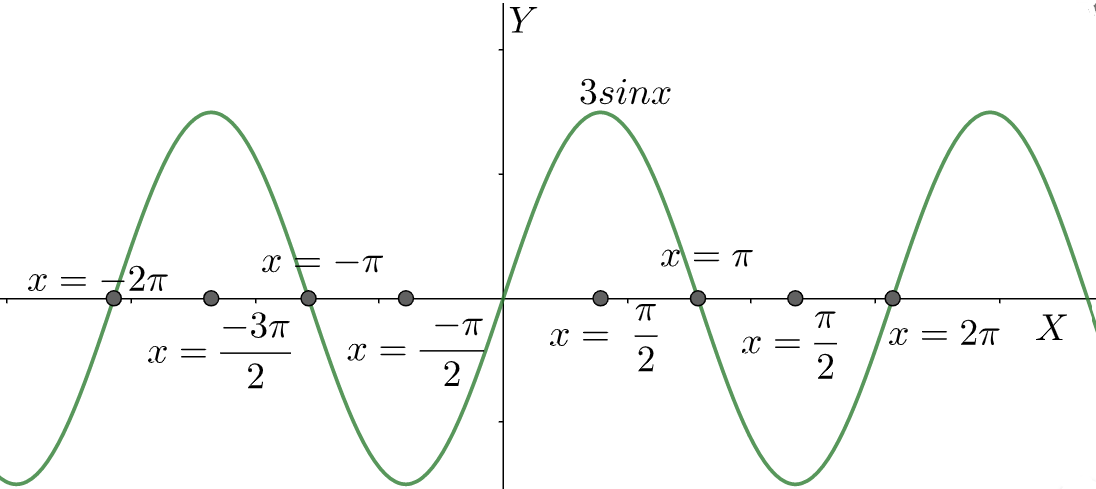
Now, writing our given equation of the form of the general defined one we get,
\[y=3\sin \left( 1.x+0 \right)+0\],
From this equation, we can write, that the Amplitude of the function is defined as,
\[A=3\]
We can also conclude that the value of the period of the function is defined as,
\[\begin{align}
& period=\dfrac{\left| 2\pi \right|}{1} \\
& \Rightarrow period=2\pi \\
\end{align}\]
We can conclude that the value of the phase shift or the horizontal shift of the function is given by,
\[c=0\] .
Note: While solving these types of problems, we must be very careful in representing the general form of the equation properly. Once the general form is represented correctly, we can find all the necessary things by comparing the given equation with the general form. We also need to remember all the variables and parameters, and what variables represent what.
Complete step by step answer: Now we start off our given solution, by writing the general form of the equation, \[y=A\sin \left( bx+c \right)+d\] , and from this, each and every variable represents some of the output values, which affect the nature of the graph of \[y=3\sin x\]. In the defined equation,
\[A\], represents, the amplitude,
From \[y=A\sin \left( bx+c \right)+d\] we can find the period of the function by using the formula of period of \[\sin x\] that \[period=\dfrac{\left| 2\pi \right|}{b}\]
\[c\] , represents the horizontal phase shift or phase shift and,
\[d\] , represents the vertical phase shift.
Now, writing our given equation of the form of the general defined one we get,
\[y=3\sin \left( 1.x+0 \right)+0\],
From this equation, we can write, that the Amplitude of the function is defined as,
\[A=3\]
We can also conclude that the value of the period of the function is defined as,
\[\begin{align}
& period=\dfrac{\left| 2\pi \right|}{1} \\
& \Rightarrow period=2\pi \\
\end{align}\]
We can conclude that the value of the phase shift or the horizontal shift of the function is given by,
\[c=0\] .
Note: While solving these types of problems, we must be very careful in representing the general form of the equation properly. Once the general form is represented correctly, we can find all the necessary things by comparing the given equation with the general form. We also need to remember all the variables and parameters, and what variables represent what.
Recently Updated Pages
If x a + bt + ct2 where x is in meters and t is in class 11 physics CBSE

A car covers the first half distance between two places class 11 physics CBSE
The resultant of two vectors overrightarrow P and overrightarrow class 11 physics CBSE
Find the value of cos 135 class 11 maths CBSE
A mass M is held in place by an applied force F and class 11 physics CBSE
A solution of glucose in water is labelled as 10 dfracwv class 11 chemistry CBSE
Trending doubts
One Metric ton is equal to kg A 10000 B 1000 C 100 class 11 physics CBSE
Find the value of the expression given below sin 30circ class 11 maths CBSE
Draw a diagram of nephron and explain its structur class 11 biology CBSE
10 examples of friction in our daily life
Proton was discovered by A Thomson B Rutherford C Chadwick class 11 chemistry CBSE
Bond order ofO2 O2+ O2 and O22 is in order A O2 langle class 11 chemistry CBSE