




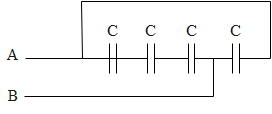
Find equivalent capacitance between points A and B :
$
{\text{A}}{\text{. }}\dfrac{{5C}}{3} \\
{\text{B}}{\text{. }}\dfrac{{4C}}{3} \\
{\text{C}}{\text{. }}C \\
{\text{D}}{\text{. 2}}C \\
$
Answer
 Verified
638.4k+ views
Hint: The voltages remain same in parallel combination and add up in series combination. As we know, $q = CV$ we can calculate the formulas used for obtaining equivalent capacitances in series and in parallel combination.
Formula used:
If we have two capacitances ${C_1}$ and ${C_2}$ and we need to calculate their resultant then
Series combination of capacitances: The resultant capacitance C is given as
$\dfrac{1}{C} = \dfrac{1}{{{C_1}}} + \dfrac{1}{{{C_2}}}{\text{ }}...{\text{(i)}}$
Parallel combination of capacitances: The resultant capacitance C is given as
$C = {C_1} + {C_2}{\text{ }}...{\text{(ii)}}$
Detailed step by step solution:
We are given four capacitances having equal value of capacitance equal to C as shown in the given figure.
The given diagram can be rearranged and redrawn in the following manner for better understanding the connections:
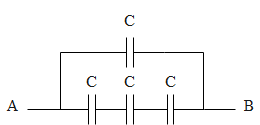
We notice now that there are three capacitors which are in series with each other. These three are further attached parallel to the fourth capacitance.
Let us first calculate the resultant capacitance of capacitors connected in series with each other. Let the resultant be C’ and it can be calculated using equation (i) as follows:
$
\dfrac{1}{{C'}} = \dfrac{1}{C} + \dfrac{1}{C} + \dfrac{1}{C} = \dfrac{3}{C} \\
\Rightarrow C' = \dfrac{C}{3} \\
$
Now this resultant C’ is in parallel with the fourth capacitance C and the final resultant capacitance between point A and B can be calculated using equation (ii) in the following way. Let the final capacitance be C’’ then
$
C'' = C + C' \\
= C + \dfrac{C}{3} = \dfrac{{4C}}{3} \\
$
This is the required equivalent capacitance between points A and B and the correct answer is option B.
Note: The student should not confuse formulas for resultant capacitance with the formulas of resultant resistance. It can be noted that the formulas of capacitance are opposite to that of resistance and can be remembered easily.
Formula used:
If we have two capacitances ${C_1}$ and ${C_2}$ and we need to calculate their resultant then
Series combination of capacitances: The resultant capacitance C is given as
$\dfrac{1}{C} = \dfrac{1}{{{C_1}}} + \dfrac{1}{{{C_2}}}{\text{ }}...{\text{(i)}}$
Parallel combination of capacitances: The resultant capacitance C is given as
$C = {C_1} + {C_2}{\text{ }}...{\text{(ii)}}$
Detailed step by step solution:
We are given four capacitances having equal value of capacitance equal to C as shown in the given figure.
The given diagram can be rearranged and redrawn in the following manner for better understanding the connections:
We notice now that there are three capacitors which are in series with each other. These three are further attached parallel to the fourth capacitance.
Let us first calculate the resultant capacitance of capacitors connected in series with each other. Let the resultant be C’ and it can be calculated using equation (i) as follows:
$
\dfrac{1}{{C'}} = \dfrac{1}{C} + \dfrac{1}{C} + \dfrac{1}{C} = \dfrac{3}{C} \\
\Rightarrow C' = \dfrac{C}{3} \\
$
Now this resultant C’ is in parallel with the fourth capacitance C and the final resultant capacitance between point A and B can be calculated using equation (ii) in the following way. Let the final capacitance be C’’ then
$
C'' = C + C' \\
= C + \dfrac{C}{3} = \dfrac{{4C}}{3} \\
$
This is the required equivalent capacitance between points A and B and the correct answer is option B.
Note: The student should not confuse formulas for resultant capacitance with the formulas of resultant resistance. It can be noted that the formulas of capacitance are opposite to that of resistance and can be remembered easily.
Recently Updated Pages
Master Class 12 Business Studies: Engaging Questions & Answers for Success

Master Class 12 Chemistry: Engaging Questions & Answers for Success
Master Class 12 Biology: Engaging Questions & Answers for Success
Class 12 Question and Answer - Your Ultimate Solutions Guide
Master Class 11 English: Engaging Questions & Answers for Success
Master Class 11 Social Science: Engaging Questions & Answers for Success
Trending doubts
Which are the Top 10 Largest Countries of the World?
Draw a labelled sketch of the human eye class 12 physics CBSE
Differentiate between homogeneous and heterogeneous class 12 chemistry CBSE
Differentiate between Pyramid of energy and pyramid class 12 biology CBSE
Why is the cell called the structural and functional class 12 biology CBSE
Draw the diagram of the pyramid of energy Explain In class 12 biology CBSE