




Fill in the blanks according to coordinate system:
(i) The interior of $\angle XOY$ is called _____ quadrant.
(ii) The interior of $\angle YOX'$ is called _____ quadrant.
(iii) The interior of $\angle XOY'$ is called _____ quadrant.
(iv) The interior of $\angle Y'OX'$ is called _____ quadrant.
(v) Abscissa of (3,5) is _____
(vi) A point whose x coordinate is negative and y coordinate is positive lies in the _____ quadrant.
Answer
 Verified
636.9k+ views
Hint: In this question, we have to first understand the coordinate system and then we will be able to answer our questions. We will draw a Cartesian plane and then analyze the plane to get our answer.
Complete step by step answer:
Here, let us first understand the coordinate system and the Cartesian plane. In the Cartesian plane, we have two axis, x axis and y axis which are perpendicular to each other. These axes cut each other at origin O and form four quadrants. The x axis is horizontal and y axis is vertical. Numbers written as x axis right side to the y axis are positive numbers whereas number on left side are the negative number. Similarly, the number on y-axis which is above x axis are positive and number on y-axis which is below x axis are negative. Any number in the plane is written in the form (x,y). Here, x is called abscissa and y is called the ordinate. Let us look at the Cartesian plane and label it according to standard notation.
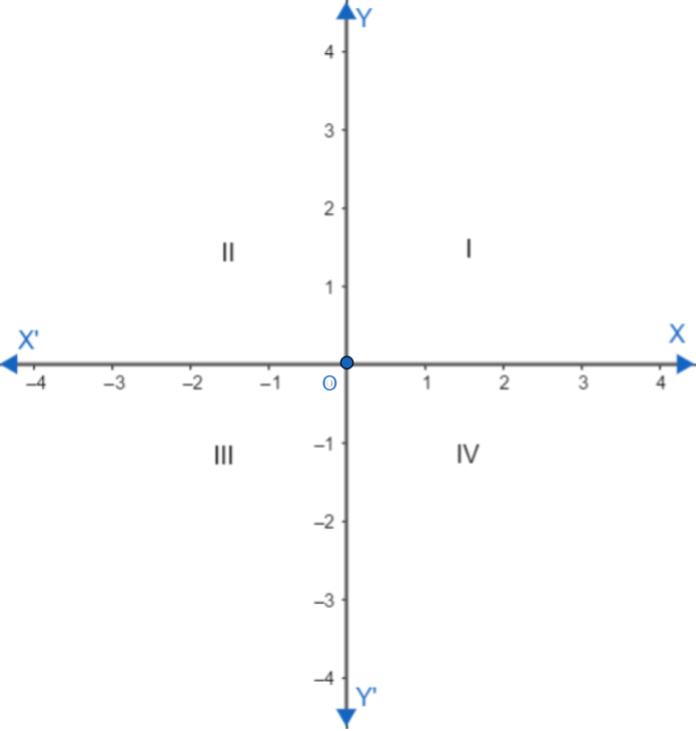
Let us move to our question and use this diagram to answer them:
(i) The interior of $\angle XOY$ is called _____ quadrant.
As we can see from our plane, we have four quadrants. Positive x axis marked as X and the negative x axis is marked as X'. Similarly, the positive y axis is marked as Y and negative y axis is marked as Y'. From diagram, $\angle XOY$ lies in first quadrant. Therefore, the interior of $\angle XOY$ is called first quadrant.
(ii) The interior of $\angle YOX'$ is called _____ quadrant.
From diagram, we can see that $\angle YOX'$ lies in second quadrant. Therefore, the interior of $\angle YOX'$ is called second quadrant.
(iii) The interior of $\angle XOY'$ is called _____ quadrant.
From diagram, we can see that, $\angle XOY'$ lies in fourth quadrant. Therefore, the interior of $\angle XOY'$ is called fourth quadrant.
(iv) The interior of $\angle Y'OX'$ is called _____ quadrant.
From diagram, we can see that, $\angle Y'OX'$ lies in third quadrant. Therefore, the interior of $\angle Y'OX'$ is called the third quadrant.
(v) Abscissa of (3,5) is _____
We know for any coordinate point (x,y),x is called abscissa and y is called ordinate. So here, abscissa will be 3.
(vi) A point whose x coordinate is negative and the y coordinate is positive lies in _____ quadrant.
From the diagram, we can see that, when x is negative it is either the second quadrant or third quadrant. If y coordinate is positive then it is in the second quadrant. Hence, a point whose x coordinate is negative and y coordinate is positive lies in the second quadrant.
Note:
Students should know, the way quadrants are written in Cartesian plane. They should know that, point of type (x,y) lies in first quadrant, (-x,y) lies in second quadrant, (-x,-y) lies in third quadrant and (x,-y) lies in the fourth quadrant.
Complete step by step answer:
Here, let us first understand the coordinate system and the Cartesian plane. In the Cartesian plane, we have two axis, x axis and y axis which are perpendicular to each other. These axes cut each other at origin O and form four quadrants. The x axis is horizontal and y axis is vertical. Numbers written as x axis right side to the y axis are positive numbers whereas number on left side are the negative number. Similarly, the number on y-axis which is above x axis are positive and number on y-axis which is below x axis are negative. Any number in the plane is written in the form (x,y). Here, x is called abscissa and y is called the ordinate. Let us look at the Cartesian plane and label it according to standard notation.
Let us move to our question and use this diagram to answer them:
(i) The interior of $\angle XOY$ is called _____ quadrant.
As we can see from our plane, we have four quadrants. Positive x axis marked as X and the negative x axis is marked as X'. Similarly, the positive y axis is marked as Y and negative y axis is marked as Y'. From diagram, $\angle XOY$ lies in first quadrant. Therefore, the interior of $\angle XOY$ is called first quadrant.
(ii) The interior of $\angle YOX'$ is called _____ quadrant.
From diagram, we can see that $\angle YOX'$ lies in second quadrant. Therefore, the interior of $\angle YOX'$ is called second quadrant.
(iii) The interior of $\angle XOY'$ is called _____ quadrant.
From diagram, we can see that, $\angle XOY'$ lies in fourth quadrant. Therefore, the interior of $\angle XOY'$ is called fourth quadrant.
(iv) The interior of $\angle Y'OX'$ is called _____ quadrant.
From diagram, we can see that, $\angle Y'OX'$ lies in third quadrant. Therefore, the interior of $\angle Y'OX'$ is called the third quadrant.
(v) Abscissa of (3,5) is _____
We know for any coordinate point (x,y),x is called abscissa and y is called ordinate. So here, abscissa will be 3.
(vi) A point whose x coordinate is negative and the y coordinate is positive lies in _____ quadrant.
From the diagram, we can see that, when x is negative it is either the second quadrant or third quadrant. If y coordinate is positive then it is in the second quadrant. Hence, a point whose x coordinate is negative and y coordinate is positive lies in the second quadrant.
Note:
Students should know, the way quadrants are written in Cartesian plane. They should know that, point of type (x,y) lies in first quadrant, (-x,y) lies in second quadrant, (-x,-y) lies in third quadrant and (x,-y) lies in the fourth quadrant.
Recently Updated Pages
Write any three differences between metals and nonmetals class 10 social science CBSE

Amit standing on a horizontal plane finds a bird flying class 10 maths CBSE
Two circles of radii 5 cm and 3 cm intersect at two class 10 maths CBSE
Solve the following i John and Jivanti together have class 10 maths CBSE
What is the relation between orthocenter circumcentre class 10 maths CBSE
Two plane mirrors are inclined at 70circ A ray incident class 10 physics CBSE
Trending doubts
Explain the Treaty of Vienna of 1815 class 10 social science CBSE
Which country is known as "The land of Fire and Ice"?
1 GB equals how many MB?
10 examples of evaporation in daily life with explanations
What is the full form of POSCO class 10 social science CBSE
Which is the hottest planet in the Solar system A Earth class 10 social science CBSE