




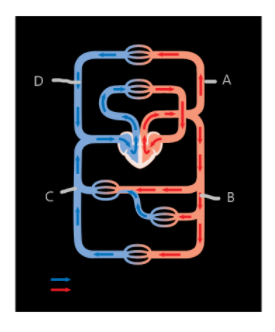
Figure shows schematic plan of blood circulation in humans with labels A to D. Identify the correct label and give its function/s.
A - Pulmonary vein - takes impure blood from body parts, PO2 = 60 mm Hg
B - Pulmonary artery - takes blood from heart to lungs, PO2 = 90 mm Hg
C - Vena Cava - takes blood from body parts to right auricle, PCO2 = 45 mm Hg
D - Dorsal aorta - takes blood from heart to body parts to right auricle, PO2 = 95 mm Hg
Answer
 Verified
594.9k+ views
Hint: The circulatory system or the cardiovascular system is an organ combined system that allows blood to circulate and transport nutrients. Through this system respiratory gases such as oxygen, carbon dioxide and other important proteins and chemicals such as hormones, and blood cells are transferred from to different parts of the human body.
Complete answer:
Human blood circulation is a system through which nutrients and oxygen are transported to the different parts of the body. This system consists of various organs. The essential components of the human cardiovascular system are the heart, arteries, veins, blood, and other blood capillaries. This is a closed-circuit system. The oxygenated blood enters the systemic circulation through the aortic semilunar valve when leaving the left ventricle. Oxygenated or pure blood passes through the pulmonary vein and the left atrium into the left ventricle. At that time, the partial pressure of oxygen arises at a very high level.
Through the pulmonary artery, the deoxygenated or impure blood goes to the lungs from the right ventricle of the heart. In this case, as the blood is deoxygenated, the more partial pressure of carbon dioxide will be functional than that of oxygen.
The dorsal aorta takes the oxygen-enriched blood from the left side of the heart to the body.
The vena cava carries the deoxygenated blood to the right atrium from the body parts. The partial pressure of carbon dioxide calculated in vena cava is 45 mm Hg and the partial pressure of oxygen calculated in the atrium is near about 100 mm Hg.
In the above diagram, the part labelled as A denotes the pulmonary vein which collects oxygenated blood from the lungs to the left atrium. B labelled region denotes the dorsal aorta of the heart which helps in carrying blood from the heart to the various parts of the human body. Next, the portion marked as C is the vena cava which functions as to carry impure blood from body parts to the right atrium, and D marked portion is the pulmonary artery through which impure blood or deoxygenated blood is taken to the lungs from the heart.
Therefore, the right answer to the question is option C.
Note:
The heart is the organ associated with pumping of blood as well as receives blood from the different parts of the body through the networks of arteries and veins. In this closed system oxygenated and deoxygenated blood is transported from the body to heart and reversed with the help of arteries and veins. The pure blood moves from the pulmonary vein to the dorsal aorta of the heart which moves the blood to the different parts of the body. The vena cava receives blood from the atria and deoxygenated blood enters the pulmonary artery which moves the blood to the lungs.
Complete answer:
Human blood circulation is a system through which nutrients and oxygen are transported to the different parts of the body. This system consists of various organs. The essential components of the human cardiovascular system are the heart, arteries, veins, blood, and other blood capillaries. This is a closed-circuit system. The oxygenated blood enters the systemic circulation through the aortic semilunar valve when leaving the left ventricle. Oxygenated or pure blood passes through the pulmonary vein and the left atrium into the left ventricle. At that time, the partial pressure of oxygen arises at a very high level.
Through the pulmonary artery, the deoxygenated or impure blood goes to the lungs from the right ventricle of the heart. In this case, as the blood is deoxygenated, the more partial pressure of carbon dioxide will be functional than that of oxygen.
The dorsal aorta takes the oxygen-enriched blood from the left side of the heart to the body.
The vena cava carries the deoxygenated blood to the right atrium from the body parts. The partial pressure of carbon dioxide calculated in vena cava is 45 mm Hg and the partial pressure of oxygen calculated in the atrium is near about 100 mm Hg.
In the above diagram, the part labelled as A denotes the pulmonary vein which collects oxygenated blood from the lungs to the left atrium. B labelled region denotes the dorsal aorta of the heart which helps in carrying blood from the heart to the various parts of the human body. Next, the portion marked as C is the vena cava which functions as to carry impure blood from body parts to the right atrium, and D marked portion is the pulmonary artery through which impure blood or deoxygenated blood is taken to the lungs from the heart.
Therefore, the right answer to the question is option C.
Note:
The heart is the organ associated with pumping of blood as well as receives blood from the different parts of the body through the networks of arteries and veins. In this closed system oxygenated and deoxygenated blood is transported from the body to heart and reversed with the help of arteries and veins. The pure blood moves from the pulmonary vein to the dorsal aorta of the heart which moves the blood to the different parts of the body. The vena cava receives blood from the atria and deoxygenated blood enters the pulmonary artery which moves the blood to the lungs.
Recently Updated Pages
Master Class 12 Business Studies: Engaging Questions & Answers for Success

Master Class 12 Biology: Engaging Questions & Answers for Success
Master Class 12 Chemistry: Engaging Questions & Answers for Success
Class 12 Question and Answer - Your Ultimate Solutions Guide
Master Class 11 Social Science: Engaging Questions & Answers for Success
Master Class 11 English: Engaging Questions & Answers for Success
Trending doubts
Which are the Top 10 Largest Countries of the World?
Draw a labelled sketch of the human eye class 12 physics CBSE
Differentiate between homogeneous and heterogeneous class 12 chemistry CBSE
Sulphuric acid is known as the king of acids State class 12 chemistry CBSE
Why is the cell called the structural and functional class 12 biology CBSE
Which is the correct genotypic ratio of mendel dihybrid class 12 biology CBSE