




Exponential growth is shown during
A. Lag phase
B. Log phase
C. Maturation phase
D. Senescence phase
Answer
 Verified
561.6k+ views
Hint: Exponential growth is the process by which quantity increases over time. It occurs when the instantaneous rate of change of a quantity concerning time is proportional to the quantity itself. A quantity undergoing exponential growth is an exponential function of time, that is, the variable representing time is the exponent (in contrast to other types of functions).
Complete answer:
Bacterial growth is the division of a bacterium into two daughter cells, a process known as binary fission. In the absence of an event, the resulting daughter cells are genetically identical to the original cell. As a result, bacterial growth occurs. Both daughter cells from the division may or may not survive. However, if the average number of survivors exceeds one, the bacterial population will become unstable.
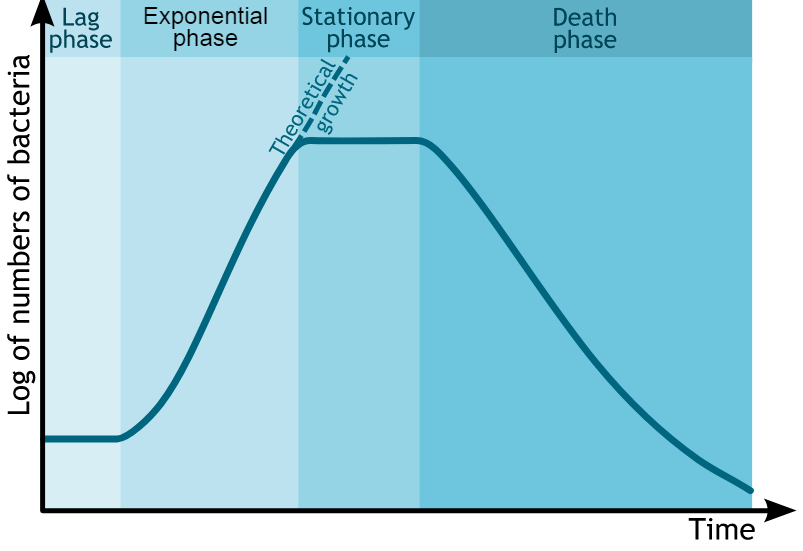
Bacterial growth is classified into four stages: the lag phase, the log phase, the stationary phase, and the death phase. Bacterial growth is minimal or non-existent during the lag phase. Bacteria are adjusting to their surroundings and synthesizing biochemicals and nutrients during this stage. The number of bacterial cells doubles at an exponential rate during the log phase.
This phase is characterized by maximum or exponential growth. The rate of cell death is equal to the rate of cell division in the stationary phase. The bacterial population decreases during the death phase due to a lack of nutrients and a high toxin concentration.
So, The log phase (also known as the logarithmic phase or the exponential phase) is a period in which cells double. The number of new bacteria that appear per unit time is proportional to the size of the current population. If growth is unrestricted, doubling will occur at a constant rate, doubling both the number of cells and the rate of population increase with each successive period.
Thus, The answer is option B: log phase.
Bacterial growth curve is given as:
Note:
Acidity (pH), temperature, water activity, macro, and micronutrients, oxygen levels, and toxins are all environmental factors that influence the rate of bacterial growth. Except for extremophiles, bacteria have relatively consistent environmental conditions. The bacterium thrives in optimal growth conditions, but once outside of those conditions, stress can result in reduced or stalled growth, dormancy (such as spore formation), or death. A key principle of food preservation is to maintain suboptimal growth conditions.
Complete answer:
Bacterial growth is the division of a bacterium into two daughter cells, a process known as binary fission. In the absence of an event, the resulting daughter cells are genetically identical to the original cell. As a result, bacterial growth occurs. Both daughter cells from the division may or may not survive. However, if the average number of survivors exceeds one, the bacterial population will become unstable.
Bacterial growth is classified into four stages: the lag phase, the log phase, the stationary phase, and the death phase. Bacterial growth is minimal or non-existent during the lag phase. Bacteria are adjusting to their surroundings and synthesizing biochemicals and nutrients during this stage. The number of bacterial cells doubles at an exponential rate during the log phase.
This phase is characterized by maximum or exponential growth. The rate of cell death is equal to the rate of cell division in the stationary phase. The bacterial population decreases during the death phase due to a lack of nutrients and a high toxin concentration.
So, The log phase (also known as the logarithmic phase or the exponential phase) is a period in which cells double. The number of new bacteria that appear per unit time is proportional to the size of the current population. If growth is unrestricted, doubling will occur at a constant rate, doubling both the number of cells and the rate of population increase with each successive period.
Thus, The answer is option B: log phase.
Bacterial growth curve is given as:
Note:
Acidity (pH), temperature, water activity, macro, and micronutrients, oxygen levels, and toxins are all environmental factors that influence the rate of bacterial growth. Except for extremophiles, bacteria have relatively consistent environmental conditions. The bacterium thrives in optimal growth conditions, but once outside of those conditions, stress can result in reduced or stalled growth, dormancy (such as spore formation), or death. A key principle of food preservation is to maintain suboptimal growth conditions.
Recently Updated Pages
Explain the structure of megasporangium class 12 biology CBSE

Why is chloroform kept in dark coloured bottles class 12 chemistry CBSE
Derive the balancing condition of a Wheatstone bri class 12 physics CBSE
Draw VI characteristics of a pn junction diode Explain class 12 physics CBSE
Is it possible to carry pride in ones language too class 12 english CBSE
In a population at Hardy Weinberg equilibrium the allele class 12 biology CBSE
Trending doubts
Draw a labelled sketch of the human eye class 12 physics CBSE
Which are the Top 10 Largest Countries of the World?
Draw ray diagrams each showing i myopic eye and ii class 12 physics CBSE
Which is the correct genotypic ratio of mendel dihybrid class 12 biology CBSE
Differentiate between homogeneous and heterogeneous class 12 chemistry CBSE
Which animal never drinks water in its entire life class 12 biology CBSE