




Explain why the flow of energy is unidirectional?
Answer
 Verified
654.6k+ views
Hint: Ecosystem is defined as a group of organisms living together and their interaction with the environment. It includes the interaction with both abiotic and biotic components. All ecosystems have sun as the main source of energy except the deep-sea hydrothermal vents.
Complete answer: All living organisms are dependent directly or indirectly for their food on autotrophs. So, it is very important to understand how the solar energy captured by the plants is transferred to different organisms of the ecosystem. This makes the unidirectional flow of energy from sun to producers (autotrophs or plants) and then to consumers. The energy flow begins from producers (first trophic level) which absorbs the solar energy and converts this into chemical energy for the synthesis of carbohydrates via photosynthesis.
The next comes the herbivores (second trophic level) that consumes the producers to get the energy. But the energy they get is 10 percent less than that received by the producers. Similarly, carnivores that consume herbivores form the next trophic level and they will get energy 10 percent less than that received by herbivores. This is known as 10 percent law. This indicates that the amount of energy decreases at each trophic level. Some of the energy is lost in the form of heat to maintain the homeostasis of the organism.
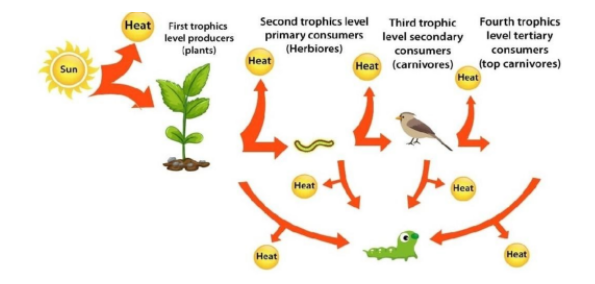
When an organism dies it decomposes and forms dead biomass that is a source of energy for decomposers. Thus, an organism at each trophic level is dependent on other organisms at lower trophic levels.
Note: Energy flow is defined as the amount of energy that passes from one trophic level to another trophic level. Energy flow at each trophic level is based on 10 percent law.
Complete answer: All living organisms are dependent directly or indirectly for their food on autotrophs. So, it is very important to understand how the solar energy captured by the plants is transferred to different organisms of the ecosystem. This makes the unidirectional flow of energy from sun to producers (autotrophs or plants) and then to consumers. The energy flow begins from producers (first trophic level) which absorbs the solar energy and converts this into chemical energy for the synthesis of carbohydrates via photosynthesis.
The next comes the herbivores (second trophic level) that consumes the producers to get the energy. But the energy they get is 10 percent less than that received by the producers. Similarly, carnivores that consume herbivores form the next trophic level and they will get energy 10 percent less than that received by herbivores. This is known as 10 percent law. This indicates that the amount of energy decreases at each trophic level. Some of the energy is lost in the form of heat to maintain the homeostasis of the organism.
When an organism dies it decomposes and forms dead biomass that is a source of energy for decomposers. Thus, an organism at each trophic level is dependent on other organisms at lower trophic levels.
Note: Energy flow is defined as the amount of energy that passes from one trophic level to another trophic level. Energy flow at each trophic level is based on 10 percent law.
Recently Updated Pages
Master Class 12 Economics: Engaging Questions & Answers for Success

Master Class 12 Social Science: Engaging Questions & Answers for Success
Master Class 12 English: Engaging Questions & Answers for Success
Master Class 12 Maths: Engaging Questions & Answers for Success
Master Class 12 Physics: Engaging Questions & Answers for Success
Master Class 12 Biology: Engaging Questions & Answers for Success
Trending doubts
Draw a labelled sketch of the human eye class 12 physics CBSE
Draw a ray diagram of compound microscope when the class 12 physics CBSE
Derive an expression for the electric field intensity class 12 physics CBSE
Ethylidene chloride and ethylene dichloride are A Chain class 12 chemistry CBSE
What is a transformer Explain the principle construction class 12 physics CBSE
Calculate the equivalent resistance between a and b class 12 physics CBSE