



Explain the use of radioactive isotopes in the study of the mechanism of photosynthesis in plants and hydrolysis of esters.
Answer
 Verified
598.2k+ views
Hint: The radioactive isotopes are the elements having unstable nuclei and can be used to study reaction mechanisms. One radioactive isotope of oxygen - ${{\text{O}}^{18}}$ is used in a reactant and the products formed in the reaction are studied to confirm the mechanism of reactions such as photosynthesis and hydrolysis of esters.
Complete answer:
Isotopes are the elements having the same number of protons but differ in the number of neutrons. Radioactive isotopes are the elements having an unstable combination of neutrons and protons and it dissipates energy by emitting radiations to attain stability.
Many radioactive isotopes have useful applications in the real world. For example, they are used to study the mechanism of many chemical reactions. Let us discuss how the radioactive isotopes are used to study the reaction mechanism of photosynthesis and hydrolysis of esters.
-Study of the reaction mechanism of photosynthesis:
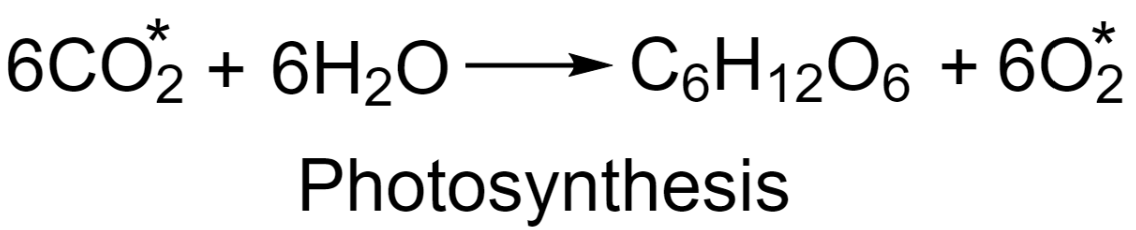
In this method, a small quantity of carbon dioxide having ${{\text{O}}^{18}}$ a radioactive isotope of oxygen is mixed with ordinary $\text{C}{{\text{O}}_{2}}$ and the process of photosynthesis is being carried out. The results reveal that the oxygen produced in the reaction is non-radioactive. This indicates that the mechanism followed in photosynthesis involves the production of oxygen from water and not from carbon dioxide.
-Study of the reaction mechanism of ester hydrolysis:
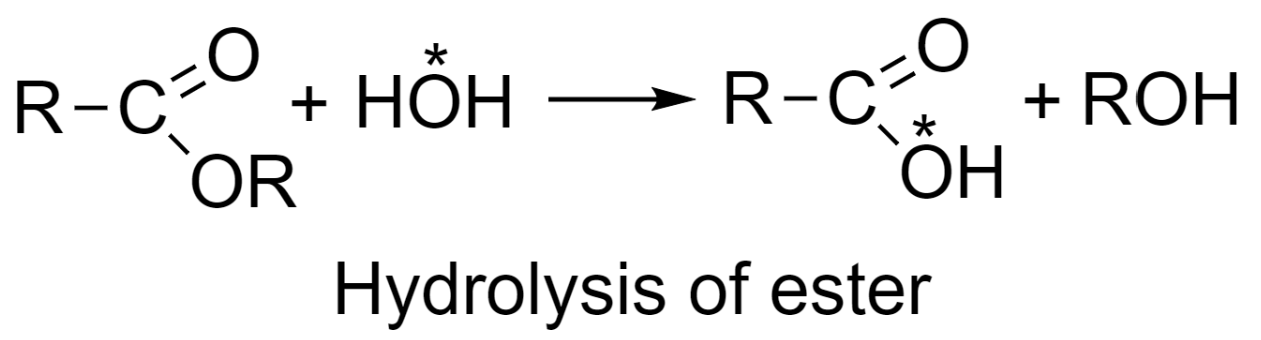
Similar to the method explained above, in the hydrolysis of esters, water used is containing ${{\text{O}}^{18}}$ radioactive isotope and the products formed in the reaction are alcohol and an acid possessing radioactivity. Thus, the mechanism of ester hydrolysis would be as given in the following reaction in which OH group of water is retained in acid formed:
Note:
There are many radioactive isotopes of oxygen ranging from ${{\text{O}}^{11}}$ to ${{\text{O}}^{26}}$. But these are short-lived species and out of all these, the most stable known isotopes of oxygen that are used in real-life applications are - ${{\text{O}}^{16}},\text{ }{{\text{O}}^{17}},\text{ }{{\text{O}}^{18}}$.
Complete answer:
Isotopes are the elements having the same number of protons but differ in the number of neutrons. Radioactive isotopes are the elements having an unstable combination of neutrons and protons and it dissipates energy by emitting radiations to attain stability.
Many radioactive isotopes have useful applications in the real world. For example, they are used to study the mechanism of many chemical reactions. Let us discuss how the radioactive isotopes are used to study the reaction mechanism of photosynthesis and hydrolysis of esters.
-Study of the reaction mechanism of photosynthesis:
In this method, a small quantity of carbon dioxide having ${{\text{O}}^{18}}$ a radioactive isotope of oxygen is mixed with ordinary $\text{C}{{\text{O}}_{2}}$ and the process of photosynthesis is being carried out. The results reveal that the oxygen produced in the reaction is non-radioactive. This indicates that the mechanism followed in photosynthesis involves the production of oxygen from water and not from carbon dioxide.
-Study of the reaction mechanism of ester hydrolysis:
Similar to the method explained above, in the hydrolysis of esters, water used is containing ${{\text{O}}^{18}}$ radioactive isotope and the products formed in the reaction are alcohol and an acid possessing radioactivity. Thus, the mechanism of ester hydrolysis would be as given in the following reaction in which OH group of water is retained in acid formed:
Note:
There are many radioactive isotopes of oxygen ranging from ${{\text{O}}^{11}}$ to ${{\text{O}}^{26}}$. But these are short-lived species and out of all these, the most stable known isotopes of oxygen that are used in real-life applications are - ${{\text{O}}^{16}},\text{ }{{\text{O}}^{17}},\text{ }{{\text{O}}^{18}}$.
Recently Updated Pages
Which of the following graphs shows the variation of class 12 physics CBSE

Draw a labelled diagram of the human male reproductive class 12 biology CBSE
Describe the experiment to compare the emf of two cells class 12 physics CBSE
What is standard hydrogen electrode
What is conventional current and electric current class 12 physics CBSE
2Bromopentane is treated with an alcoholic KOH solution class 12 chemistry CBSE
Trending doubts
Draw a labelled sketch of the human eye class 12 physics CBSE
Which are the Top 10 Largest Countries of the World?
Differentiate between homogeneous and heterogeneous class 12 chemistry CBSE
Draw ray diagrams each showing i myopic eye and ii class 12 physics CBSE
Which is the correct genotypic ratio of mendel dihybrid class 12 biology CBSE
What is the Full Form of PVC, PET, HDPE, LDPE, PP and PS ?