




Excretory matter of the earthworm is mainly
A. Creatinine
B. Urea
C. Ammonia
D. Both B and C
Answer
 Verified
620.4k+ views
Hint: They are the nitrogenous wastes products in various animals that are excreted out of the body, out of these two one them is highly toxic and is later converted into the other form.
Complete answer:
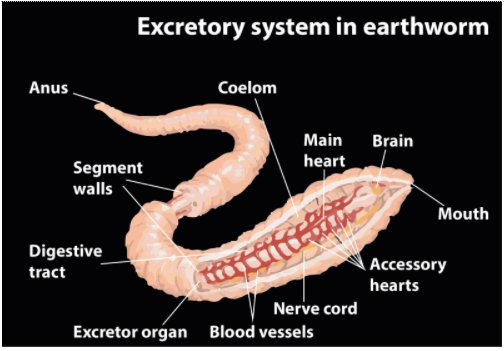
The earthworms are both ureotelic and ammonotelic and secrete both urea and ammonia as waste products. The excretory organs are called nephridia in the earthworm.
Additional Information:
-Ammonia is a toxic element even when present in small amounts and must be immediately removed from the body.
-Ammonia is a waste which is formed by amino acid catabolism.
-Ammonia is a nitrogenous waste that is formed generally in aquatic organisms.
-The ammonia needs to be removed from the body as fast as possible or else it will become detrimental.
-Those organisms which cannot remove their nitrogenous waste mostly ammonia will convert it into urea or uric acid.
-This process of conversion of ammonia into urea is known as the urea cycle or ornithine cycle, which takes place in the liver.
-In the liver, urea is produced which is then transferred into the bloodstream and from the bloodstream to the kidney for excretion.
-Urea is excreted as a solution present in the urine.
-The urea as a waste product was discovered in 1828 by Friedrich Wohler.
-In 1727, the Dutch scientist Herman Boerhaave discovered urea for the first time.
-Urea is present in the urine of the mammals as a main nitrogen-containing waste substance.
So, the correct answer is ‘Both B and C’.
Note: The urea cycle was discovered after five years of the discovery of the TCA (Tricarboxylic acid cycle or Krebs cycle) cycle. It was the first metabolic cycle that was discovered in 1932 by Hans Kreb and Kurt Henseleit. The urea cycle was described in more detail by Ratner and Cohen. It occurs mostly in ammonotelic organisms.
Complete answer:
The earthworms are both ureotelic and ammonotelic and secrete both urea and ammonia as waste products. The excretory organs are called nephridia in the earthworm.
Additional Information:
-Ammonia is a toxic element even when present in small amounts and must be immediately removed from the body.
-Ammonia is a waste which is formed by amino acid catabolism.
-Ammonia is a nitrogenous waste that is formed generally in aquatic organisms.
-The ammonia needs to be removed from the body as fast as possible or else it will become detrimental.
-Those organisms which cannot remove their nitrogenous waste mostly ammonia will convert it into urea or uric acid.
-This process of conversion of ammonia into urea is known as the urea cycle or ornithine cycle, which takes place in the liver.
-In the liver, urea is produced which is then transferred into the bloodstream and from the bloodstream to the kidney for excretion.
-Urea is excreted as a solution present in the urine.
-The urea as a waste product was discovered in 1828 by Friedrich Wohler.
-In 1727, the Dutch scientist Herman Boerhaave discovered urea for the first time.
-Urea is present in the urine of the mammals as a main nitrogen-containing waste substance.
So, the correct answer is ‘Both B and C’.
Note: The urea cycle was discovered after five years of the discovery of the TCA (Tricarboxylic acid cycle or Krebs cycle) cycle. It was the first metabolic cycle that was discovered in 1932 by Hans Kreb and Kurt Henseleit. The urea cycle was described in more detail by Ratner and Cohen. It occurs mostly in ammonotelic organisms.
Recently Updated Pages
Master Class 11 Social Science: Engaging Questions & Answers for Success

Master Class 11 English: Engaging Questions & Answers for Success
Master Class 11 Maths: Engaging Questions & Answers for Success
Master Class 11 Chemistry: Engaging Questions & Answers for Success
Master Class 11 Biology: Engaging Questions & Answers for Success
Master Class 11 Physics: Engaging Questions & Answers for Success
Trending doubts
One Metric ton is equal to kg A 10000 B 1000 C 100 class 11 physics CBSE
Difference Between Prokaryotic Cells and Eukaryotic Cells
How many of the following diseases can be studied with class 11 biology CBSE
Which of the following enzymes is used for carboxylation class 11 biology CBSE
Two of the body parts which do not appear in MRI are class 11 biology CBSE
Draw a diagram of a plant cell and label at least eight class 11 biology CBSE