




Exchange of gases between alveoli and blood in pulmonary capillaries is known as
a. External respiration
b. Internal respiration
c. Cellular respiration
d. None of the above
Answer
 Verified
567.3k+ views
Hint: Respiration is a biological process that is concerned with exchange of gases between the body of organisms and the environment. The oxygen inhaled helps in breaking down complex organic compounds and thus, producing energy in the body.
Complete Answer
Respiration, being a complex process, completes in three different stages: external respiration, internal respiration and cellular respiration. Let's study each of these to find the correct answer.
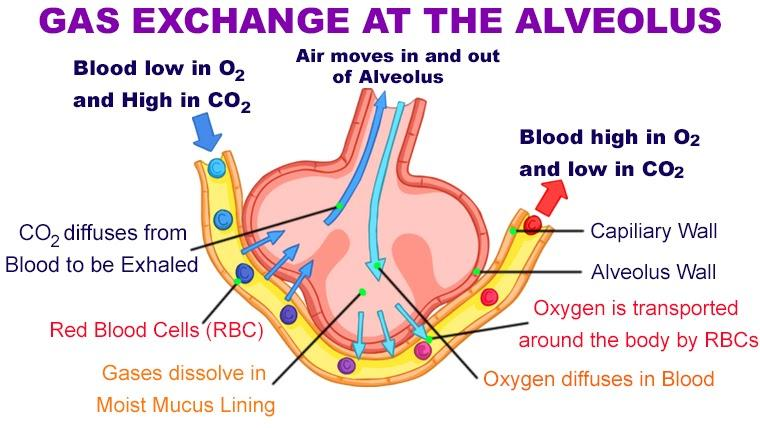
External respiration: It is the first stage of respiration. It involves exchange of gases between respiratory organs of the organism (such as lungs, nostrils) and the environment. After that, the oxygen rich air supplies oxygen to blood flowing in pulmonary capillaries and takes back Carbon dioxide. This is the simplest stage of respiration which is also termed as breathing.
Internal respiration: It is the second stage of respiration that involves exchange of gases (that is Carbon dioxide and Oxygen) between oxygenated blood and body tissues. Therefore, option B is an incorrect answer.
Cellular respiration: It is the third stage of respiration that involves usage of oxygen for energy production at cellular level. The oxygen inhaled helps in breakdown of organic compounds (glucose) which in turn supplies energy for carrying out metabolic processes in the body. This is the final stage of the respiration process that involves a set of chemical
reactions besides gaseous exchange.
Thus, from the above discussed concepts about respiration, we can say that option A) External respiration is the correct answer.
Note:
The inhaled air travels through nostrils to the lungs where it travels through narrow pipes called bronchioles. The ends of these bronchioles are fitted with a small air sac called alveoli (the ultimate gas exchanging unit of lungs).
Complete Answer
Respiration, being a complex process, completes in three different stages: external respiration, internal respiration and cellular respiration. Let's study each of these to find the correct answer.
External respiration: It is the first stage of respiration. It involves exchange of gases between respiratory organs of the organism (such as lungs, nostrils) and the environment. After that, the oxygen rich air supplies oxygen to blood flowing in pulmonary capillaries and takes back Carbon dioxide. This is the simplest stage of respiration which is also termed as breathing.
Internal respiration: It is the second stage of respiration that involves exchange of gases (that is Carbon dioxide and Oxygen) between oxygenated blood and body tissues. Therefore, option B is an incorrect answer.
Cellular respiration: It is the third stage of respiration that involves usage of oxygen for energy production at cellular level. The oxygen inhaled helps in breakdown of organic compounds (glucose) which in turn supplies energy for carrying out metabolic processes in the body. This is the final stage of the respiration process that involves a set of chemical
reactions besides gaseous exchange.
Thus, from the above discussed concepts about respiration, we can say that option A) External respiration is the correct answer.
Note:
The inhaled air travels through nostrils to the lungs where it travels through narrow pipes called bronchioles. The ends of these bronchioles are fitted with a small air sac called alveoli (the ultimate gas exchanging unit of lungs).
Recently Updated Pages
Master Class 11 English: Engaging Questions & Answers for Success

Master Class 11 Physics: Engaging Questions & Answers for Success
Master Class 11 Computer Science: Engaging Questions & Answers for Success
Master Class 11 Chemistry: Engaging Questions & Answers for Success
Master Class 11 Social Science: Engaging Questions & Answers for Success
Master Class 11 Accountancy: Engaging Questions & Answers for Success
Trending doubts
Difference Between Prokaryotic Cells and Eukaryotic Cells
Two of the body parts which do not appear in MRI are class 11 biology CBSE
10 examples of friction in our daily life
Draw a diagram of nephron and explain its structur class 11 biology CBSE
One Metric ton is equal to kg A 10000 B 1000 C 100 class 11 physics CBSE
Draw a diagram of a plant cell and label at least eight class 11 biology CBSE