




Ethanoic acid is the IUPAC name of acetic acid.
a.) True
b.) False
Answer
 Verified
642.3k+ views
Hint: Start this question by breaking up the name of ethanoic acid. As the name suggests, ethanoic acid is made from ‘eth-’ and ‘-oic acid’. It is one of the simplest carboxylic acids. It is made from some ‘acetic acid bacteria’.
Complete step by step answer:
Let us try to draw the structure of ethanoic acids by breaking up the name of the compound. It is made up of -
‘eth-’ which indicates that the compound is made up of two carbons.
‘-an-’ which indicates that the compound is an alkane.
‘-oic acid’ which indicates that the compound is a carboxylic acid.
Now, let us draw the structure of the compound.
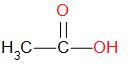 Ethanoic acid is commonly known as acetic acid, which is derived from the Latin word ‘acetum’.
It is a weak acid, because it does not dissociate completely in aqueous solution. Acetic acid dissociates as –
\[C{{H}_{3}}COOH\rightleftharpoons C{{H}_{3}}CO{{O}^{-}}+{{H}^{+}}\]
It is a monoprotic acid (releases one proton in aqueous solution).
Therefore, the answer is – option (a) – The given statement is true.
Additional Information:
Vinegar is 4% acetic acid by volume. It has a pKa of around 4.7. It has a very distinctive sour taste and pungent smell.
Note: Acetic acid is generally produced from bacterial fermentation, more specifically - Acetobacter. The substrate can be fermented grain, malt, rice or potato masher. It is made by carbonylation of methanol (introduction of CO in methanol). It is also produced from oxidation of acetaldehyde.
Complete step by step answer:
Let us try to draw the structure of ethanoic acids by breaking up the name of the compound. It is made up of -
‘eth-’ which indicates that the compound is made up of two carbons.
‘-an-’ which indicates that the compound is an alkane.
‘-oic acid’ which indicates that the compound is a carboxylic acid.
Now, let us draw the structure of the compound.
It is a weak acid, because it does not dissociate completely in aqueous solution. Acetic acid dissociates as –
\[C{{H}_{3}}COOH\rightleftharpoons C{{H}_{3}}CO{{O}^{-}}+{{H}^{+}}\]
It is a monoprotic acid (releases one proton in aqueous solution).
Therefore, the answer is – option (a) – The given statement is true.
Additional Information:
Vinegar is 4% acetic acid by volume. It has a pKa of around 4.7. It has a very distinctive sour taste and pungent smell.
Note: Acetic acid is generally produced from bacterial fermentation, more specifically - Acetobacter. The substrate can be fermented grain, malt, rice or potato masher. It is made by carbonylation of methanol (introduction of CO in methanol). It is also produced from oxidation of acetaldehyde.
Recently Updated Pages
Master Class 12 Business Studies: Engaging Questions & Answers for Success

Master Class 12 Chemistry: Engaging Questions & Answers for Success
Master Class 12 Biology: Engaging Questions & Answers for Success
Class 12 Question and Answer - Your Ultimate Solutions Guide
Master Class 11 English: Engaging Questions & Answers for Success
Master Class 11 Social Science: Engaging Questions & Answers for Success
Trending doubts
Which are the Top 10 Largest Countries of the World?
Draw a labelled sketch of the human eye class 12 physics CBSE
Differentiate between homogeneous and heterogeneous class 12 chemistry CBSE
Differentiate between Pyramid of energy and pyramid class 12 biology CBSE
Why is the cell called the structural and functional class 12 biology CBSE
Draw the diagram of the pyramid of energy Explain In class 12 biology CBSE