




Establish the relation amongst u, v and f for concave lens.
Answer
 Verified
625.8k+ views
Hint: We will use the formula for refraction at spherical surfaces here twice. First with the original object at the left side of the lens and then taking the image formed as the virtual object on the right side of the lens to get the result.
Formula used:
refraction at spherical surfaces
$\dfrac{{{n}_{2}}}{v}-\dfrac{{{n}_{1}}}{u}=\dfrac{{{n}_{2}}-{{n}_{1}}}{R}$
Complete step-by-step answer:
We will use the formula for refraction at spherical surfaces on the left side first. Here the medium 2 will be the glass of the lens and medium 1 will be air. Let ${{v}_{o}}$ be the distance of the image formed after the first refraction.
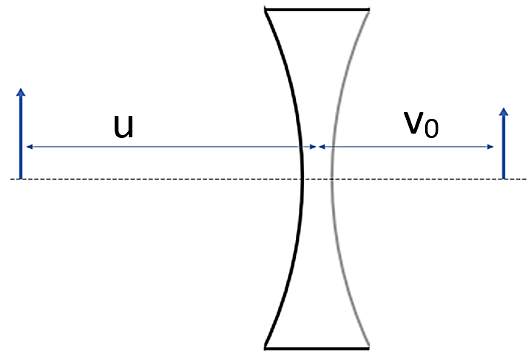
$\dfrac{n}{{{v}_{o}}}-\dfrac{1}{u}=\dfrac{n-1}{-R}$
Negative sign on R appears here because the radius of curvature is towards the left of the lens.
For the second reflection, ${{v}_{o}}$ will be the distance of the object and v will be the distance of image from the lens.
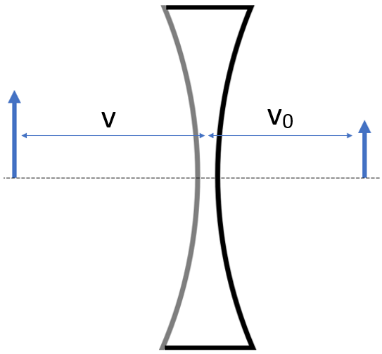
The equation will now be
\[\dfrac{1}{v}-\dfrac{n}{{{v}_{o}}}=\dfrac{1-n}{R}\].
If we add both these equations, we get the final equation as
$\begin{align}
& (\dfrac{n}{{{v}_{o}}}-\dfrac{1}{u}=\dfrac{n-1}{-R})+(\dfrac{1}{v}-\dfrac{n}{{{v}_{o}}}=\dfrac{1-n}{R}) \\
& \Rightarrow \dfrac{1}{v}-\dfrac{1}{u}=\dfrac{2(1-n)}{R} \\
\end{align}$
Then we have gotten a relation with v and u in it. However, we also need to include f. If you remember, if an object was at infinity its image will be formed at the focus of the lens. When we put $u=\infty $in this equation the $\dfrac{1}{u}$ term becomes zero and we get $\dfrac{1}{v}=\dfrac{2(1-n)}{R}$. Now here v must be equal to f so the quantity on the right of the equals to sign is the inverse of focal length. So, we get the final relation between v, u and f as $\dfrac{1}{v}-\dfrac{1}{u}=\dfrac{1}{f}$.
Note: The sign convention must be used properly when using these equations. Any sign convention can be chosen but it must remain the same throughout the calculations. Most commonly used and widely accepted sign convention is considering the object to the left of the lens as negative and to the right as positive. The focal length of a concave mirror is negative in this sign convention.
Formula used:
refraction at spherical surfaces
$\dfrac{{{n}_{2}}}{v}-\dfrac{{{n}_{1}}}{u}=\dfrac{{{n}_{2}}-{{n}_{1}}}{R}$
Complete step-by-step answer:
We will use the formula for refraction at spherical surfaces on the left side first. Here the medium 2 will be the glass of the lens and medium 1 will be air. Let ${{v}_{o}}$ be the distance of the image formed after the first refraction.
$\dfrac{n}{{{v}_{o}}}-\dfrac{1}{u}=\dfrac{n-1}{-R}$
Negative sign on R appears here because the radius of curvature is towards the left of the lens.
For the second reflection, ${{v}_{o}}$ will be the distance of the object and v will be the distance of image from the lens.
The equation will now be
\[\dfrac{1}{v}-\dfrac{n}{{{v}_{o}}}=\dfrac{1-n}{R}\].
If we add both these equations, we get the final equation as
$\begin{align}
& (\dfrac{n}{{{v}_{o}}}-\dfrac{1}{u}=\dfrac{n-1}{-R})+(\dfrac{1}{v}-\dfrac{n}{{{v}_{o}}}=\dfrac{1-n}{R}) \\
& \Rightarrow \dfrac{1}{v}-\dfrac{1}{u}=\dfrac{2(1-n)}{R} \\
\end{align}$
Then we have gotten a relation with v and u in it. However, we also need to include f. If you remember, if an object was at infinity its image will be formed at the focus of the lens. When we put $u=\infty $in this equation the $\dfrac{1}{u}$ term becomes zero and we get $\dfrac{1}{v}=\dfrac{2(1-n)}{R}$. Now here v must be equal to f so the quantity on the right of the equals to sign is the inverse of focal length. So, we get the final relation between v, u and f as $\dfrac{1}{v}-\dfrac{1}{u}=\dfrac{1}{f}$.
Note: The sign convention must be used properly when using these equations. Any sign convention can be chosen but it must remain the same throughout the calculations. Most commonly used and widely accepted sign convention is considering the object to the left of the lens as negative and to the right as positive. The focal length of a concave mirror is negative in this sign convention.
Recently Updated Pages
Explain the structure of megasporangium class 12 biology CBSE

Why is chloroform kept in dark coloured bottles class 12 chemistry CBSE
Derive the balancing condition of a Wheatstone bri class 12 physics CBSE
Draw VI characteristics of a pn junction diode Explain class 12 physics CBSE
Is it possible to carry pride in ones language too class 12 english CBSE
In a population at Hardy Weinberg equilibrium the allele class 12 biology CBSE
Trending doubts
Draw a labelled sketch of the human eye class 12 physics CBSE
Which are the Top 10 Largest Countries of the World?
Draw ray diagrams each showing i myopic eye and ii class 12 physics CBSE
One megawatt is equal to how many units of electri class 12 physics CBSE
Which is the correct genotypic ratio of mendel dihybrid class 12 biology CBSE
Give 10 examples of unisexual and bisexual flowers