




Epididymis is
(a) the network of sinuses between seminiferous tubules and vas efferentia
(b) the intermediate structure between rete testis and vas efferentia
(c) a long coiled tube between vasa efferentia and vas deferens
(d) the connection between vasa efferentia and seminal vesicles
Answer
 Verified
605.4k+ views
Hint: The passage of spermatozoa: seminiferous tubules $\rightarrow$ rete testis $\rightarrow$ vasa efferentia $\rightarrow$ epididymis $\rightarrow$ vas deferens $\rightarrow$ ejaculatory duct $\rightarrow$ urethra $\rightarrow$ penis
Complete step by step answer:
The seminiferous tubules present in the testis open into vasa efferentia through the rete testis. Vasa efferentia leaves the testis and epididymis which is a long, narrow, tightly coiled tube. Epididymis enters into a long, narrow, muscular tube called vas deferens.
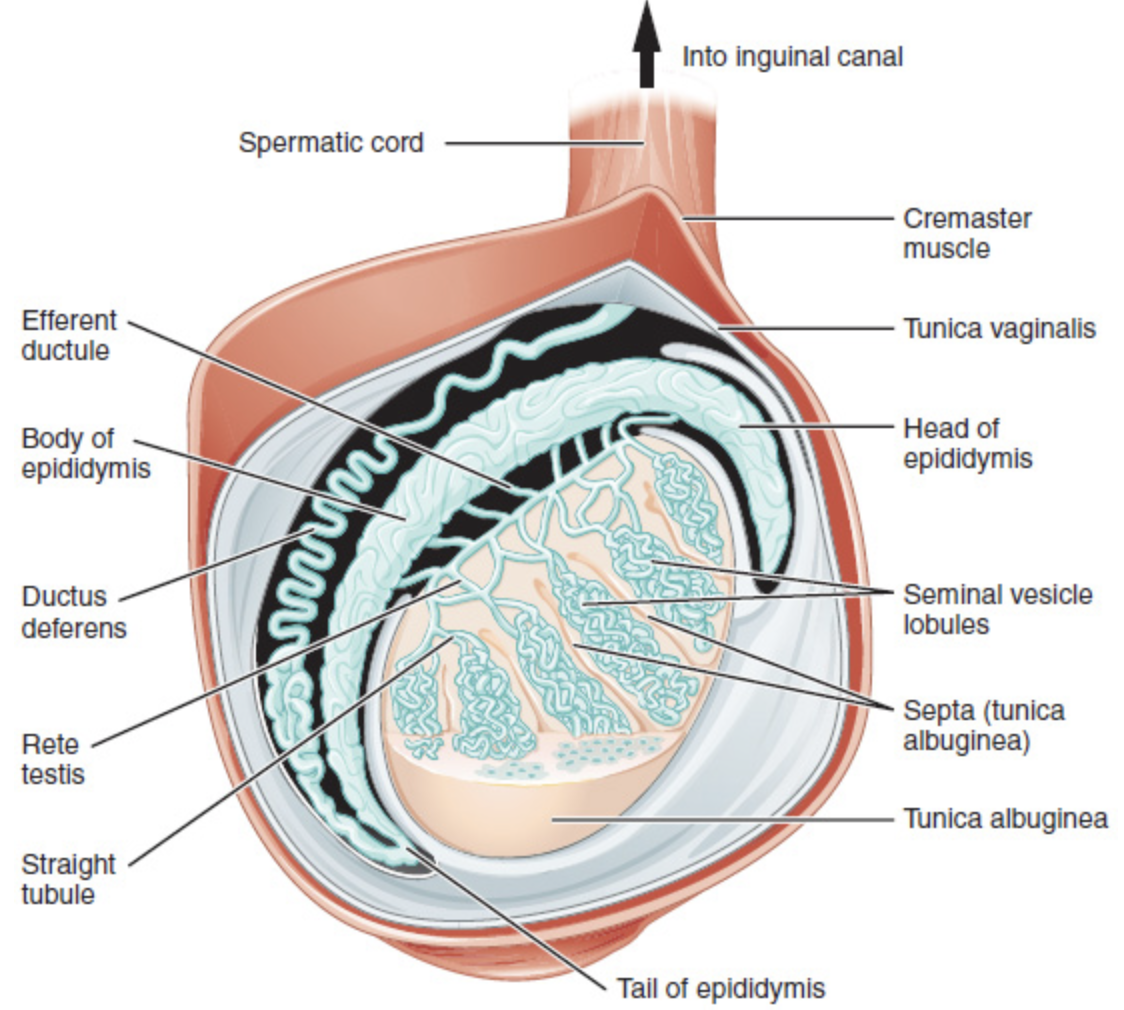
So, the correct answer is ‘a long coiled tube between vasa efferentia and vas deferens’.
Additional information:
- Epididymis is a comma-shaped organ that is 4cm long present along the posterior side of the testis.
- It is a long, coiled tube that has a large head, narrow midportion, and thin tail.
- Epididymis provides a space for storage of sperms and it also helps the sperms to mature.
- Epididymis is differentiated into three regions namely caput epididymis, corpus epididymis, and cauda epididymis. Caput epididymis, as it is a starting portion of the epididymis, it receives spermatozoa from seminal vesicles via vasa efferentia.
- A mass of connective tissue that covers the rete testis situated at the back of the testis is called mediastinum testis which is a part of vasa efferentia.
- Seminal vesicles open into vasa efferentia via rete testis which is a network of tubules in the testis.
- Spermatozoa produced in testis enter into vasa efferentia via rete testis. From there it enters into the caput epididymis which is the starting portion of the epididymis. From the epididymis, sperms enter into a long, narrow muscular tube called vas deferens. The epididymis is situated between vasa efferentia and vas deferens.
Note: Functionally, the epididymis is the site of sperm maturation. Maturation takes place in about 14 days. The epididymis keeps the sperm viable for up to several months. Any stored sperm that are not ejaculated by that time are eventually reabsorbed.
Complete step by step answer:
The seminiferous tubules present in the testis open into vasa efferentia through the rete testis. Vasa efferentia leaves the testis and epididymis which is a long, narrow, tightly coiled tube. Epididymis enters into a long, narrow, muscular tube called vas deferens.
So, the correct answer is ‘a long coiled tube between vasa efferentia and vas deferens’.
Additional information:
- Epididymis is a comma-shaped organ that is 4cm long present along the posterior side of the testis.
- It is a long, coiled tube that has a large head, narrow midportion, and thin tail.
- Epididymis provides a space for storage of sperms and it also helps the sperms to mature.
- Epididymis is differentiated into three regions namely caput epididymis, corpus epididymis, and cauda epididymis. Caput epididymis, as it is a starting portion of the epididymis, it receives spermatozoa from seminal vesicles via vasa efferentia.
- A mass of connective tissue that covers the rete testis situated at the back of the testis is called mediastinum testis which is a part of vasa efferentia.
- Seminal vesicles open into vasa efferentia via rete testis which is a network of tubules in the testis.
- Spermatozoa produced in testis enter into vasa efferentia via rete testis. From there it enters into the caput epididymis which is the starting portion of the epididymis. From the epididymis, sperms enter into a long, narrow muscular tube called vas deferens. The epididymis is situated between vasa efferentia and vas deferens.
Note: Functionally, the epididymis is the site of sperm maturation. Maturation takes place in about 14 days. The epididymis keeps the sperm viable for up to several months. Any stored sperm that are not ejaculated by that time are eventually reabsorbed.
Recently Updated Pages
Master Class 12 Business Studies: Engaging Questions & Answers for Success

Master Class 12 Biology: Engaging Questions & Answers for Success
Master Class 12 Chemistry: Engaging Questions & Answers for Success
Class 12 Question and Answer - Your Ultimate Solutions Guide
Master Class 11 Social Science: Engaging Questions & Answers for Success
Master Class 11 English: Engaging Questions & Answers for Success
Trending doubts
Which are the Top 10 Largest Countries of the World?
Draw a labelled sketch of the human eye class 12 physics CBSE
Differentiate between homogeneous and heterogeneous class 12 chemistry CBSE
Sulphuric acid is known as the king of acids State class 12 chemistry CBSE
Why is the cell called the structural and functional class 12 biology CBSE
Which is the correct genotypic ratio of mendel dihybrid class 12 biology CBSE