




Embryophyta includes
A) Hornworts
B) Liverworts
C) Mosses
D) All of the above
Answer
 Verified
633k+ views
Hint: The group of plants that provide nourishment to its sporophytes during their development phase within the gametophyte. They are also called the amphibians of the plant kingdom because they live on soil but need water for reproducing sexually.
Complete answer:
Hornworts, Liverworts, and Mosses are all included in Embryophytes. They all come under the category of Bryophyta. Bryophytes are commonly found in moist shaded areas in the hills.
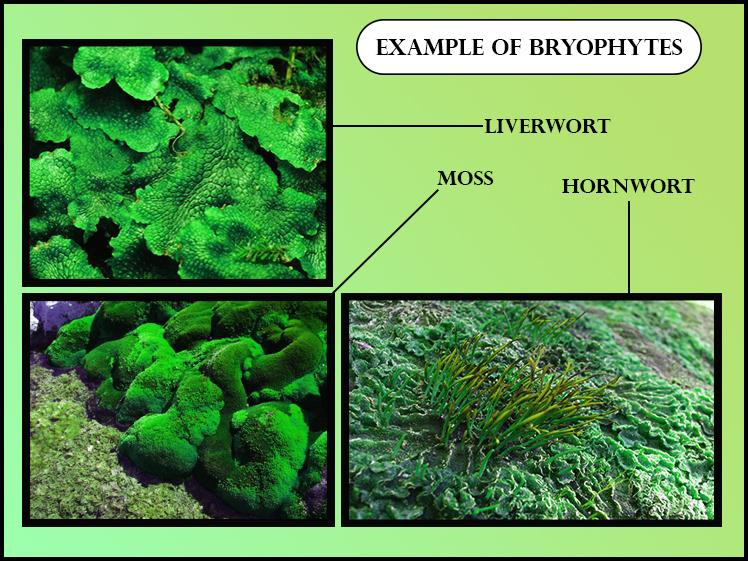
Additional Information:
Some general characters of the Bryophyta:
-They are found in both terrestrial and aquatic habitats.
-They show two morphologically different phases in their life also known as heteromorphic alternation of generation.
-These phases are the gametophyte phase which is the dominant and sporophytic phase which depends on the gametophyte for their nutritional requirements.
-The male sex organ is known as antheridium while the female sex organ is archegonium.
-The antheridium produces a large number of biflagellated male gametes.
-They are released in water and fuse with female gametes to form a zygote.
-The embryo of Bryophyta is divided into the foot, seta, and capsule.
-The formation of spores takes place in capsules and after dispersal, they form new plants.
So, the correct answer is ‘All of the above.’
Note:
-Sphagnum is a moss that provides peat that has been used as fuel, and as packing material for trans-shipment of living material because of their capacity to hold water.
-Gemmae are specialized structures that help Liverworts in asexual reproduction through fragmentation. Gemmae are green, multicellular, asexual buds, which develop in small receptacles called gemma cups located on the thalli.
-Moses exist in two stages in their life cycle, the first stage is protonema, and the second stage is the leafy stage.
Complete answer:
Hornworts, Liverworts, and Mosses are all included in Embryophytes. They all come under the category of Bryophyta. Bryophytes are commonly found in moist shaded areas in the hills.
Additional Information:
Some general characters of the Bryophyta:
-They are found in both terrestrial and aquatic habitats.
-They show two morphologically different phases in their life also known as heteromorphic alternation of generation.
-These phases are the gametophyte phase which is the dominant and sporophytic phase which depends on the gametophyte for their nutritional requirements.
-The male sex organ is known as antheridium while the female sex organ is archegonium.
-The antheridium produces a large number of biflagellated male gametes.
-They are released in water and fuse with female gametes to form a zygote.
-The embryo of Bryophyta is divided into the foot, seta, and capsule.
-The formation of spores takes place in capsules and after dispersal, they form new plants.
So, the correct answer is ‘All of the above.’
Note:
-Sphagnum is a moss that provides peat that has been used as fuel, and as packing material for trans-shipment of living material because of their capacity to hold water.
-Gemmae are specialized structures that help Liverworts in asexual reproduction through fragmentation. Gemmae are green, multicellular, asexual buds, which develop in small receptacles called gemma cups located on the thalli.
-Moses exist in two stages in their life cycle, the first stage is protonema, and the second stage is the leafy stage.
Recently Updated Pages
If x a + bt + ct2 where x is in meters and t is in class 11 physics CBSE

A car covers the first half distance between two places class 11 physics CBSE
The resultant of two vectors overrightarrow P and overrightarrow class 11 physics CBSE
Find the value of cos 135 class 11 maths CBSE
A mass M is held in place by an applied force F and class 11 physics CBSE
A solution of glucose in water is labelled as 10 dfracwv class 11 chemistry CBSE
Trending doubts
Find the value of the expression given below sin 30circ class 11 maths CBSE
One Metric ton is equal to kg A 10000 B 1000 C 100 class 11 physics CBSE
Draw a diagram of nephron and explain its structur class 11 biology CBSE
10 examples of friction in our daily life
Proton was discovered by A Thomson B Rutherford C Chadwick class 11 chemistry CBSE
Bond order ofO2 O2+ O2 and O22 is in order A O2 langle class 11 chemistry CBSE