




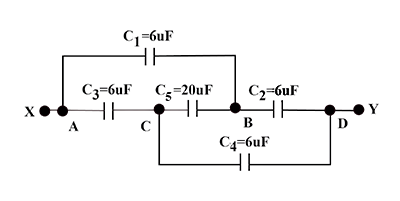
What is the effective capacitance between points X and Y?
${\text{A}}{\text{. 24}}\mu F$
${\text{B}}{\text{. 18}}\mu F$
${\text{C}}{\text{. 12}}\mu F$
${\text{D}}{\text{. 6}}\mu F$
Answer
 Verified
650.4k+ views
- Hint – The given circuit is a Wheatstone bridge circuit and here $\dfrac{{{C_1}}}{{{C_3}}} = \dfrac{{{C_2}}}{{{C_4}}}$ . Thus, no charge flows through the capacitor ${C_5} = 20\mu F$ . Use this to solve the question.
Formula used - $\dfrac{{{C_1}}}{{{C_3}}} = \dfrac{{{C_2}}}{{{C_4}}}$ , ${C_{13}} = \dfrac{{{C_1} \times {C_3}}}{{{C_1} + {C_3}}}$ , ${C_{24}} = \dfrac{{{C_2} \times {C_4}}}{{{C_2} + {C_4}}}$ , ${C_{XY}} = {C_{13}} + {C_{24}}$
Complete step-by-step solution -
The circuit given in the question is a Wheatstone bridge circuit and here $\dfrac{{{C_1}}}{{{C_3}}} = \dfrac{{{C_2}}}{{{C_4}}}$ . Also, no charge flows through the capacitor ${C_5} = 20\mu F$ .
Drawing the equivalent circuit-
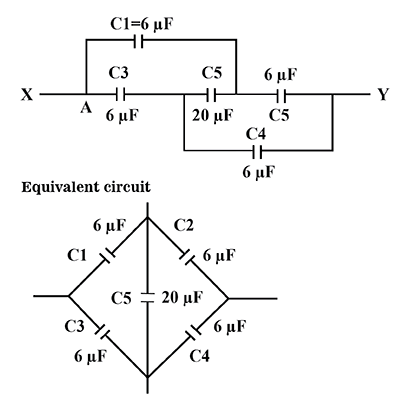
Now, we can see that C1 and C3 are in series, so the equivalent capacitance will be-
${C_{13}} = \dfrac{{{C_1} \times {C_3}}}{{{C_1} + {C_3}}}$
Putting the values of ${C_1} = 6\mu F,{C_3} = 6\mu F$ , we get-
${C_{13}} = \dfrac{{6 \times 6}}{{6 + 6}} = 3\mu F$
Also, C2 and C4 are in series, so the equivalent capacitance will be-
${C_{24}} = \dfrac{{{C_2} \times {C_4}}}{{{C_2} + {C_4}}}$
Putting the values of ${C_2} = 6\mu F,{C_4} = 6\mu F$ , we get-
${C_{24}} = \dfrac{{6 \times 6}}{{6 + 6}} = 3\mu F$
Now, ${C_{13}}$ and ${C_{24}}$ are in parallel, so now the equivalent of this combination will give us the capacitance between the points X and Y.
So, finding the value of the capacitance between X and Y.
${C_{XY}} = {C_{13}} + {C_{24}}$
putting the values, we get-
${C_{XY}} = 3 + 3 = 6\mu F$
Therefore, the effective capacitance between points X and Y is $6\mu F$ .
Hence, the correct option is D.
Note- Whenever solving such types of questions, first draw the equivalent circuit which makes it easier to solve. Also, as mentioned in the solution, the given circuit is a Wheatstone bridge circuit, so as we know, a Wheatstone bridge is an electrical circuit used to measure an unknown capacitance by balancing two legs of a bridge circuit, one leg of which includes the unknown. So, using this concept we have found out the capacitance between the given points.
Formula used - $\dfrac{{{C_1}}}{{{C_3}}} = \dfrac{{{C_2}}}{{{C_4}}}$ , ${C_{13}} = \dfrac{{{C_1} \times {C_3}}}{{{C_1} + {C_3}}}$ , ${C_{24}} = \dfrac{{{C_2} \times {C_4}}}{{{C_2} + {C_4}}}$ , ${C_{XY}} = {C_{13}} + {C_{24}}$
Complete step-by-step solution -
The circuit given in the question is a Wheatstone bridge circuit and here $\dfrac{{{C_1}}}{{{C_3}}} = \dfrac{{{C_2}}}{{{C_4}}}$ . Also, no charge flows through the capacitor ${C_5} = 20\mu F$ .
Drawing the equivalent circuit-
Now, we can see that C1 and C3 are in series, so the equivalent capacitance will be-
${C_{13}} = \dfrac{{{C_1} \times {C_3}}}{{{C_1} + {C_3}}}$
Putting the values of ${C_1} = 6\mu F,{C_3} = 6\mu F$ , we get-
${C_{13}} = \dfrac{{6 \times 6}}{{6 + 6}} = 3\mu F$
Also, C2 and C4 are in series, so the equivalent capacitance will be-
${C_{24}} = \dfrac{{{C_2} \times {C_4}}}{{{C_2} + {C_4}}}$
Putting the values of ${C_2} = 6\mu F,{C_4} = 6\mu F$ , we get-
${C_{24}} = \dfrac{{6 \times 6}}{{6 + 6}} = 3\mu F$
Now, ${C_{13}}$ and ${C_{24}}$ are in parallel, so now the equivalent of this combination will give us the capacitance between the points X and Y.
So, finding the value of the capacitance between X and Y.
${C_{XY}} = {C_{13}} + {C_{24}}$
putting the values, we get-
${C_{XY}} = 3 + 3 = 6\mu F$
Therefore, the effective capacitance between points X and Y is $6\mu F$ .
Hence, the correct option is D.
Note- Whenever solving such types of questions, first draw the equivalent circuit which makes it easier to solve. Also, as mentioned in the solution, the given circuit is a Wheatstone bridge circuit, so as we know, a Wheatstone bridge is an electrical circuit used to measure an unknown capacitance by balancing two legs of a bridge circuit, one leg of which includes the unknown. So, using this concept we have found out the capacitance between the given points.
Recently Updated Pages
Master Class 12 Business Studies: Engaging Questions & Answers for Success

Master Class 12 Chemistry: Engaging Questions & Answers for Success
Master Class 12 Biology: Engaging Questions & Answers for Success
Class 12 Question and Answer - Your Ultimate Solutions Guide
Master Class 11 English: Engaging Questions & Answers for Success
Master Class 11 Social Science: Engaging Questions & Answers for Success
Trending doubts
Which are the Top 10 Largest Countries of the World?
Draw a labelled sketch of the human eye class 12 physics CBSE
The end of compass needle which points towards north class 12 physics CBSE
Differentiate between homogeneous and heterogeneous class 12 chemistry CBSE
Why is the cell called the structural and functional class 12 biology CBSE
When was the first election held in India a 194748 class 12 sst CBSE