




During the manufacture of cast iron, the slag \[\left( {CaSi{O_3}} \right)\] is formed in:
A.Zone of fusion only
B.Zone of reduction and Zone of fusion
C.Zone of heat absorption
D.Zone of reduction only
Answer
 Verified
587.4k+ views
Hint: The solution of the problem is revolving about the Blast furnace for the manufacture of iron. The temperature in a blast furnace varies from ${1600^0}C$ to \[{250^0}C\] from bottom to top. The temperature increases from top to bottom. Due to this variation in temperature range, four different zones are formed where different chemical changes occur.
Complete step by step answer:
The shape of the blast furnace is a huge cylindrical furnace almost $30m$ in height and $5m$ in diameter. The process is as follows the blast furnace is heated with a blast of air and due to the variation in temperature four zones are created where different chemical changes occur. These four changes are as follows:
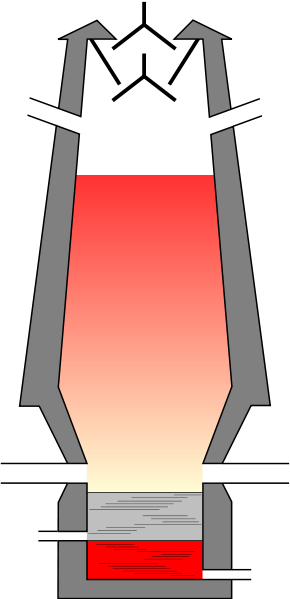
First zone is zone of fusion. In this zone temperature remains between $({1200^0} - {1500^0}C)$. In this zone the iron gets fused and appear in hearth while the slag floats.
Second zone is the zone of combustion. Zone of combustion is present in the lower part of the blast furnace and in this zone the temperature range is about $({1500^0} - {1600^0}C)$. As this zone is of combustion, carbon gets burned in presence of air and produces carbon dioxide and large amounts of heat.
$C + {O_2} \to C{O_2} + 97.0Kcal$
After that carbon dioxide produced in the zone rises up and reacts with hot coke $\left( C \right)$ and produces carbon monoxide.
$C{O_2} + C\xrightarrow{{{{1500}^0}C}}2CO$
Third zone is the zone of reduction. This zone is the upper most part of the blast furnace where temperature range varies from $({250^0} - {700^0}C)$. In this zone ore is reduced to iron as follows:
$3F{e_2}{O_3} + CO\xrightarrow{{300 - {{400}^0}C}}2F{e_3}{O_4} + C{O_2}$
$F{e_3}{O_4} + CO\xrightarrow{{500 - {{600}^0}C}}3FeO + C{O_2}$
$F{e_3}{O_4} + 4CO \to 3Fe + 4C{O_2}$
Fourth Zone is the zone of heat absorption. This zone is also called the middle zone or zone of slag formation of blast furnaces and the temperature range in this zone is $({800^0} - {1000^0}C)$. The slag is formed as follows:
$CaO + Si{O_3} \to CaSi{O_3}$
Final Result: From above four zones we can easily conclude that the slag \[\left( {CaSi{O_3}} \right)\] is formed in a zone of heat absorption.
Therefore, the correct option is (C).
Note:The most important thing to note here is that Zone of heat absorption is also called lower zone of reduction. So there may be an option given in the question that slag \[\left( {CaSi{O_3}} \right)\] is formed in the zone of heat of absorption and zone of reduction.
Complete step by step answer:
The shape of the blast furnace is a huge cylindrical furnace almost $30m$ in height and $5m$ in diameter. The process is as follows the blast furnace is heated with a blast of air and due to the variation in temperature four zones are created where different chemical changes occur. These four changes are as follows:
First zone is zone of fusion. In this zone temperature remains between $({1200^0} - {1500^0}C)$. In this zone the iron gets fused and appear in hearth while the slag floats.
Second zone is the zone of combustion. Zone of combustion is present in the lower part of the blast furnace and in this zone the temperature range is about $({1500^0} - {1600^0}C)$. As this zone is of combustion, carbon gets burned in presence of air and produces carbon dioxide and large amounts of heat.
$C + {O_2} \to C{O_2} + 97.0Kcal$
After that carbon dioxide produced in the zone rises up and reacts with hot coke $\left( C \right)$ and produces carbon monoxide.
$C{O_2} + C\xrightarrow{{{{1500}^0}C}}2CO$
Third zone is the zone of reduction. This zone is the upper most part of the blast furnace where temperature range varies from $({250^0} - {700^0}C)$. In this zone ore is reduced to iron as follows:
$3F{e_2}{O_3} + CO\xrightarrow{{300 - {{400}^0}C}}2F{e_3}{O_4} + C{O_2}$
$F{e_3}{O_4} + CO\xrightarrow{{500 - {{600}^0}C}}3FeO + C{O_2}$
$F{e_3}{O_4} + 4CO \to 3Fe + 4C{O_2}$
Fourth Zone is the zone of heat absorption. This zone is also called the middle zone or zone of slag formation of blast furnaces and the temperature range in this zone is $({800^0} - {1000^0}C)$. The slag is formed as follows:
$CaO + Si{O_3} \to CaSi{O_3}$
Final Result: From above four zones we can easily conclude that the slag \[\left( {CaSi{O_3}} \right)\] is formed in a zone of heat absorption.
Therefore, the correct option is (C).
Note:The most important thing to note here is that Zone of heat absorption is also called lower zone of reduction. So there may be an option given in the question that slag \[\left( {CaSi{O_3}} \right)\] is formed in the zone of heat of absorption and zone of reduction.
Recently Updated Pages
Master Class 12 Social Science: Engaging Questions & Answers for Success

Master Class 12 Physics: Engaging Questions & Answers for Success
Master Class 12 Maths: Engaging Questions & Answers for Success
Master Class 12 Economics: Engaging Questions & Answers for Success
Master Class 12 Chemistry: Engaging Questions & Answers for Success
Master Class 12 Business Studies: Engaging Questions & Answers for Success
Trending doubts
Which are the Top 10 Largest Countries of the World?
Draw a labelled sketch of the human eye class 12 physics CBSE
Explain the structure of megasporangium class 12 biology CBSE
What are the major means of transport Explain each class 12 social science CBSE
How many chromosomes are found in human ovum a 46 b class 12 biology CBSE
The diagram of the section of a maize grain is given class 12 biology CBSE