




During the cell cycle, RNA and protein synthesis takes place during which of the following phase
(a) ${ G }_{ 1 }$ and ${ G }_{ 2 }$
(b) S phase
(c) M phase
(d) Cytokinesis
Answer
 Verified
625.2k+ views
Hint: It is the first phase of the cell cycle which occurs in the eukaryotic organisms. In this phase, metabolic changes take place that prepares the cell for division. After this cell enters the S phase.
Complete step by step answer:
${ G }_{ 1 }$ is also known as the Gap 1 phase while Gap 2 is also known as${ G }_{ 2 }$ phase They are the first stage, the last phase which occurs in the cell cycle. In these stages, the cells synthesize mRNA and proteins and prepare the cell for the cell cycle and check whether the cells are ready to divide yet.
So, the correct answer is ‘${ G }_{ 1 }$’.
Additional information:
- The cell cycle is so known as the cell division, where one of the cells divides to form two daughter cells.
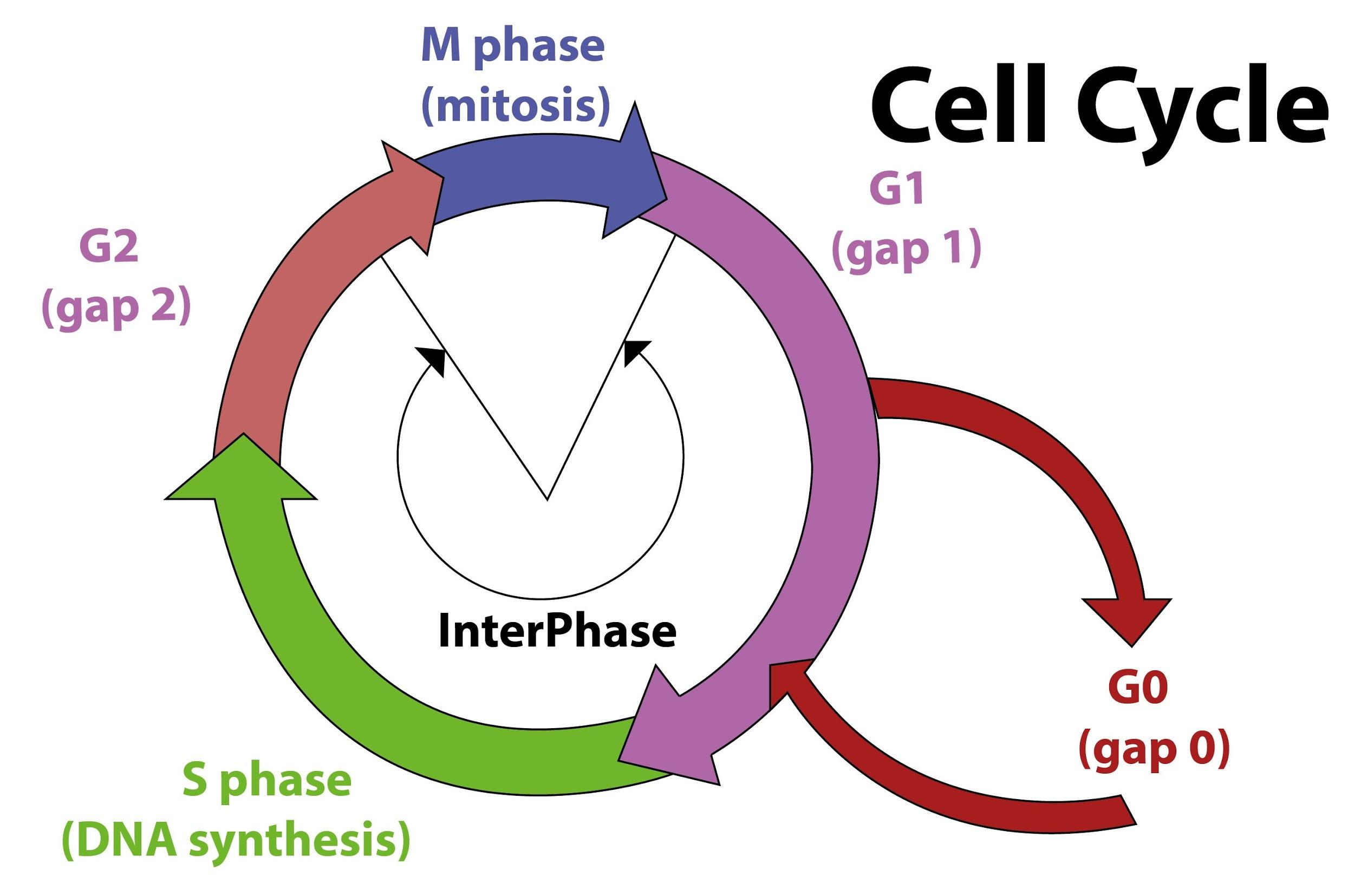
- The cell cycle has two important phases: interphase, and mitotic (M) phase.
- The eukaryotic interphase four main phases, ${ G }_{ 1 }$, A phase, ${ G }_{ 2 }$, and mitotic phase.
- All three phases ${ G }_{ 1 }$, A phase, and ${ G }_{ 2 }$ together constitute interphase.
- ${ G }_{ 1 }$ helps in the synthesis of the mRNA and proteins resulting in the meiosis.
- This phase is responsible for checking the preparation of the cell to undergo cell cycle.
- After this phase, the cells will start its replication when it enters the S-phase.
Note: For checking whether the cell is prepared, the ${ G }_{ 2 }$ phase is responsible before the cell enters the mitotic phase. This phase is also called the growth phase. The process of division of cells that results in the formation of two daughter cells is called the mitotic phase. This phase is also called the chromosome separation phase. Howard and Pelc were the first to describe the cell cycle.
Complete step by step answer:
${ G }_{ 1 }$ is also known as the Gap 1 phase while Gap 2 is also known as${ G }_{ 2 }$ phase They are the first stage, the last phase which occurs in the cell cycle. In these stages, the cells synthesize mRNA and proteins and prepare the cell for the cell cycle and check whether the cells are ready to divide yet.
So, the correct answer is ‘${ G }_{ 1 }$’.
Additional information:
- The cell cycle is so known as the cell division, where one of the cells divides to form two daughter cells.
- The cell cycle has two important phases: interphase, and mitotic (M) phase.
- The eukaryotic interphase four main phases, ${ G }_{ 1 }$, A phase, ${ G }_{ 2 }$, and mitotic phase.
- All three phases ${ G }_{ 1 }$, A phase, and ${ G }_{ 2 }$ together constitute interphase.
- ${ G }_{ 1 }$ helps in the synthesis of the mRNA and proteins resulting in the meiosis.
- This phase is responsible for checking the preparation of the cell to undergo cell cycle.
- After this phase, the cells will start its replication when it enters the S-phase.
Note: For checking whether the cell is prepared, the ${ G }_{ 2 }$ phase is responsible before the cell enters the mitotic phase. This phase is also called the growth phase. The process of division of cells that results in the formation of two daughter cells is called the mitotic phase. This phase is also called the chromosome separation phase. Howard and Pelc were the first to describe the cell cycle.
Recently Updated Pages
The given figure shows two endocrine glands marked class 11 biology NEET_UG

Match columnI with columnII and select the correct class 11 biology NEET
Match column I with column II and select the correct class 11 biology NEET_UG
Which floral family has left 9 right + 1 arrangement class 11 biology NEET_UG
Which is not a variety of sheep A Lohi B Beetal C Nellore class 11 biology NEET_UG
Match column I with column II and select the correct class 11 biology NEET_UG
Trending doubts
One Metric ton is equal to kg A 10000 B 1000 C 100 class 11 physics CBSE
What is cell theory Who formulated it class 11 biology CBSE
Phyllotaxy is the arrangement of ALeaflets BLeaves class 11 biology CBSE
Difference Between Prokaryotic Cells and Eukaryotic Cells
The symbiotic association of fungi and algae is called class 11 biology CBSE
Cell theory was formulated by A Schleiden and Schwann class 11 biology CBSE