




During a coordinate bond formation:
a.) One electron from an atom is transferred to other
b.) One electron is lost from both the atoms
c.) A pair of electrons are contributed by one atom and shared by both the atoms
d.) A pair of electrons are transferred to the other atom
Answer
 Verified
661.8k+ views
Hint: A coordinate bond is a covalent bond formed between two atoms in which the shared pair of electrons is contributed by only one of the atoms.
Complete answer:
A coordinate bond is a type of covalent bond formed between two species in which a shared pair of electrons is denoted by one species only but shared by both species. It is also known as a dative bond.
For example:
${ NH }_{ 3 }$ shares the pair of electrons present on Nitrogen with ${ BF }_{ 3 }$, which is electron deficient.
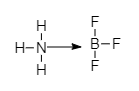
Hence when in a bond between two species both the electrons are donated by one atom (unlike a covalent bond in which both the atoms donate one electron each), the bond will be a coordinate bond. The coordinate bond is denoted by an arrow from the donor atom of the electron-donating species to the acceptor atom of the electron-deficient species.
So, the correct answer is “Option C”.
Additional Information: Characteristics of Co-ordinate bond:
In this kind of bonding, the molecule that shares an electron pair from itself is named as the donor.
The other ion which acknowledges these common pairs of electrons is known as a receptor or acceptor.
The bond is shown with an arrow → pointing towards the acceptor from the donator.
Subsequent to the sharing of the electron pair every ion gets stability.
This sort of bonding is integral to the Lewis Theory.
Getting a decent comprehension of the coordination bonds can help inappropriately structuring complex organic particles.
Note: The possibility to make a mistake is that you may choose option A. But one electron from an atom is transferred to another is known as an ionic bond, not a coordinate bond.
Complete answer:
A coordinate bond is a type of covalent bond formed between two species in which a shared pair of electrons is denoted by one species only but shared by both species. It is also known as a dative bond.
For example:
${ NH }_{ 3 }$ shares the pair of electrons present on Nitrogen with ${ BF }_{ 3 }$, which is electron deficient.
Hence when in a bond between two species both the electrons are donated by one atom (unlike a covalent bond in which both the atoms donate one electron each), the bond will be a coordinate bond. The coordinate bond is denoted by an arrow from the donor atom of the electron-donating species to the acceptor atom of the electron-deficient species.
So, the correct answer is “Option C”.
Additional Information: Characteristics of Co-ordinate bond:
In this kind of bonding, the molecule that shares an electron pair from itself is named as the donor.
The other ion which acknowledges these common pairs of electrons is known as a receptor or acceptor.
The bond is shown with an arrow → pointing towards the acceptor from the donator.
Subsequent to the sharing of the electron pair every ion gets stability.
This sort of bonding is integral to the Lewis Theory.
Getting a decent comprehension of the coordination bonds can help inappropriately structuring complex organic particles.
Note: The possibility to make a mistake is that you may choose option A. But one electron from an atom is transferred to another is known as an ionic bond, not a coordinate bond.
Recently Updated Pages
If x a + bt + ct2 where x is in meters and t is in class 11 physics CBSE

A car covers the first half distance between two places class 11 physics CBSE
The resultant of two vectors overrightarrow P and overrightarrow class 11 physics CBSE
Find the value of cos 135 class 11 maths CBSE
A mass M is held in place by an applied force F and class 11 physics CBSE
A solution of glucose in water is labelled as 10 dfracwv class 11 chemistry CBSE
Trending doubts
Find the value of the expression given below sin 30circ class 11 maths CBSE
One Metric ton is equal to kg A 10000 B 1000 C 100 class 11 physics CBSE
Draw a diagram of nephron and explain its structur class 11 biology CBSE
10 examples of friction in our daily life
Proton was discovered by A Thomson B Rutherford C Chadwick class 11 chemistry CBSE
Bond order ofO2 O2+ O2 and O22 is in order A O2 langle class 11 chemistry CBSE