




Draw the well labelled diagram of the internal structure of the human heart.
Answer
 Verified
647.4k+ views
Hint:Heart is the main organ of the circulatory system. It is the main organ which supplies oxygenated blood to the whole body.
Complete answer:
Human heart is a muscular organ made up of cardiac muscles situated between the two lungs. It is well protected by a membrane called the pericardium.
Four chambers of heart- The left and right atrium (upper chamber) and the left and right ventricles (lower chamber). The two atriums are the receiving chambers for the blood entering the heart. The ventricles are thicker as they have to pump the blood away from the heart. In between the left ventricle and atrium, two cusp valves are present called the mitral valve and in between the right atrium and ventricle, three cusp tricuspid valves are present which prevents the backflow of the blood.
>Aorta- It is the main artery that carries oxygenated blood away from the heart to the entire body. It is guarded by aortic valves.
>Pulmonary artery- It carries deoxygenated blood from right ventricles to the lungs for oxygenation.
>Pulmonary vein- It carries oxygenated blood from lungs to the heart.
>Superior vena cava- It carries the deoxygenated blood from the upper half of the body to the right atrium of the heart.
>Inferior vena cava- It is a vein that carries deoxygenated blood from the lower end of the body to the right atrium of the heart.
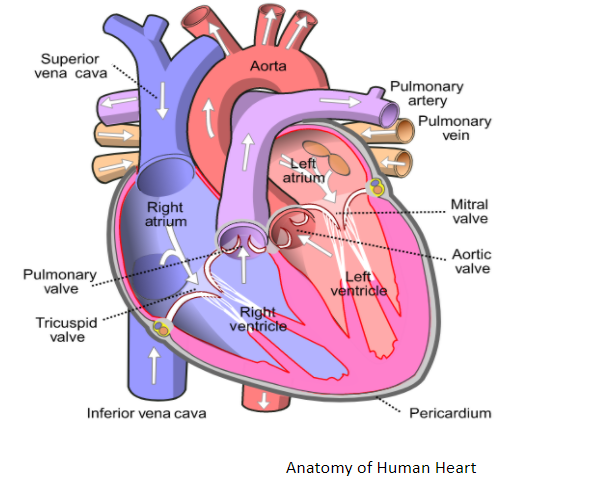
Note: Human heart is a four chambered organ which pumps blood throughout the body. The right side of the heart deals with deoxygenated blood (blue colour in the above fig.) and the left side deals with oxygenated blood (red colour in the fig.)
Complete answer:
Human heart is a muscular organ made up of cardiac muscles situated between the two lungs. It is well protected by a membrane called the pericardium.
Four chambers of heart- The left and right atrium (upper chamber) and the left and right ventricles (lower chamber). The two atriums are the receiving chambers for the blood entering the heart. The ventricles are thicker as they have to pump the blood away from the heart. In between the left ventricle and atrium, two cusp valves are present called the mitral valve and in between the right atrium and ventricle, three cusp tricuspid valves are present which prevents the backflow of the blood.
>Aorta- It is the main artery that carries oxygenated blood away from the heart to the entire body. It is guarded by aortic valves.
>Pulmonary artery- It carries deoxygenated blood from right ventricles to the lungs for oxygenation.
>Pulmonary vein- It carries oxygenated blood from lungs to the heart.
>Superior vena cava- It carries the deoxygenated blood from the upper half of the body to the right atrium of the heart.
>Inferior vena cava- It is a vein that carries deoxygenated blood from the lower end of the body to the right atrium of the heart.
Note: Human heart is a four chambered organ which pumps blood throughout the body. The right side of the heart deals with deoxygenated blood (blue colour in the above fig.) and the left side deals with oxygenated blood (red colour in the fig.)
Recently Updated Pages
Master Class 12 Economics: Engaging Questions & Answers for Success

Master Class 12 Social Science: Engaging Questions & Answers for Success
Master Class 12 English: Engaging Questions & Answers for Success
Master Class 12 Maths: Engaging Questions & Answers for Success
Master Class 12 Physics: Engaging Questions & Answers for Success
Master Class 12 Biology: Engaging Questions & Answers for Success
Trending doubts
Draw a labelled sketch of the human eye class 12 physics CBSE
Which are the Top 10 Largest Countries of the World?
Draw ray diagrams each showing i myopic eye and ii class 12 physics CBSE
Which is the correct genotypic ratio of mendel dihybrid class 12 biology CBSE
Differentiate between homogeneous and heterogeneous class 12 chemistry CBSE
Which animal never drinks water in its entire life class 12 biology CBSE