




Draw the Block diagram of the communication system and names its main components.
Answer
 Verified
587.8k+ views
Hint: Block diagram of a general communication represents the different functional elements in the form of blocks and the direction of connection.
Complete step by step answer:
Communication is basically a process of establishing a connection for the information exchange between two points.
Below is a block diagram of communication system with its main components:
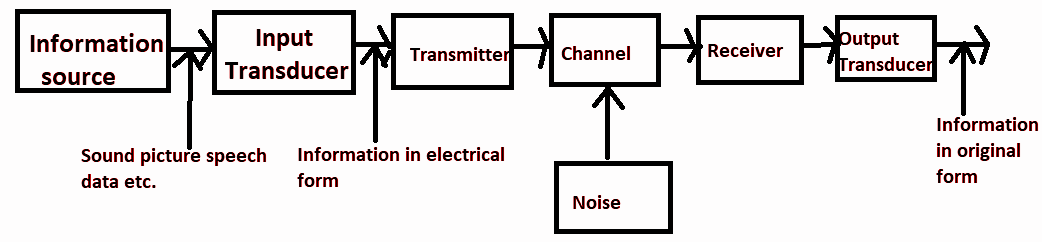
The essential components of a communication system are information source, input transducer, transmitter, communication channel, receiver and destination.
Information source:
Communication systems basically serve to communicate a message and this is in the form of a word, group of words, code or symbol and out of all these a desired message is to be communicated and therefore this is the function of an information source to produce the required message which has to be transmitted.
Input transducer:
Its main function is the conversion of one form of energy into another form, actually in a case if the message produced by an information source is not in electrical nature then an input transducer converts it in the form of an electric signal.
Transmitter:
This is used to process the electrical signal from different aspects means the processing of signals like restriction of range of audio frequencies, amplification and modulation of signal in order to ease the transmission of signal through the channel.
The channel and the noise:
Channel means the medium through which message travels from transmitter to receiver or we can say it provides a physical connection between the transmitter and receiver.
Channels are of two types, one is point to point for example wire lines, microwave links and optical fibers and other is broadcast channel which provides a capability where several receiving stations can be reached simultaneously from a single transmitter for example a satellite in geostationary orbit which covers about one third of earth's surface.
Receiver:
The purpose of the receiver is to reproduce the message signal in electrical form from the distorted received signal.
Destination:
Now destination is the last stage where the electrical message signal is converted into its original form like in radio broadcasting the destination is a loudspeaker who works as a transducer means it converts the electrical signal in the form of original sound signal.
Note: Examples of communication systems are line telephony & line telegraphy, radio telephony & radio telegraphy, radio broadcasting, mobile communication, television broadcasting, computer communication and radar communication etc.
Complete step by step answer:
Communication is basically a process of establishing a connection for the information exchange between two points.
Below is a block diagram of communication system with its main components:
The essential components of a communication system are information source, input transducer, transmitter, communication channel, receiver and destination.
Information source:
Communication systems basically serve to communicate a message and this is in the form of a word, group of words, code or symbol and out of all these a desired message is to be communicated and therefore this is the function of an information source to produce the required message which has to be transmitted.
Input transducer:
Its main function is the conversion of one form of energy into another form, actually in a case if the message produced by an information source is not in electrical nature then an input transducer converts it in the form of an electric signal.
Transmitter:
This is used to process the electrical signal from different aspects means the processing of signals like restriction of range of audio frequencies, amplification and modulation of signal in order to ease the transmission of signal through the channel.
The channel and the noise:
Channel means the medium through which message travels from transmitter to receiver or we can say it provides a physical connection between the transmitter and receiver.
Channels are of two types, one is point to point for example wire lines, microwave links and optical fibers and other is broadcast channel which provides a capability where several receiving stations can be reached simultaneously from a single transmitter for example a satellite in geostationary orbit which covers about one third of earth's surface.
Receiver:
The purpose of the receiver is to reproduce the message signal in electrical form from the distorted received signal.
Destination:
Now destination is the last stage where the electrical message signal is converted into its original form like in radio broadcasting the destination is a loudspeaker who works as a transducer means it converts the electrical signal in the form of original sound signal.
Note: Examples of communication systems are line telephony & line telegraphy, radio telephony & radio telegraphy, radio broadcasting, mobile communication, television broadcasting, computer communication and radar communication etc.
Recently Updated Pages
Write any three differences between metals and nonmetals class 10 social science CBSE

Amit standing on a horizontal plane finds a bird flying class 10 maths CBSE
Two circles of radii 5 cm and 3 cm intersect at two class 10 maths CBSE
Solve the following i John and Jivanti together have class 10 maths CBSE
What is the relation between orthocenter circumcentre class 10 maths CBSE
Two plane mirrors are inclined at 70circ A ray incident class 10 physics CBSE
Trending doubts
Explain the Treaty of Vienna of 1815 class 10 social science CBSE
Which country is known as "The land of Fire and Ice"?
1 GB equals how many MB?
10 examples of evaporation in daily life with explanations
What is the full form of POSCO class 10 social science CBSE
Make a sketch of the human nerve cell What function class 10 biology CBSE