




Draw phasor diagram of $ LCR $ series AC circuit.
Answer
 Verified
580.8k+ views
Hint :In order to solve this question, we are going to first take the circuit for the $ LCR $ series combination. Then, by considering the voltage elements across each and their directions, we can plot the phasor diagrams for the resistance, inductance and the capacitance elements.
Complete Step By Step Answer:
An $ LCR $ series AC circuit is a circuit that consists of a pure resistance of $ R $ ohms, a pure inductance of $ L $ Henry and a pure capacitance $ C $ farads, all connected in series in the circuit. As these elements are connected in series, so the current through each element of the circuit is the same as the total current $ I $ flowing in the circuit.
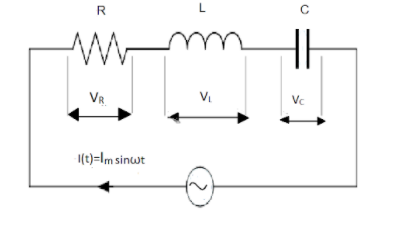
The current relation for this circuit is given by
$ I\left( t \right) = {I_m}\sin \omega t $
In order to draw the phase diagram, we use the following facts:
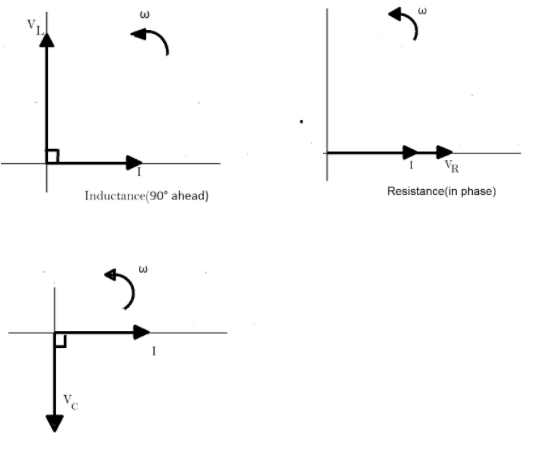
(1) The instantaneous voltage across the pure resistance $ R $ , is $ {V_R} $ which is in phase with the applied current.
(2) The instantaneous voltage across the pure inductance $ L $ , is $ {V_L} $ which is $ {90^ \circ } $ ahead of the current.
(3) The instantaneous voltage across the pure inductance $ C $ is $ {V_C} $ which lags the current by $ {90^ \circ } $ .
Thus, the phasor diagram for the circuit can be drawn to depict these voltages as:
Note :
We cannot simply add the voltages $ {V_R} $ , $ {V_L} $ and $ {V_C} $ together to find the support voltage, $ {V_S} $ across all the three components as three voltage vectors point in different directions with regards to the current vector. Therefore, we will have to find the supply voltage as the phasor sum of all the three component voltages together vectorially.
Complete Step By Step Answer:
An $ LCR $ series AC circuit is a circuit that consists of a pure resistance of $ R $ ohms, a pure inductance of $ L $ Henry and a pure capacitance $ C $ farads, all connected in series in the circuit. As these elements are connected in series, so the current through each element of the circuit is the same as the total current $ I $ flowing in the circuit.
The current relation for this circuit is given by
$ I\left( t \right) = {I_m}\sin \omega t $
In order to draw the phase diagram, we use the following facts:
(1) The instantaneous voltage across the pure resistance $ R $ , is $ {V_R} $ which is in phase with the applied current.
(2) The instantaneous voltage across the pure inductance $ L $ , is $ {V_L} $ which is $ {90^ \circ } $ ahead of the current.
(3) The instantaneous voltage across the pure inductance $ C $ is $ {V_C} $ which lags the current by $ {90^ \circ } $ .
Thus, the phasor diagram for the circuit can be drawn to depict these voltages as:
Note :
We cannot simply add the voltages $ {V_R} $ , $ {V_L} $ and $ {V_C} $ together to find the support voltage, $ {V_S} $ across all the three components as three voltage vectors point in different directions with regards to the current vector. Therefore, we will have to find the supply voltage as the phasor sum of all the three component voltages together vectorially.
Recently Updated Pages
Master Class 5 English: Engaging Questions & Answers for Success

Master Class 5 Maths: Engaging Questions & Answers for Success
Master Class 5 Social Science: Engaging Questions & Answers for Success
Master Class 5 Science: Engaging Questions & Answers for Success
Class 5 Question and Answer - Your Ultimate Solutions Guide
Master Class 9 General Knowledge: Engaging Questions & Answers for Success
Trending doubts
Which are the Top 10 Largest Countries of the World?
The total number of vertebrae in man is a30 b31 c32 class 12 biology CBSE
Draw a labelled sketch of the human eye class 12 physics CBSE
The number of cranial nerves in a frog is A 10 pairs class 12 biology CBSE
Differentiate between homogeneous and heterogeneous class 12 chemistry CBSE
Differentiate between Pyramid of energy and pyramid class 12 biology CBSE