




How can I draw axial and equatorial bonds in glucose?
Answer
 Verified
615k+ views
Hint: Glucose is a carbohydrate which is named so because of the presence of the carbon hydrogen and oxygen in its structure.
The structure of the glucose has six of these carbon atoms and an aldehyde group along with the alcoholic groups.
Complete step-by-step answer:There are a number of steps, following which we will be able to draw the axial and equatorial bonds in a glucose molecule. But first we need to know what are axial and equatorial bonds.
The substituents which are present in the ring but are not part of the ring, can show these axial and equatorial bonds. The bonds which are connecting the non-ring substituent or atoms and the ring, which are present at about $90{}^\circ $ to the plane of the ring, are termed as axial bonds.
Whereas, the bonds which are present at only small angles with the plane of the ring, are termed as the equatorial bonds.
Now at first we will draw the Fischer projection of the glucose, which is,
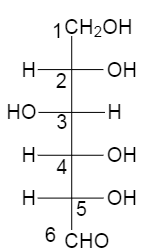
Next we will draw this same glucose molecule in the form of a cyclohexane chair.
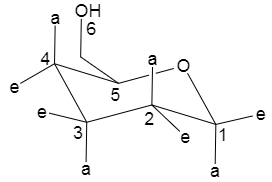
Now we will replace the signs ‘a’ and ‘e’ with the actual substituents which are hydroxide and hydrogen moieties. Now, we will look at the Fischer projection and put the substituents accordingly.
The final structure of the glucose, having axial and equatorial bonds, would look like,
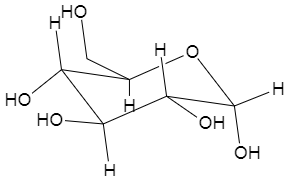
Note: The axial bonds of the glucose are the bonds which are present in the $90{}^\circ $ angle with the place of the ring. Whereas, equatorial bonds are those which are present in smaller angles with the plane of the ring.
The structure of the glucose has six of these carbon atoms and an aldehyde group along with the alcoholic groups.
Complete step-by-step answer:There are a number of steps, following which we will be able to draw the axial and equatorial bonds in a glucose molecule. But first we need to know what are axial and equatorial bonds.
The substituents which are present in the ring but are not part of the ring, can show these axial and equatorial bonds. The bonds which are connecting the non-ring substituent or atoms and the ring, which are present at about $90{}^\circ $ to the plane of the ring, are termed as axial bonds.
Whereas, the bonds which are present at only small angles with the plane of the ring, are termed as the equatorial bonds.
Now at first we will draw the Fischer projection of the glucose, which is,
Next we will draw this same glucose molecule in the form of a cyclohexane chair.
Now we will replace the signs ‘a’ and ‘e’ with the actual substituents which are hydroxide and hydrogen moieties. Now, we will look at the Fischer projection and put the substituents accordingly.
The final structure of the glucose, having axial and equatorial bonds, would look like,
Note: The axial bonds of the glucose are the bonds which are present in the $90{}^\circ $ angle with the place of the ring. Whereas, equatorial bonds are those which are present in smaller angles with the plane of the ring.
Recently Updated Pages
Explain the structure of megasporangium class 12 biology CBSE

Why is chloroform kept in dark coloured bottles class 12 chemistry CBSE
Derive the balancing condition of a Wheatstone bri class 12 physics CBSE
Draw VI characteristics of a pn junction diode Explain class 12 physics CBSE
Is it possible to carry pride in ones language too class 12 english CBSE
In a population at Hardy Weinberg equilibrium the allele class 12 biology CBSE
Trending doubts
Draw a labelled sketch of the human eye class 12 physics CBSE
Which are the Top 10 Largest Countries of the World?
Draw ray diagrams each showing i myopic eye and ii class 12 physics CBSE
Which is the correct genotypic ratio of mendel dihybrid class 12 biology CBSE
Differentiate between homogeneous and heterogeneous class 12 chemistry CBSE
Which animal never drinks water in its entire life class 12 biology CBSE