




Draw a well-labeled diagram of an antibody molecule.
Answer
 Verified
607.5k+ views
Hint: An antibody (Ab), otherwise called immunoglobulin (Ig),[1] is a huge, Y-formed protein delivered mostly by plasma cells that are utilized by the safe framework to kill microorganisms, for example, pathogenic microbes and infections. The antibody perceives a novel particle of the microorganism, called an antigen, by means of the piece antigen-official (Fab) variable region.
Complete answer:
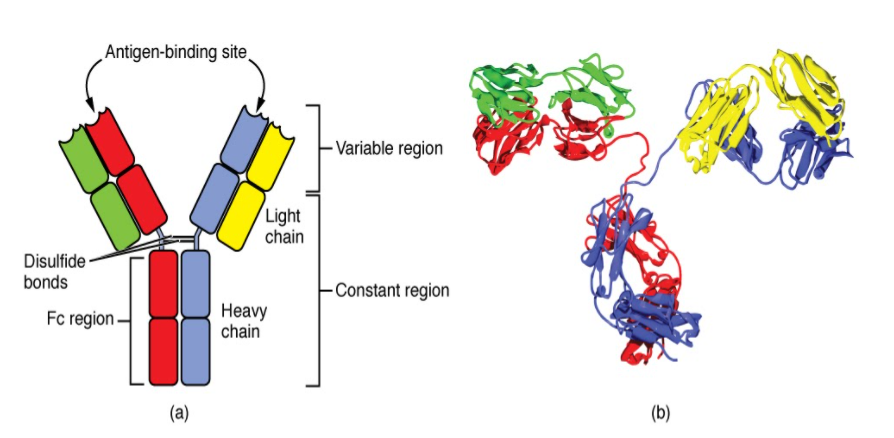
Antibodies are resistant framework related proteins called immunoglobulins. Every counteracting agent comprises four polypeptides–two substantial chains and two light ties joined to frame a "Y" molded atom.
The amino corrosive grouping in the tips of the "Y" changes extraordinarily among various antibodies. This variable area, made out of 110-130 amino acids, gives the immune response its particularity for restricting antigen. The variable area incorporates the finishes of the light and hefty chains. Treating the immune response with a protease can divide this area, delivering Fab or section antigen restricting that incorporates the variable finishes of a counteracting agent. The material utilized for the investigations that appeared underneath started from Fab.
The steady area decides the system used to decimate the antigen. Antibodies are separated into five significant classes, IgM, IgG, Iga, IgD, and IgE, in view of their consistent locale structure and resistant capacity.
The variable area is additionally partitioned into hypervariable (HV) and structure (FR) locales. Hypervariable districts have a high proportion of various amino acids in a given position, comparative with the most widely recognized amino corrosive in that position. Inside light and weighty chains, three hypervariable areas exist – HV 1, 2, and 3. Four FR areas that have more steady amino acids arrangements separate the HV locales.
Note:
The HV districts straightforwardly contact a part of the antigen's surface. Hence, HV districts are additionally at times alluded to as complementarity deciding areas or CDRs. The FR districts structure a beta-sheet structure which fills in as a framework to hold the HV locales in position to contact antigen.
Complete answer:
Antibodies are resistant framework related proteins called immunoglobulins. Every counteracting agent comprises four polypeptides–two substantial chains and two light ties joined to frame a "Y" molded atom.
The amino corrosive grouping in the tips of the "Y" changes extraordinarily among various antibodies. This variable area, made out of 110-130 amino acids, gives the immune response its particularity for restricting antigen. The variable area incorporates the finishes of the light and hefty chains. Treating the immune response with a protease can divide this area, delivering Fab or section antigen restricting that incorporates the variable finishes of a counteracting agent. The material utilized for the investigations that appeared underneath started from Fab.
The steady area decides the system used to decimate the antigen. Antibodies are separated into five significant classes, IgM, IgG, Iga, IgD, and IgE, in view of their consistent locale structure and resistant capacity.
The variable area is additionally partitioned into hypervariable (HV) and structure (FR) locales. Hypervariable districts have a high proportion of various amino acids in a given position, comparative with the most widely recognized amino corrosive in that position. Inside light and weighty chains, three hypervariable areas exist – HV 1, 2, and 3. Four FR areas that have more steady amino acids arrangements separate the HV locales.
Note:
The HV districts straightforwardly contact a part of the antigen's surface. Hence, HV districts are additionally at times alluded to as complementarity deciding areas or CDRs. The FR districts structure a beta-sheet structure which fills in as a framework to hold the HV locales in position to contact antigen.
Recently Updated Pages
Master Class 12 Economics: Engaging Questions & Answers for Success

Master Class 12 English: Engaging Questions & Answers for Success
Master Class 12 Social Science: Engaging Questions & Answers for Success
Master Class 12 Maths: Engaging Questions & Answers for Success
Master Class 12 Physics: Engaging Questions & Answers for Success
Master Class 9 General Knowledge: Engaging Questions & Answers for Success
Trending doubts
Which are the Top 10 Largest Countries of the World?
Draw a labelled sketch of the human eye class 12 physics CBSE
Differentiate between homogeneous and heterogeneous class 12 chemistry CBSE
Why is the cell called the structural and functional class 12 biology CBSE
Draw ray diagrams each showing i myopic eye and ii class 12 physics CBSE
Which is the correct genotypic ratio of mendel dihybrid class 12 biology CBSE