




Draw a rhombus KLMN such that its side is $ 4cm $ and m $ \angle K = {75^o}. $
Answer
 Verified
588.9k+ views
Hint: We know that in rhombus all sides are equal and parallel. Therefore using properties of parallel lines we can find all three remaining angles of rhombus with the help of which we can draw the required figure of rhombus.
Complete step-by-step answer:
First, we will find all four angles of rhombus KLMN.
Since, we know that in rhombus opposite sides are parallel.
Therefore, angles $ \angle K\,\,and\,\,\angle L $ co-interior angles.
Hence, the sum of these two angles will be equal to $ {180^0} $ .
$ \angle K + \angle L = {180^0} $
Substituting value of $ \angle K = {75^o} $ in above we have,
$
{75^0} + \angle L = {180^0} \\
\Rightarrow \angle L = {180^0} - {75^0} \\
\Rightarrow \angle L = {105^0} \;
$
Also, $ \angle L\,\,and\,\,\angle M $ are co-interior angles of rhombus.
Therefore, sum of these two angles will be equal to $ {180^0} $
$ \Rightarrow \angle L + \angle M = {180^0} $
Substituting value of $ \angle L $ calculated above in above equation.
$
{105^0} + \angle M = {180^0} \\
\Rightarrow \angle M = {180^0} - {105^0} \\
\Rightarrow \angle M = {75^0} \;
$
Since, $ \angle L\,\,and\,\,\angle N $ are opposite angles of rhombus.
And we know that in rhombus opposite angles are equal.
Therefore, $ \angle L = \angle N = {105^0} $
Hence, from above we see that at four angles of rhombus are $ {75^0},{105^0},{75^0}\,\,and\,\,{105^0} $
Now, we draw rhombus of given measurements.
To draw the rhombus of the side 4cm.
Draw a line segment of measure 4cm and name it as K and L.

Now, at initial K draw an angle of $ {75^0} $ and at initial L draw an angle of $ {105^0} $ with the help of compass.
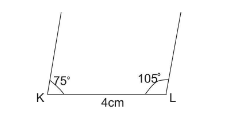
Now, from the initial K and L mark arc of length $ 4cm $ on angle forming arms. Where it cut name M and N as shown.
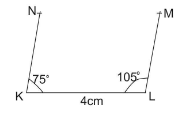
Join initial M and N marked in the above step.
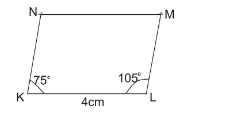
Quadrilateral so formed above is a rhombus of side $ 4cm $ and angle $ m\angle K = {75^0} $ .
Note: A quadrilateral Rhombus is a parallelogram in which all four sides are equal and opposite sides are parallel. Therefore, using properties of parallel lines we first find base angles of parallelogram and then using these we can construct the required figure of dimensions so obtained by using properties of parallelogram.
Complete step-by-step answer:
First, we will find all four angles of rhombus KLMN.
Since, we know that in rhombus opposite sides are parallel.
Therefore, angles $ \angle K\,\,and\,\,\angle L $ co-interior angles.
Hence, the sum of these two angles will be equal to $ {180^0} $ .
$ \angle K + \angle L = {180^0} $
Substituting value of $ \angle K = {75^o} $ in above we have,
$
{75^0} + \angle L = {180^0} \\
\Rightarrow \angle L = {180^0} - {75^0} \\
\Rightarrow \angle L = {105^0} \;
$
Also, $ \angle L\,\,and\,\,\angle M $ are co-interior angles of rhombus.
Therefore, sum of these two angles will be equal to $ {180^0} $
$ \Rightarrow \angle L + \angle M = {180^0} $
Substituting value of $ \angle L $ calculated above in above equation.
$
{105^0} + \angle M = {180^0} \\
\Rightarrow \angle M = {180^0} - {105^0} \\
\Rightarrow \angle M = {75^0} \;
$
Since, $ \angle L\,\,and\,\,\angle N $ are opposite angles of rhombus.
And we know that in rhombus opposite angles are equal.
Therefore, $ \angle L = \angle N = {105^0} $
Hence, from above we see that at four angles of rhombus are $ {75^0},{105^0},{75^0}\,\,and\,\,{105^0} $
Now, we draw rhombus of given measurements.
To draw the rhombus of the side 4cm.
Draw a line segment of measure 4cm and name it as K and L.
Now, at initial K draw an angle of $ {75^0} $ and at initial L draw an angle of $ {105^0} $ with the help of compass.
Now, from the initial K and L mark arc of length $ 4cm $ on angle forming arms. Where it cut name M and N as shown.
Join initial M and N marked in the above step.
Quadrilateral so formed above is a rhombus of side $ 4cm $ and angle $ m\angle K = {75^0} $ .
Note: A quadrilateral Rhombus is a parallelogram in which all four sides are equal and opposite sides are parallel. Therefore, using properties of parallel lines we first find base angles of parallelogram and then using these we can construct the required figure of dimensions so obtained by using properties of parallelogram.
Recently Updated Pages
Basicity of sulphurous acid and sulphuric acid are

Master Class 8 Social Science: Engaging Questions & Answers for Success
Master Class 8 Science: Engaging Questions & Answers for Success
Master Class 8 Maths: Engaging Questions & Answers for Success
Class 8 Question and Answer - Your Ultimate Solutions Guide
Master Class 11 Business Studies: Engaging Questions & Answers for Success
Trending doubts
What are gulf countries and why they are called Gulf class 8 social science CBSE
What is BLO What is the full form of BLO class 8 social science CBSE
What are the 12 elements of nature class 8 chemistry CBSE
In Indian rupees 1 trillion is equal to how many c class 8 maths CBSE
Who created the image of Bharat Mata for the first class 8 social science CBSE
What is the Balkan issue in brief class 8 social science CBSE