




Draw a neat diagram of spirogyra and label on it- Jelly like substance in the cell where the organelles are suspended.
Answer
 Verified
620.7k+ views
Hint: Spirogyra any genus member of some 400 free-floating green algae species of the Chlorophyta division found globally in freshwater environments Spirogyras are filamentous algae consisting of thin unbranched chains of cylindrical cells, named for their exquisite spiral chloroplasts.
Complete answer:
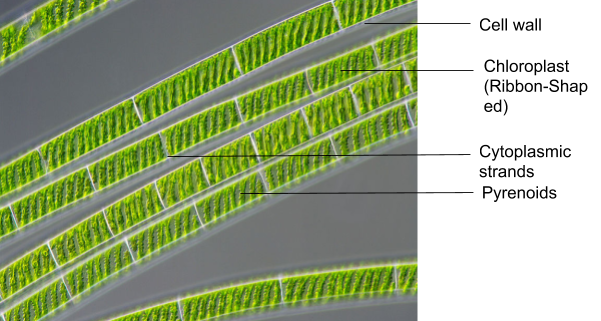
They can form masses that float near the surface of streams and ponds, buoyed by oxygen bubbles produced during photosynthesis.. They are widely used in laboratory demonstrations. Each filament cell has a large central vacuole, within which fine cytoplasm strands suspend the nucleus.
The chloroplasts form a spiral around the vacuole and have specialised bodies that store starch, known as pyrenoids.. The cell wall is formed by the inner layer of cellulose and the outer layer of pectin, which is responsible for the slippery texture of the algae.
Species of Spirogyra can reproduce sexually as well as asexually. Asexual, or vegetative, reproduction occurs by simple filament fragmentation. Sexual reproduction occurs by a mechanism known as conjugation, in which outgrowths called conjugation tubes are joined by cells of two filaments lying side by side.
This helps one cell's contents to fully move into and fuse with the other's contents. A dense wall covers and overwinters the resulting fused cell (zygote), while the vegetative filaments die.
Note: An unbranched filamentous thallus is the vegetative structure of Spirogyra.
With - cylindrical cells joining end to end, the thallus is multicellular.
They are 10-100 μm wide and can be several centimetres tall.
Owing to the presence of the mucilage sheath around the filament, they are present as a slimy mass
Complete answer:
They can form masses that float near the surface of streams and ponds, buoyed by oxygen bubbles produced during photosynthesis.. They are widely used in laboratory demonstrations. Each filament cell has a large central vacuole, within which fine cytoplasm strands suspend the nucleus.
The chloroplasts form a spiral around the vacuole and have specialised bodies that store starch, known as pyrenoids.. The cell wall is formed by the inner layer of cellulose and the outer layer of pectin, which is responsible for the slippery texture of the algae.
Species of Spirogyra can reproduce sexually as well as asexually. Asexual, or vegetative, reproduction occurs by simple filament fragmentation. Sexual reproduction occurs by a mechanism known as conjugation, in which outgrowths called conjugation tubes are joined by cells of two filaments lying side by side.
This helps one cell's contents to fully move into and fuse with the other's contents. A dense wall covers and overwinters the resulting fused cell (zygote), while the vegetative filaments die.
Note: An unbranched filamentous thallus is the vegetative structure of Spirogyra.
With - cylindrical cells joining end to end, the thallus is multicellular.
They are 10-100 μm wide and can be several centimetres tall.
Owing to the presence of the mucilage sheath around the filament, they are present as a slimy mass
Recently Updated Pages
Difference Between Prokaryotic Cells and Eukaryotic Cells

If x a + bt + ct2 where x is in meters and t is in class 11 physics CBSE
A car covers the first half distance between two places class 11 physics CBSE
The resultant of two vectors overrightarrow P and overrightarrow class 11 physics CBSE
Find the value of cos 135 class 11 maths CBSE
A mass M is held in place by an applied force F and class 11 physics CBSE
Trending doubts
One Metric ton is equal to kg A 10000 B 1000 C 100 class 11 physics CBSE
Find the value of the expression given below sin 30circ class 11 maths CBSE
Draw a diagram of nephron and explain its structur class 11 biology CBSE
10 examples of friction in our daily life
Proton was discovered by A Thomson B Rutherford C Chadwick class 11 chemistry CBSE
Bond order ofO2 O2+ O2 and O22 is in order A O2 langle class 11 chemistry CBSE