




Draw a line segment CD. Produce it to CE such that CE = 3CD.
Answer
 Verified
634.8k+ views
Hint: Draw a line l and take two points C and D on it. Take a divider and open it such that the ends of both of its arms are at C and D. Now, lift the divide and place one end at D and the other end opposite to C at A without changing its length i.e distance between sharp points of the divider. Repeat this step again to get the point E. This is the required construction.
Complete step-by-step answer:
In this question, we need to draw a line segment CD. We then need to produce it to CE such that CE = 3CD.
We draw a line l and take two points C and D on it.
We will now take a divider and open it such that the ends of both of its arms are at C and D. Then, we will lift the divider and place its one end at D and the other end on the line l on the side opposite to point C without changing its length.
Let this point be A.
Now, we will lift the divider again and place its one end at A and the other end on the line l on the side opposite to point C without changing its length.
Name this point as E.
The figure below shows the final construction.
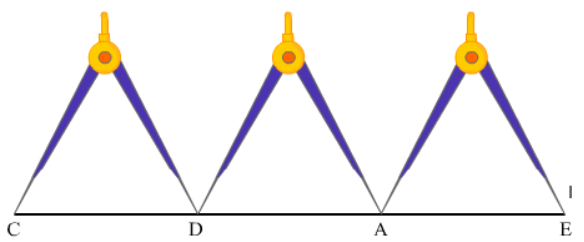
Here we have the following:
CD = DE = AE (because we did not change the length on the divider) …(1)
CE = CD + DE + AE
Substituting equation (1) in this, we will have the following:
CE = CD + CD + CD
CE = 3CD
Note: In this question, it is very important to know what a divider is and how it is used. Dividers are one of the earliest and most basic types of mathematical instruments. In their simplest form, dividers consist of a jointed pair of legs, each with a sharp point. They can be used for geometrical operations such as for taking off and transferring dimensions.
Complete step-by-step answer:
In this question, we need to draw a line segment CD. We then need to produce it to CE such that CE = 3CD.
We draw a line l and take two points C and D on it.
We will now take a divider and open it such that the ends of both of its arms are at C and D. Then, we will lift the divider and place its one end at D and the other end on the line l on the side opposite to point C without changing its length.
Let this point be A.
Now, we will lift the divider again and place its one end at A and the other end on the line l on the side opposite to point C without changing its length.
Name this point as E.
The figure below shows the final construction.
Here we have the following:
CD = DE = AE (because we did not change the length on the divider) …(1)
CE = CD + DE + AE
Substituting equation (1) in this, we will have the following:
CE = CD + CD + CD
CE = 3CD
Note: In this question, it is very important to know what a divider is and how it is used. Dividers are one of the earliest and most basic types of mathematical instruments. In their simplest form, dividers consist of a jointed pair of legs, each with a sharp point. They can be used for geometrical operations such as for taking off and transferring dimensions.
Recently Updated Pages
Three beakers labelled as A B and C each containing 25 mL of water were taken A small amount of NaOH anhydrous CuSO4 and NaCl were added to the beakers A B and C respectively It was observed that there was an increase in the temperature of the solutions contained in beakers A and B whereas in case of beaker C the temperature of the solution falls Which one of the following statements isarecorrect i In beakers A and B exothermic process has occurred ii In beakers A and B endothermic process has occurred iii In beaker C exothermic process has occurred iv In beaker C endothermic process has occurred

Master Class 5 Social Science: Engaging Questions & Answers for Success
Master Class 5 Science: Engaging Questions & Answers for Success
Master Class 5 Maths: Engaging Questions & Answers for Success
Class 5 Question and Answer - Your Ultimate Solutions Guide
Master Class 9 Social Science: Engaging Questions & Answers for Success
Three beakers labelled as A B and C each containing 25 mL of water were taken A small amount of NaOH anhydrous CuSO4 and NaCl were added to the beakers A B and C respectively It was observed that there was an increase in the temperature of the solutions contained in beakers A and B whereas in case of beaker C the temperature of the solution falls Which one of the following statements isarecorrect i In beakers A and B exothermic process has occurred ii In beakers A and B endothermic process has occurred iii In beaker C exothermic process has occurred iv In beaker C endothermic process has occurred
Master Class 5 Social Science: Engaging Questions & Answers for Success
Master Class 5 Science: Engaging Questions & Answers for Success
Trending doubts
Write the number names for the following numbers A class 5 maths CBSE
XIX+XXX A 49 B 51 C 55 D 44 class 5 maths CBSE
Which are the Top 10 Largest Countries of the World?
One Metric ton is equal to kg A 10000 B 1000 C 100 class 11 physics CBSE
Explain the Treaty of Vienna of 1815 class 10 social science CBSE
Draw a labelled sketch of the human eye class 12 physics CBSE