




Draw a labeled diagram of the drip irrigation system.
Answer
 Verified
636k+ views
Hint: Drip irrigation can be called a type of micro-irrigation. Micro-irrigation is lower pressure and flow type of irrigation than a sprinkler and is often called trickle irrigation. It is a technique of irrigation which has proven to be very helpful.
Complete answer:A type of micro-irrigation or trickle irrigation system that can save water and nutrients in the drip irrigation system as it allows water to drip slowly to the roots and also to the correct amounts of the plants and not above or below the soil surface. This helps the roots to be supplied with drop by drop water and to reduce evaporation. For the supply of water via a drip irrigation system, pumps, pipes, tubing, and emitters can be used. Any of the benefits of drip irrigation are as follows: the depletion of fertilizers and nutrients is reduced using drip irrigation. If properly handled, the performance of water application management can be improved and fields with irregular shapes can easily be accommodated.
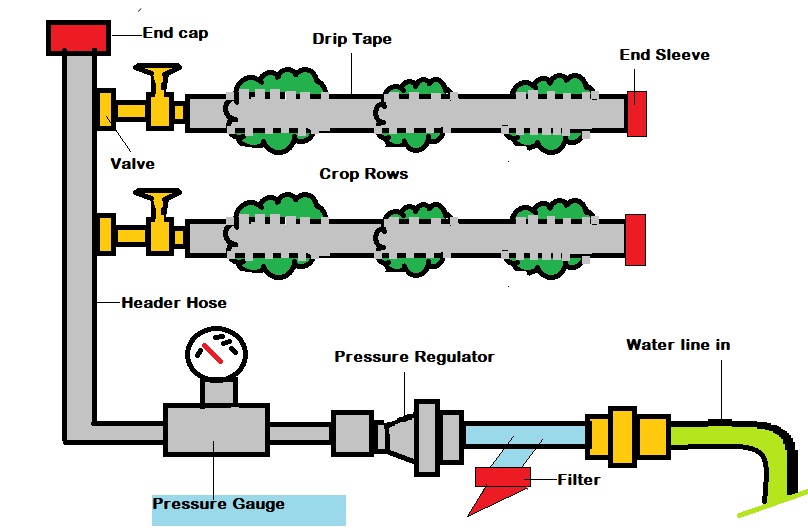
Fig: Drip Irrigation
Note: It is possible to use recycled non-potable water, preserve humidity within the root zone, and the form of soil does not play an important role in the frequency of irrigation. Soil erosion and weed growth are limited, the distribution of water is highly uninformed, and labor costs are also declining. Drip irrigation is now widely used in fields, greenhouses, and gardens, saving water and helping to grow crops such as cocoa, strawberries, tomatoes, etc. In ancient times, China pioneered the use of drip irrigation. In the 1950s, Israeli engineers sold the use of drip irrigation.
Complete answer:A type of micro-irrigation or trickle irrigation system that can save water and nutrients in the drip irrigation system as it allows water to drip slowly to the roots and also to the correct amounts of the plants and not above or below the soil surface. This helps the roots to be supplied with drop by drop water and to reduce evaporation. For the supply of water via a drip irrigation system, pumps, pipes, tubing, and emitters can be used. Any of the benefits of drip irrigation are as follows: the depletion of fertilizers and nutrients is reduced using drip irrigation. If properly handled, the performance of water application management can be improved and fields with irregular shapes can easily be accommodated.
Fig: Drip Irrigation
Note: It is possible to use recycled non-potable water, preserve humidity within the root zone, and the form of soil does not play an important role in the frequency of irrigation. Soil erosion and weed growth are limited, the distribution of water is highly uninformed, and labor costs are also declining. Drip irrigation is now widely used in fields, greenhouses, and gardens, saving water and helping to grow crops such as cocoa, strawberries, tomatoes, etc. In ancient times, China pioneered the use of drip irrigation. In the 1950s, Israeli engineers sold the use of drip irrigation.
Recently Updated Pages
What are the two major island groups in India class 9 social science CBSE

What is Jhum cultivation class 9 biology CBSE
Write an Article on Save Earth Save Life
Silk is obtained from of the silk moth APupa BLarva class 9 chemistry CBSE
Write chemical formulas of the following compounds class 9 chemistry CBSE
The Indo Gangetic Plains of India are fertile due to class 9 social science CBSE
Trending doubts
Fill the blanks with the suitable prepositions 1 The class 9 english CBSE
Difference Between Plant Cell and Animal Cell
Name 10 Living and Non living things class 9 biology CBSE
What is the full form of pH?
On an outline map of India show its neighbouring c class 9 social science CBSE
What is pollution? How many types of pollution? Define it