




Draw a circle with centre C and radius 3.4cm. Draw any chord $\overline {AB} $. Construct the perpendicular bisector of $\overline {AB} $ and examine if it passes through C.
Answer
 Verified
594.9k+ views
Hint: Start the solution with the construction/ in this type of questions no logic or formula is needed. You have to directly start construction the diagram by using the information and conditions. Also you have to conclude the answer in respect to the construction of the diagram. The construction should not be free handed.
Complete step by step solution:
(Diagrams drawn in the solution are for explanation purposes only. They are not constructed with the exact measurements.)
We will start the solution by drawing a Circle of radius 3.4cm respectively. We will name the centre of the circle C as given in the figure.
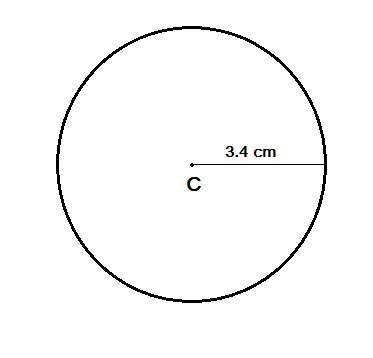
After this step we have been asked to draw a chord $\overline {AB} $. We all know that chord is a segment joining any two points of the circle. Since we have not given any specifications of the chord, we can draw any chord of our choice. Following is the construction of the chord.
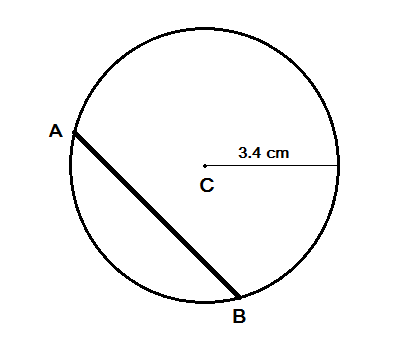
Next we have been asked to construct a perpendicular bisector of a chord. For this step you will have to use a compass(rounder). You have to consider the chord as a line and draw its perpendicular bisector.
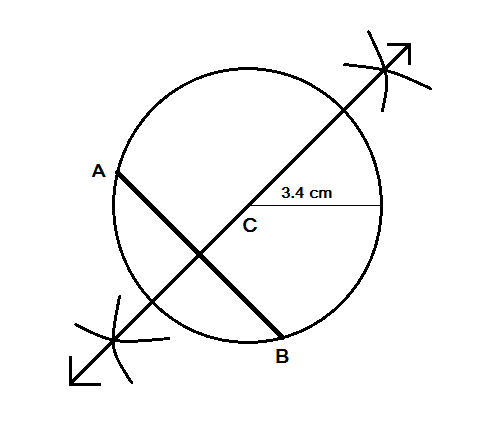
In this construction you can see that the perpendicular bisector of the chord passes through the centre of the circle
Hence the perpendicular bisector of the chord $\overline {AB} $ passes through centre C.
Note: Since the assumed length of the chord was arbitrary this proves that this result is applicable to the perpendicular bisector of any chords of the given circle. The steps shown in the solution are for just explanation purposes. When such a question is asked you have to directly construct the final diagram.
Complete step by step solution:
(Diagrams drawn in the solution are for explanation purposes only. They are not constructed with the exact measurements.)
We will start the solution by drawing a Circle of radius 3.4cm respectively. We will name the centre of the circle C as given in the figure.
After this step we have been asked to draw a chord $\overline {AB} $. We all know that chord is a segment joining any two points of the circle. Since we have not given any specifications of the chord, we can draw any chord of our choice. Following is the construction of the chord.
Next we have been asked to construct a perpendicular bisector of a chord. For this step you will have to use a compass(rounder). You have to consider the chord as a line and draw its perpendicular bisector.
In this construction you can see that the perpendicular bisector of the chord passes through the centre of the circle
Hence the perpendicular bisector of the chord $\overline {AB} $ passes through centre C.
Note: Since the assumed length of the chord was arbitrary this proves that this result is applicable to the perpendicular bisector of any chords of the given circle. The steps shown in the solution are for just explanation purposes. When such a question is asked you have to directly construct the final diagram.
Recently Updated Pages
Master Class 12 Economics: Engaging Questions & Answers for Success

Master Class 12 Social Science: Engaging Questions & Answers for Success
Master Class 12 English: Engaging Questions & Answers for Success
Master Class 12 Maths: Engaging Questions & Answers for Success
Master Class 12 Physics: Engaging Questions & Answers for Success
Master Class 12 Biology: Engaging Questions & Answers for Success
Trending doubts
The common name of Rheo leaf is A Oyster plant B Boat class 9 biology CBSE
Difference Between Plant Cell and Animal Cell
Fill the blanks with the suitable prepositions 1 The class 9 english CBSE
What is the full form of pH?
Any five important events between the years 1930 to class 9 social science CBSE
What is the Full Form of ICSE, CBSE and SSC