




How is DNA isolated from prokaryotic and eukaryotic cells?
Answer
 Verified
619.8k+ views
Hint: Both the prokaryotic and the eukaryotic cells consist of the DNA present in them. The DNA is extracted from the cells by carrying out various steps. DNA present is double-stranded and is so long that it is compressed in such a way that it can fit in the nuclear membrane of the cell.
Complete answer:
In the DNA isolation procedure, the sample from which DNA needs to be extracted is taken and the sample is made to undergo cell lysis. In this, the cell wall is broken down and then the sample ire made to centrifuge at high speed. The cell debris is removed through this process. After these proteins are denatured using protease. Then they are made to precipitate using the organic solvents in the ratio of 1:1 of a mixture of chloroform and phenol.
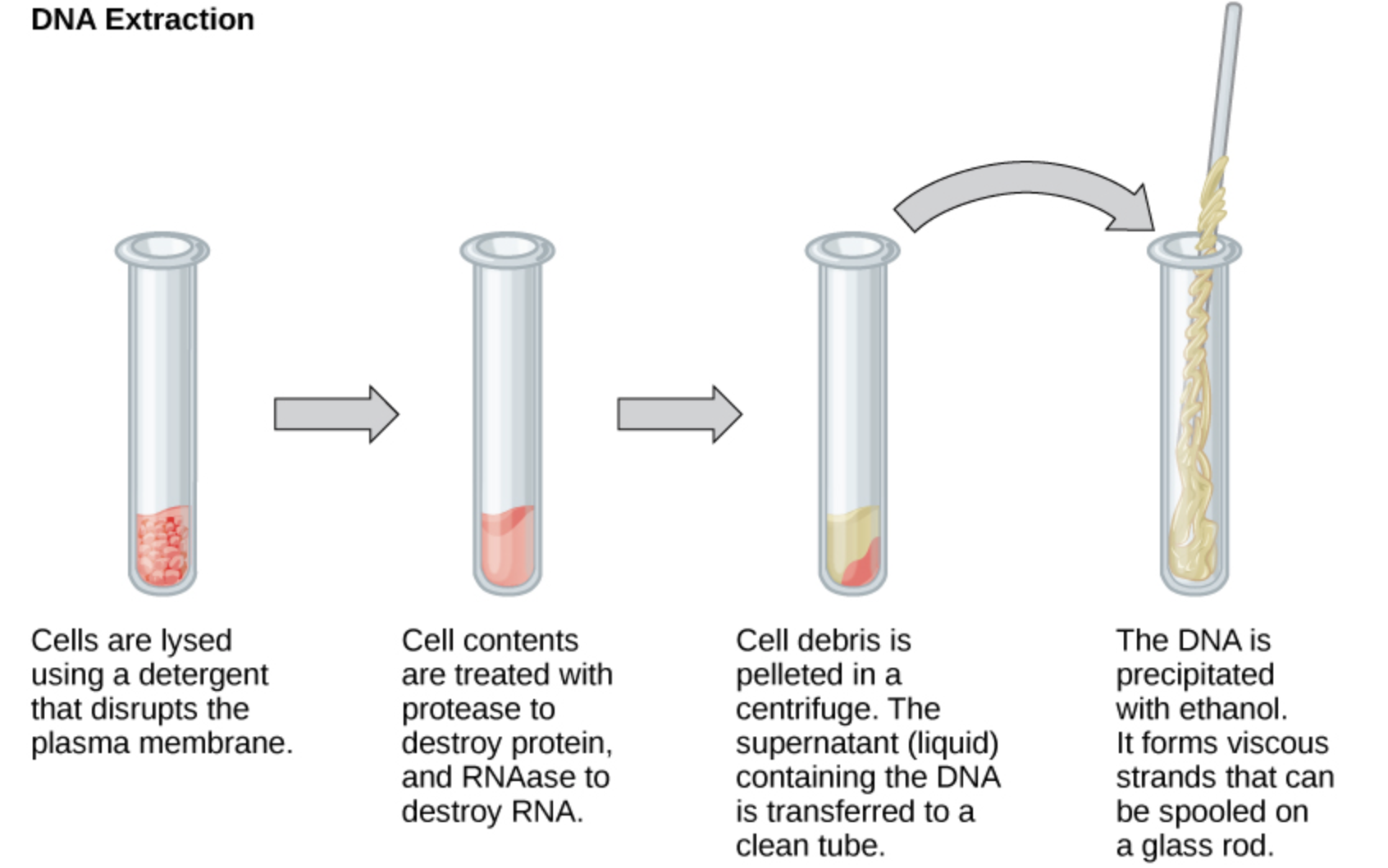
The precipitate is then removed using centrifugation. DNA can be obtained now by the precipitation of the ethanol at -20 degrees Celsius. At very low temperatures the DNA gets precipitated and then can be used for the further study. The microbes are first cultured to a level where they reach maximum density. The DNA isolation from the microbes can be done by lysing the cell using lysozyme or EDTA. Then the cell is removed by the centrifugation. The other steps are the same as done in the plant and animals’ cells.
Note: The lysis of cells using EDTA or lysozyme is necessary to help in the extraction of the DNA from the cell. The use of absolute ethanol should be only done at very low temperatures to facilitate the precipitation of the DNA.
Complete answer:
In the DNA isolation procedure, the sample from which DNA needs to be extracted is taken and the sample is made to undergo cell lysis. In this, the cell wall is broken down and then the sample ire made to centrifuge at high speed. The cell debris is removed through this process. After these proteins are denatured using protease. Then they are made to precipitate using the organic solvents in the ratio of 1:1 of a mixture of chloroform and phenol.
The precipitate is then removed using centrifugation. DNA can be obtained now by the precipitation of the ethanol at -20 degrees Celsius. At very low temperatures the DNA gets precipitated and then can be used for the further study. The microbes are first cultured to a level where they reach maximum density. The DNA isolation from the microbes can be done by lysing the cell using lysozyme or EDTA. Then the cell is removed by the centrifugation. The other steps are the same as done in the plant and animals’ cells.
Note: The lysis of cells using EDTA or lysozyme is necessary to help in the extraction of the DNA from the cell. The use of absolute ethanol should be only done at very low temperatures to facilitate the precipitation of the DNA.
Recently Updated Pages
Basicity of sulphurous acid and sulphuric acid are

Master Class 12 Economics: Engaging Questions & Answers for Success
Master Class 12 Biology: Engaging Questions & Answers for Success
Master Class 11 English: Engaging Questions & Answers for Success
Master Class 11 Physics: Engaging Questions & Answers for Success
Master Class 11 Computer Science: Engaging Questions & Answers for Success
Trending doubts
Draw a labelled sketch of the human eye class 12 physics CBSE
The chemical formula of tear gas is A CO Cl 2 B C 10 class 12 chemistry CBSE
Draw ray diagrams each showing i myopic eye and ii class 12 physics CBSE
Which are the Top 10 Largest Countries of the World?
Differentiate between homogeneous and heterogeneous class 12 chemistry CBSE
Which is the correct genotypic ratio of mendel dihybrid class 12 biology CBSE