




DNA contains the sugar
A. Deoxyribose
B. Ribose
C. D-Fructose
D. D-glucose
Answer
 Verified
636.9k+ views
Hint: DNA is the nucleic acid which contains all the information and instructions for the proteins constituting in the cell. DNA is responsible for all the genetic information for every living and non living cell of humans, animals, plants and microorganisms.
Complete step by step answer:
DNA is the short form of deoxyribonucleic acid. It is made of nucleotides present in every cell of living organisms. It contains the genetic blueprint of the main building block of the cell.
The nucleotide consists of phosphate, sugar and nitrogen base. There are four types of nitrogen bases present on the two strands of DNA named as adenine (A), thymine (T), guanine (G) and cytosine (C). The phosphate group is the linkers between the two strands of the DNA. The sugar is the deoxyribose sugar.
The deoxyribose found in DNA is a different type of sugar which lacks in one oxygen atom. Thus due to the presence of one less oxygen the sugar is named as deoxy. This makes the enzymes easier to distinguish between DNA and RNA.
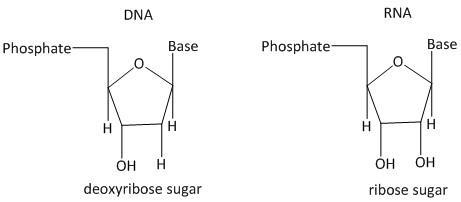
The ribose sugar is found in RNA. It is a simple sugar molecule with molecular formula \[{C_5}{H_{10}}{O_5}\]. It is a form of sugar molecule and has a single ring pentose structure.
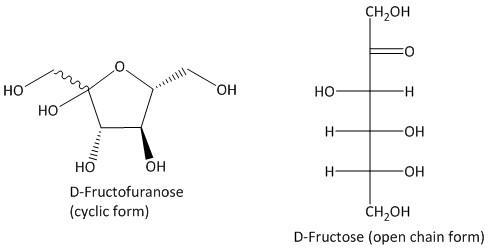
D-Fructose is a monosaccharide sugar which has a ketone functional group. The fructose is derived from cane sugars and sugar beets. The structural analysis suggests that it has a D-fructofuranose structure in cyclic form and has a ketone group in open chain form.
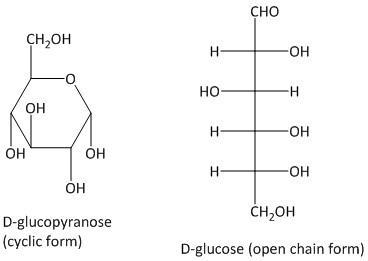
D-glucose is a single sugar with the molecular formula \[{C_6}{H_{12}}{O_6}\]. It has a D-glucopyranose structure in cyclic form and contains an aldehyde functional group in open chain form.
So, the correct answer is “Option A”.
Note:
DNA carries all the hereditary information from one age to the next age. The DNA replication involves three steps namely initiation, elongation and termination. The nitrogen bases are coupled as A-T and G-C connected by the phosphate and sugar linkages.
Complete step by step answer:
DNA is the short form of deoxyribonucleic acid. It is made of nucleotides present in every cell of living organisms. It contains the genetic blueprint of the main building block of the cell.
The nucleotide consists of phosphate, sugar and nitrogen base. There are four types of nitrogen bases present on the two strands of DNA named as adenine (A), thymine (T), guanine (G) and cytosine (C). The phosphate group is the linkers between the two strands of the DNA. The sugar is the deoxyribose sugar.
The deoxyribose found in DNA is a different type of sugar which lacks in one oxygen atom. Thus due to the presence of one less oxygen the sugar is named as deoxy. This makes the enzymes easier to distinguish between DNA and RNA.
The ribose sugar is found in RNA. It is a simple sugar molecule with molecular formula \[{C_5}{H_{10}}{O_5}\]. It is a form of sugar molecule and has a single ring pentose structure.
D-Fructose is a monosaccharide sugar which has a ketone functional group. The fructose is derived from cane sugars and sugar beets. The structural analysis suggests that it has a D-fructofuranose structure in cyclic form and has a ketone group in open chain form.
D-glucose is a single sugar with the molecular formula \[{C_6}{H_{12}}{O_6}\]. It has a D-glucopyranose structure in cyclic form and contains an aldehyde functional group in open chain form.
So, the correct answer is “Option A”.
Note:
DNA carries all the hereditary information from one age to the next age. The DNA replication involves three steps namely initiation, elongation and termination. The nitrogen bases are coupled as A-T and G-C connected by the phosphate and sugar linkages.
Recently Updated Pages
If x a + bt + ct2 where x is in meters and t is in class 11 physics CBSE

A car covers the first half distance between two places class 11 physics CBSE
The resultant of two vectors overrightarrow P and overrightarrow class 11 physics CBSE
Find the value of cos 135 class 11 maths CBSE
A mass M is held in place by an applied force F and class 11 physics CBSE
A solution of glucose in water is labelled as 10 dfracwv class 11 chemistry CBSE
Trending doubts
Find the value of the expression given below sin 30circ class 11 maths CBSE
One Metric ton is equal to kg A 10000 B 1000 C 100 class 11 physics CBSE
Draw a diagram of nephron and explain its structur class 11 biology CBSE
10 examples of friction in our daily life
Proton was discovered by A Thomson B Rutherford C Chadwick class 11 chemistry CBSE
Bond order ofO2 O2+ O2 and O22 is in order A O2 langle class 11 chemistry CBSE