




How do you determine the area enclosed by an ellipse $\dfrac{{{x}^{2}}}{5}+\dfrac{{{y}^{2}}}{3}$ using the trapezoidal rule?
Answer
 Verified
579k+ views
Hint: We have been given an ellipse whose area is to be found using the trapezoidal rule. We have to divide our desired area into ‘n’ intervals or ‘n’ rectangles whose area will be then added to find the total area of the required area. Thus, we shall first find the width of the interval by taking ‘n’ as some suitable positive integer and then apply the formula of calculating area by trapezoidal rule.
Complete step by step solution:
Given the ellipse $\dfrac{{{x}^{2}}}{5}+\dfrac{{{y}^{2}}}{3}=1$.
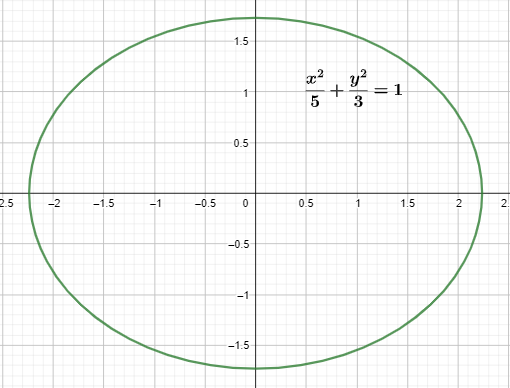
We see that the major axis is the x-axis and the minor axis of the ellipse is the y-axis.
Thus, for the given ellipse, $\dfrac{{{x}^{2}}}{5}+\dfrac{{{y}^{2}}}{3}=1$,
$a=\sqrt{5}$ and $b=\sqrt{3}$
Since an ellipse is a symmetrical figure with respect to the x-axis, thus the lower half of the ellipse is equal to the upper half of the ellipse and the total area of ellipse is double the area of the upper half of ellipse.
The upper half of the ellipse is given by the function, $y=\sqrt{\dfrac{15-3{{x}^{2}}}{5}}$ or $f\left( x \right)=\sqrt{\dfrac{15-3{{x}^{2}}}{5}}$.
The value of x varies from $-\sqrt{5}$ to $\sqrt{5}$.
Now, to apply the trapezoidal rule, we shall first find a positive integer ‘n’.
We have the upper limit, $b=\sqrt{5}$ and the lower limit, $a=-\sqrt{5}$.
$\Delta x$ is the value of every sub interval or rectangle which is equal to the upper limit of integral minus the lower limit divided by ‘n’. Let us choose ‘n’ equal to 5.
$\Delta x=\dfrac{b-a}{n}$
$\begin{align}
& \Rightarrow \Delta x=\dfrac{\sqrt{5}-\left( -\sqrt{5} \right)}{5} \\
& \Rightarrow \Delta x=\dfrac{2\sqrt{5}}{5} \\
& \Rightarrow \Delta x=\dfrac{2}{\sqrt{5}} \\
\end{align}$
The width of each subinterval is $\Delta x$.
The formula of the trapezoidal rule is ${{T}_{n}}=\dfrac{\Delta x}{2}\left[ f\left( {{x}_{0}} \right)+2f\left( {{x}_{1}} \right)+2f\left( {{x}_{2}} \right)+......+2f\left( {{x}_{n-1}} \right)+f\left( {{x}_{n}} \right) \right]$
Putting all values, we get
$\Rightarrow {{T}_{n}}=\dfrac{2}{2\sqrt{5}}\left[ f\left( -\sqrt{5} \right)+2f\left( \dfrac{2}{\sqrt{5}} \right)+2f\left( 2.\dfrac{2}{\sqrt{5}} \right)+......+2f\left( 4.\dfrac{2}{\sqrt{5}} \right)+f\left( \sqrt{5} \right) \right]$
$\Rightarrow {{T}_{n}}=\dfrac{2}{2\sqrt{5}}\left[ \begin{align}
& \left( \sqrt{\dfrac{15-3{{\left( -\sqrt{5} \right)}^{2}}}{5}} \right)+2\left( \sqrt{\dfrac{15-3{{\left( \dfrac{2}{\sqrt{5}} \right)}^{2}}}{5}} \right)+2\left( \sqrt{\dfrac{15-3{{\left( \dfrac{4}{\sqrt{5}} \right)}^{2}}}{5}} \right)+...... \\
& ..........+2\left( \sqrt{\dfrac{15-3{{\left( \dfrac{8}{\sqrt{5}} \right)}^{2}}}{5}} \right)+\left( \sqrt{\dfrac{15-3{{\left( \sqrt{5} \right)}^{2}}}{5}} \right) \\
\end{align} \right]$
We know that $\sqrt{5}=2.236$.
$\Rightarrow {{T}_{n}}=6.0832$
But the total area of the ellipse is $2{{T}_{n}}$.
$\begin{align}
& \Rightarrow 2{{T}_{n}}=2\times 6.0832 \\
& \Rightarrow 2{{T}_{n}}=12.1668 \\
\end{align}$
Therefore, the area enclosed by an ellipse $\dfrac{{{x}^{2}}}{5}+\dfrac{{{y}^{2}}}{3}$ using the trapezoidal rule is 12.1668 square units.
Note:
The trapezoidal rule allows you to estimate the value of a definite integral which represents the area under a curve. If we have to use the trapezoidal rule, then we divide the area under the graph into ‘n’ subintervals of ‘n’ rectangles. Then we can estimate how close our approximation is using the exact value of the definite integral.
Complete step by step solution:
Given the ellipse $\dfrac{{{x}^{2}}}{5}+\dfrac{{{y}^{2}}}{3}=1$.
We see that the major axis is the x-axis and the minor axis of the ellipse is the y-axis.
Thus, for the given ellipse, $\dfrac{{{x}^{2}}}{5}+\dfrac{{{y}^{2}}}{3}=1$,
$a=\sqrt{5}$ and $b=\sqrt{3}$
Since an ellipse is a symmetrical figure with respect to the x-axis, thus the lower half of the ellipse is equal to the upper half of the ellipse and the total area of ellipse is double the area of the upper half of ellipse.
The upper half of the ellipse is given by the function, $y=\sqrt{\dfrac{15-3{{x}^{2}}}{5}}$ or $f\left( x \right)=\sqrt{\dfrac{15-3{{x}^{2}}}{5}}$.
The value of x varies from $-\sqrt{5}$ to $\sqrt{5}$.
Now, to apply the trapezoidal rule, we shall first find a positive integer ‘n’.
We have the upper limit, $b=\sqrt{5}$ and the lower limit, $a=-\sqrt{5}$.
$\Delta x$ is the value of every sub interval or rectangle which is equal to the upper limit of integral minus the lower limit divided by ‘n’. Let us choose ‘n’ equal to 5.
$\Delta x=\dfrac{b-a}{n}$
$\begin{align}
& \Rightarrow \Delta x=\dfrac{\sqrt{5}-\left( -\sqrt{5} \right)}{5} \\
& \Rightarrow \Delta x=\dfrac{2\sqrt{5}}{5} \\
& \Rightarrow \Delta x=\dfrac{2}{\sqrt{5}} \\
\end{align}$
The width of each subinterval is $\Delta x$.
The formula of the trapezoidal rule is ${{T}_{n}}=\dfrac{\Delta x}{2}\left[ f\left( {{x}_{0}} \right)+2f\left( {{x}_{1}} \right)+2f\left( {{x}_{2}} \right)+......+2f\left( {{x}_{n-1}} \right)+f\left( {{x}_{n}} \right) \right]$
Putting all values, we get
$\Rightarrow {{T}_{n}}=\dfrac{2}{2\sqrt{5}}\left[ f\left( -\sqrt{5} \right)+2f\left( \dfrac{2}{\sqrt{5}} \right)+2f\left( 2.\dfrac{2}{\sqrt{5}} \right)+......+2f\left( 4.\dfrac{2}{\sqrt{5}} \right)+f\left( \sqrt{5} \right) \right]$
$\Rightarrow {{T}_{n}}=\dfrac{2}{2\sqrt{5}}\left[ \begin{align}
& \left( \sqrt{\dfrac{15-3{{\left( -\sqrt{5} \right)}^{2}}}{5}} \right)+2\left( \sqrt{\dfrac{15-3{{\left( \dfrac{2}{\sqrt{5}} \right)}^{2}}}{5}} \right)+2\left( \sqrt{\dfrac{15-3{{\left( \dfrac{4}{\sqrt{5}} \right)}^{2}}}{5}} \right)+...... \\
& ..........+2\left( \sqrt{\dfrac{15-3{{\left( \dfrac{8}{\sqrt{5}} \right)}^{2}}}{5}} \right)+\left( \sqrt{\dfrac{15-3{{\left( \sqrt{5} \right)}^{2}}}{5}} \right) \\
\end{align} \right]$
We know that $\sqrt{5}=2.236$.
$\Rightarrow {{T}_{n}}=6.0832$
But the total area of the ellipse is $2{{T}_{n}}$.
$\begin{align}
& \Rightarrow 2{{T}_{n}}=2\times 6.0832 \\
& \Rightarrow 2{{T}_{n}}=12.1668 \\
\end{align}$
Therefore, the area enclosed by an ellipse $\dfrac{{{x}^{2}}}{5}+\dfrac{{{y}^{2}}}{3}$ using the trapezoidal rule is 12.1668 square units.
Note:
The trapezoidal rule allows you to estimate the value of a definite integral which represents the area under a curve. If we have to use the trapezoidal rule, then we divide the area under the graph into ‘n’ subintervals of ‘n’ rectangles. Then we can estimate how close our approximation is using the exact value of the definite integral.
Recently Updated Pages
Master Class 12 Business Studies: Engaging Questions & Answers for Success

Master Class 12 Chemistry: Engaging Questions & Answers for Success
Master Class 12 Biology: Engaging Questions & Answers for Success
Class 12 Question and Answer - Your Ultimate Solutions Guide
Master Class 11 English: Engaging Questions & Answers for Success
Master Class 11 Social Science: Engaging Questions & Answers for Success
Trending doubts
Which are the Top 10 Largest Countries of the World?
Draw a labelled sketch of the human eye class 12 physics CBSE
Differentiate between homogeneous and heterogeneous class 12 chemistry CBSE
Differentiate between Pyramid of energy and pyramid class 12 biology CBSE
Why is the cell called the structural and functional class 12 biology CBSE
Draw the diagram of the pyramid of energy Explain In class 12 biology CBSE