




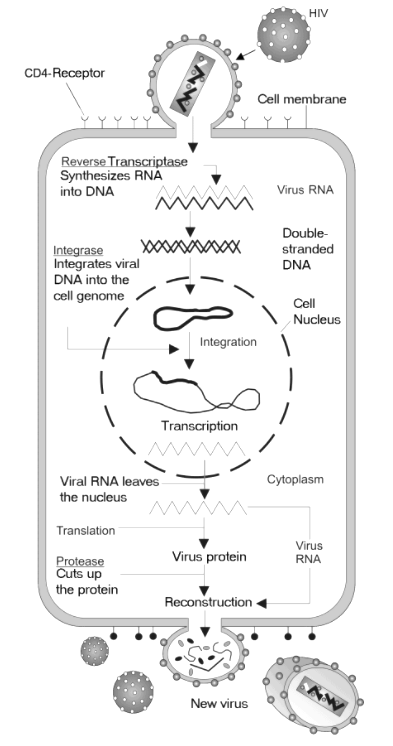
Describe the replication of HIV with schematic representation of the life cycle of HIV.
Answer
 Verified
601.8k+ views
Hint:- In order for you to arrive at an answer, try to understand the meaning of the replication cycle. Replication in viruses begins only when it hijacks the host machinery to produce new cells. The viruses act as non-living bodies outside a host body. However, when they enter the body of the host, they start to behave as living bodies.
Complete Answer:-The life cycle of HIV begins when it attaches to the host cell. In the first step, the virus fuses with the host cell surface and a capsid containing the viral genome and proteins which are injected into the cell. After the viral genome and protein enter the host cell, the disintegration of the capsid takes place and reverse transcriptase enters the cell. This helps in the transcribing of the viral RNA to DNA. The viral DNA passes through the nucleus where another important HIV protein called the integrase integrates the viral DNA along with the DNA of the host. The host cell machinery is now hijacked. Now the transcription machinery of the host transcribes the HIV DNA that leads to the production of multiple copies of HIV RNA. A part of the new RNA formed becomes incorporated into the viral genome. while the cell uses other copies of the RNA to make new HIV proteins. The new viral RNA and HIV proteins combine to form a new virus.
Note:- HIV attacks the body's immune system and if not treated may read to the serious condition of AIDS (acquired immunodeficiency syndrome).AIDS (acquired immunodeficiency syndrome) is the last stage of HIV. It takes a long time to develop and once it is developed, it gives rise to certain types of cancer and other clinical issues due to a weakened immune system. The virus enters the body via blood or semen. It is also passed from mother to child during pregnancy.
Complete Answer:-The life cycle of HIV begins when it attaches to the host cell. In the first step, the virus fuses with the host cell surface and a capsid containing the viral genome and proteins which are injected into the cell. After the viral genome and protein enter the host cell, the disintegration of the capsid takes place and reverse transcriptase enters the cell. This helps in the transcribing of the viral RNA to DNA. The viral DNA passes through the nucleus where another important HIV protein called the integrase integrates the viral DNA along with the DNA of the host. The host cell machinery is now hijacked. Now the transcription machinery of the host transcribes the HIV DNA that leads to the production of multiple copies of HIV RNA. A part of the new RNA formed becomes incorporated into the viral genome. while the cell uses other copies of the RNA to make new HIV proteins. The new viral RNA and HIV proteins combine to form a new virus.
Note:- HIV attacks the body's immune system and if not treated may read to the serious condition of AIDS (acquired immunodeficiency syndrome).AIDS (acquired immunodeficiency syndrome) is the last stage of HIV. It takes a long time to develop and once it is developed, it gives rise to certain types of cancer and other clinical issues due to a weakened immune system. The virus enters the body via blood or semen. It is also passed from mother to child during pregnancy.
Recently Updated Pages
Master Class 12 Business Studies: Engaging Questions & Answers for Success

Master Class 12 Chemistry: Engaging Questions & Answers for Success
Master Class 12 Biology: Engaging Questions & Answers for Success
Class 12 Question and Answer - Your Ultimate Solutions Guide
Master Class 11 English: Engaging Questions & Answers for Success
Master Class 11 Social Science: Engaging Questions & Answers for Success
Trending doubts
Which are the Top 10 Largest Countries of the World?
Draw a labelled sketch of the human eye class 12 physics CBSE
Differentiate between homogeneous and heterogeneous class 12 chemistry CBSE
In order to find out the different types of gametes class 12 biology NEET_UG
Why is the cell called the structural and functional class 12 biology CBSE
Draw ray diagrams each showing i myopic eye and ii class 12 physics CBSE