




Describe the Primary structure of T.S of Monocot stem.
Answer
 Verified
417.6k+ views
Hint: The monocot stem's outermost layer. Parenchyma cells are closely packed in a single layer. Sclerenchyma supports the plant mechanically.
Complete Step-by-Step Answer:
The primary structure of the T.S. Monocot system are as follows:
A. Epidermis: It is not layered outside and has numerous unicellular root hairs. It is made up of thin-walled, densely packed live parenchymatous cells. The root epidermis varies from the stem epidermis in that it lacks a distinct cuticle and stomata. It also aids in the absorption of water and nutrients from the soil due to unicellular root hairs. The monocot stem's outermost layer. Parenchyma cells are closely packed in a single layer. A thick cuticle protects the outside wall. The epidermis has few stomata. There are no multicellular hairs.
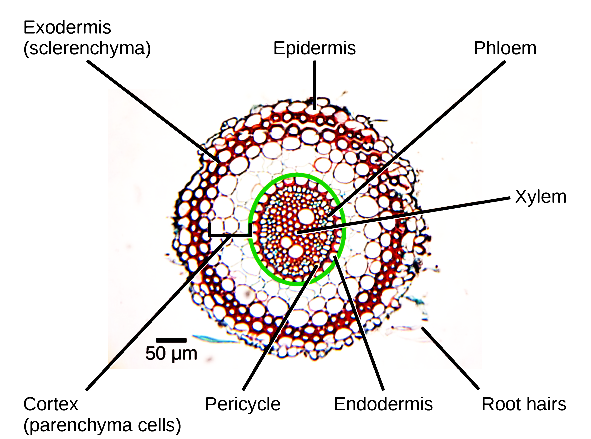
Image: Diagram of T.S Monocot stem
B. Hypodermis: The layer underneath the epidermis is known as the hypodermis. Sclerenchymatous cells make up the hypodermis. It is broken up by chlorenchyma. Sclerenchyma supports the plant mechanically.
C. Ground tissue: The cortex, endodermis, pericycle, and pith are all the same. The ground tissue is formed from inner to hypodermis parenchyma cells.
D. Vascular bundles are distributed throughout the ground tissue. Each vascular bundle is encased in a bundle sheath made of sclerenchymatous tissue.
Note: Cortex is located beneath the epiblema. The cortex comprises many layers (6-8) of thin-walled oval, rounded, or angular parenchyma cells with intercellular gaps for gas exchange. Food is stored in the cortical cells. They also transport water from the epidermis to the internal tissues.
Complete Step-by-Step Answer:
The primary structure of the T.S. Monocot system are as follows:
A. Epidermis: It is not layered outside and has numerous unicellular root hairs. It is made up of thin-walled, densely packed live parenchymatous cells. The root epidermis varies from the stem epidermis in that it lacks a distinct cuticle and stomata. It also aids in the absorption of water and nutrients from the soil due to unicellular root hairs. The monocot stem's outermost layer. Parenchyma cells are closely packed in a single layer. A thick cuticle protects the outside wall. The epidermis has few stomata. There are no multicellular hairs.
Image: Diagram of T.S Monocot stem
B. Hypodermis: The layer underneath the epidermis is known as the hypodermis. Sclerenchymatous cells make up the hypodermis. It is broken up by chlorenchyma. Sclerenchyma supports the plant mechanically.
C. Ground tissue: The cortex, endodermis, pericycle, and pith are all the same. The ground tissue is formed from inner to hypodermis parenchyma cells.
D. Vascular bundles are distributed throughout the ground tissue. Each vascular bundle is encased in a bundle sheath made of sclerenchymatous tissue.
Note: Cortex is located beneath the epiblema. The cortex comprises many layers (6-8) of thin-walled oval, rounded, or angular parenchyma cells with intercellular gaps for gas exchange. Food is stored in the cortical cells. They also transport water from the epidermis to the internal tissues.
Recently Updated Pages
Master Class 11 English: Engaging Questions & Answers for Success

Master Class 11 Maths: Engaging Questions & Answers for Success
Class 11 Question and Answer - Your Ultimate Solutions Guide
Master Class 11 Biology: Engaging Questions & Answers for Success
Master Class 11 Physics: Engaging Questions & Answers for Success
Master Class 11 Accountancy: Engaging Questions & Answers for Success
Trending doubts
Cornea transplant in humans is almost never rejected class 11 biology NEET_UG
The common characteristics between tomato and potato class 11 biology NEET_UG
Differentiate between an exothermic and an endothermic class 11 chemistry CBSE
Which is more stable and why class 12 chemistry CBSE
Which are the Top 10 Largest Countries of the World?
One Metric ton is equal to kg A 10000 B 1000 C 100 class 11 physics CBSE