




Describe how crystals of copper sulphate are prepared?
Answer
 Verified
639.3k+ views
Hint: The copper sulphate crystals are bright blue in colour. It is formed readily by reacting acid with copper oxide. The blue coloured crystals are generally formed by copper sulphate pentahydrate. It is the common form in which it generally exists but there are other variants too. Like, dihydrate or tetrahydrate.
Complete step by step solution:
Copper sulphate crystals are formed by the process of crystallization. To prepare the crystals, we need dilute sulphuric acid and Copper(II) oxide. The method of preparation is as follows-
- Sulphuric acid is taken in a conical flask and heated in a water bath till slightly warm. Warm acid reacts faster than cold acid, hence making it easier to react with the copper oxide.
- Then a spatula of copper oxide powder is added to the acid and the mixture is stirred with a glass rod.
- We keep adding the copper oxide powder till the solution is saturated.
- The excess copper oxide powder is filtered through filter paper and discarded.
- The filtrate obtained (copper sulphate solution) is poured in an evaporation basin.
- The solution is evaporated till it becomes half in volume.
- The remaining solution is poured in a petri dish, left untouched at room temperature and allowed to crystallize.
- After sometime we observe blue crystals of copper sulphate appearing.
- Then we decant the excess solution and the obtained crystals are blotted dry.
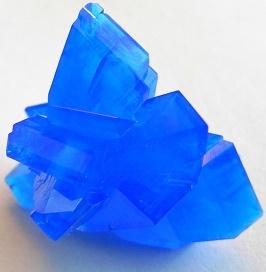
The equation of the chemical reaction is
\[{{H}_{2}}S{{O}_{4}}(dil.)+CuO(s)\to CuS{{O}_{4}}(s)+{{H}_{2}}O(l)\]
ADDITIONAL INFORMATION: Copper sulphate can also be produced by slowly leaching low grade copper ore in the atmosphere. It is industrially produced by treating copper metal with hot concentrated sulphuric acid.
NOTE: The blue coloured crystal is pentahydrate copper sulphate $CuS{{O}_{4}}\cdot 5{{H}_{2}}O$ which is the most common form of copper sulphate. However, the number of water molecules can range anywhere from 0 to 5.
Complete step by step solution:
Copper sulphate crystals are formed by the process of crystallization. To prepare the crystals, we need dilute sulphuric acid and Copper(II) oxide. The method of preparation is as follows-
- Sulphuric acid is taken in a conical flask and heated in a water bath till slightly warm. Warm acid reacts faster than cold acid, hence making it easier to react with the copper oxide.
- Then a spatula of copper oxide powder is added to the acid and the mixture is stirred with a glass rod.
- We keep adding the copper oxide powder till the solution is saturated.
- The excess copper oxide powder is filtered through filter paper and discarded.
- The filtrate obtained (copper sulphate solution) is poured in an evaporation basin.
- The solution is evaporated till it becomes half in volume.
- The remaining solution is poured in a petri dish, left untouched at room temperature and allowed to crystallize.
- After sometime we observe blue crystals of copper sulphate appearing.
- Then we decant the excess solution and the obtained crystals are blotted dry.
The equation of the chemical reaction is
\[{{H}_{2}}S{{O}_{4}}(dil.)+CuO(s)\to CuS{{O}_{4}}(s)+{{H}_{2}}O(l)\]
ADDITIONAL INFORMATION: Copper sulphate can also be produced by slowly leaching low grade copper ore in the atmosphere. It is industrially produced by treating copper metal with hot concentrated sulphuric acid.
NOTE: The blue coloured crystal is pentahydrate copper sulphate $CuS{{O}_{4}}\cdot 5{{H}_{2}}O$ which is the most common form of copper sulphate. However, the number of water molecules can range anywhere from 0 to 5.
Recently Updated Pages
Master Class 5 English: Engaging Questions & Answers for Success

Master Class 5 Maths: Engaging Questions & Answers for Success
Master Class 5 Social Science: Engaging Questions & Answers for Success
Master Class 5 Science: Engaging Questions & Answers for Success
Class 5 Question and Answer - Your Ultimate Solutions Guide
Master Class 9 General Knowledge: Engaging Questions & Answers for Success
Trending doubts
One Metric ton is equal to kg A 10000 B 1000 C 100 class 11 physics CBSE
What is cell theory Who formulated it class 11 biology CBSE
Phyllotaxy is the arrangement of ALeaflets BLeaves class 11 biology CBSE
Difference Between Prokaryotic Cells and Eukaryotic Cells
The symbiotic association of fungi and algae is called class 11 biology CBSE
Cell theory was formulated by A Schleiden and Schwann class 11 biology CBSE