




Describe a clinical thermometer. How does it differ from the thermometer used in the laboratory?
Answer
 Verified
631.5k+ views
Hint: In the laboratory thermometer, a kink is absent so immediate reading from the thermometer should be taken.
A typical range of laboratory thermometers is -10℃ to 110℃, so it can be used for multiple purposes.
Complete answer:
Thermometer is an apparatus used to measure the temperature. Temperature is the measurable amount of hotness and coldness. It can be described as a mathematical representation of heat. Temperature can be measured in Celsius (℃), Kelvin (K) and Fahrenheit (F°).
Heat is a form of energy.
The liquid which is present inside the thermometer is known as thermometric liquid, which should be visible, uniform and its freezing point should be low.
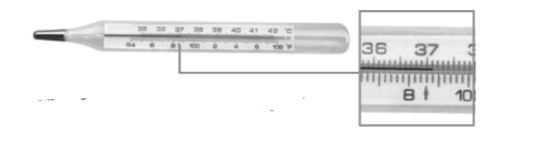
> Clinical Thermometer: A clinical thermometer or medical thermometer is used for measuring temperature of humans and animals. It is a long narrow glass tube with a mercury bulb at the end. There is a kink near the bulb which prevents mercury level from falling on its own. Its tip is inserted in the mouth under the tongue, under the armpits, into the ear or into the rectum through anus.
The normal body temperature of humans is 37℃, so the typical range of thermometers that are used orally is 35℃ to 42℃ or 90°F to 110°F.
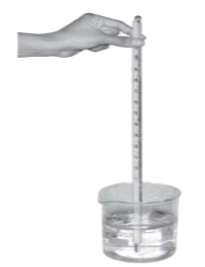
> Laboratory Thermometer: A laboratory thermometer is used to measure temperature at schools or laboratories for scientific purposes. It has a long stem with a silver bulb at the end. The silver colour at the bulb points towards the presence of mercury with the rise in temperature.
The typical range of laboratory thermometers is -10℃ to 110℃.
So, the main differences between clinical and laboratory thermometer are as follows:
- The clinical thermometer is used to measure temperature of human and animal body while the laboratory thermometer cannot measure temperature of human and animal body. It is only used to measure the temperature at laboratories for scientific purposes.
- In the clinical thermometer a kink is present near the bulb which prevents the falling of mercury level so the value can be read for a longer time while in the laboratory thermometer a kink is absent so the reading begins to drop as soon as withdrawn from medium.
- The temperature range of a clinical thermometer is 35℃ to 42℃ while that of laboratory thermometer is -10℃ to 110℃.
Note: Mercury is a toxic substance and very difficult to dispose of, so a digital thermometer is used in place of mercury thermometer. The clinical thermometers should be sterilized with antiseptic solutions before use.
A typical range of laboratory thermometers is -10℃ to 110℃, so it can be used for multiple purposes.
Complete answer:
Thermometer is an apparatus used to measure the temperature. Temperature is the measurable amount of hotness and coldness. It can be described as a mathematical representation of heat. Temperature can be measured in Celsius (℃), Kelvin (K) and Fahrenheit (F°).
Heat is a form of energy.
The liquid which is present inside the thermometer is known as thermometric liquid, which should be visible, uniform and its freezing point should be low.
> Clinical Thermometer: A clinical thermometer or medical thermometer is used for measuring temperature of humans and animals. It is a long narrow glass tube with a mercury bulb at the end. There is a kink near the bulb which prevents mercury level from falling on its own. Its tip is inserted in the mouth under the tongue, under the armpits, into the ear or into the rectum through anus.
The normal body temperature of humans is 37℃, so the typical range of thermometers that are used orally is 35℃ to 42℃ or 90°F to 110°F.
> Laboratory Thermometer: A laboratory thermometer is used to measure temperature at schools or laboratories for scientific purposes. It has a long stem with a silver bulb at the end. The silver colour at the bulb points towards the presence of mercury with the rise in temperature.
The typical range of laboratory thermometers is -10℃ to 110℃.
So, the main differences between clinical and laboratory thermometer are as follows:
- The clinical thermometer is used to measure temperature of human and animal body while the laboratory thermometer cannot measure temperature of human and animal body. It is only used to measure the temperature at laboratories for scientific purposes.
- In the clinical thermometer a kink is present near the bulb which prevents the falling of mercury level so the value can be read for a longer time while in the laboratory thermometer a kink is absent so the reading begins to drop as soon as withdrawn from medium.
- The temperature range of a clinical thermometer is 35℃ to 42℃ while that of laboratory thermometer is -10℃ to 110℃.
Note: Mercury is a toxic substance and very difficult to dispose of, so a digital thermometer is used in place of mercury thermometer. The clinical thermometers should be sterilized with antiseptic solutions before use.
Recently Updated Pages
Master Class 11 English: Engaging Questions & Answers for Success

Master Class 11 Social Science: Engaging Questions & Answers for Success
Master Class 11 Maths: Engaging Questions & Answers for Success
Master Class 11 Biology: Engaging Questions & Answers for Success
Master Class 11 Physics: Engaging Questions & Answers for Success
Master Class 11 Chemistry: Engaging Questions & Answers for Success
Trending doubts
One Metric ton is equal to kg A 10000 B 1000 C 100 class 11 physics CBSE
Difference Between Prokaryotic Cells and Eukaryotic Cells
Find the value of the expression given below sin 30circ class 11 maths CBSE
Difference between physical and chemical change class 11 chemistry CBSE
Two of the body parts which do not appear in MRI are class 11 biology CBSE
Draw a diagram of a plant cell and label at least eight class 11 biology CBSE