




Define Critical angle and also find formula for the critical angle.
Answer
 Verified
619.5k+ views
Hint: The above problem can be resolved using the concepts and the fundamentals of the refractive index as well as the critical angle. The Critical angle is that value of angle at which the refraction takes place in perpendicular direction. There are several applications of the critical angle, but the primary application of the critical angle is to determine the phenomenon of Total Internal Reflection.
Complete step by step answer:
When a light ray travels in a medium, strikes a surface such that there is some reflection occurring from the surface. And the incident ray of light will form a specific angle of incidence, this specific angle of incidence is that value of angle of incidence, beyond which the phenomena of total internal reflection can happen to take place.
Let us consider two mediums of different values of index. If \[{i_C}\] be the value of critical angle
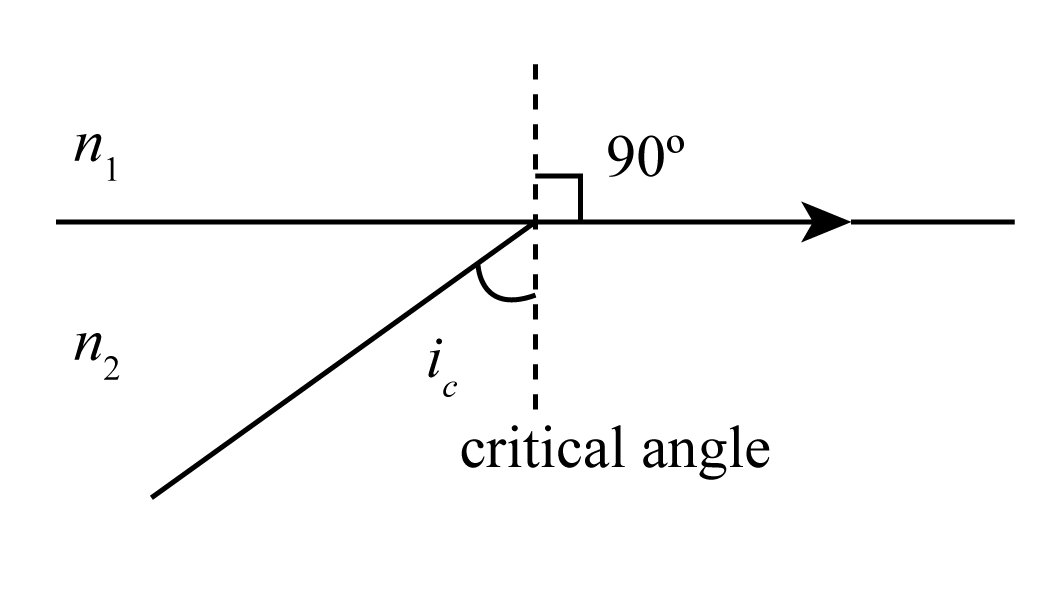
Here, \[{n_1}\] is the refractive index of one medium and \[{n_2}\]is the refractive index of another medium.
Then apply the Snell’s law as,
\[{n_1}\sin {\theta _1} = {n_2}\sin {\theta _2}\]……………………………..(1)
Here, \[{\theta _1}\] is the angle of incidence and \[{\theta _2}\] is the angle of refraction.
As, for the condition of critical angle, the refraction angle is at perpendicular direction.
Then substituting the value of \[{\theta _2}\] in equation 1 as,
\[\begin{array}{l}
{n_1}\sin {\theta _1} = {n_2}\sin {\theta _2}\\
\Rightarrow {n_1}\sin {i_C} = {n_2}\sin 90\;^\circ \\
\Rightarrow \sin {i_C} = \dfrac{{{n_2}}}{{{n_1}}}\\
\Rightarrow {i_c} = {\sin ^{ - 1}}\left( {\dfrac{{{n_2}}}{{{n_1}}}} \right)
\end{array}\]
Note:To solve the given problem, one must be aware of the phenomenon used in optics like refractions, reflection, angle of refraction, critical angle and many more. These variables have a direct impact on the angle of inclinations, namely called the angle of incidence and the angle of refraction. Moreover, one must remember the mathematical relations as per Snell's Law and their relations with the refractive indices of media.
Complete step by step answer:
When a light ray travels in a medium, strikes a surface such that there is some reflection occurring from the surface. And the incident ray of light will form a specific angle of incidence, this specific angle of incidence is that value of angle of incidence, beyond which the phenomena of total internal reflection can happen to take place.
Let us consider two mediums of different values of index. If \[{i_C}\] be the value of critical angle
Here, \[{n_1}\] is the refractive index of one medium and \[{n_2}\]is the refractive index of another medium.
Then apply the Snell’s law as,
\[{n_1}\sin {\theta _1} = {n_2}\sin {\theta _2}\]……………………………..(1)
Here, \[{\theta _1}\] is the angle of incidence and \[{\theta _2}\] is the angle of refraction.
As, for the condition of critical angle, the refraction angle is at perpendicular direction.
Then substituting the value of \[{\theta _2}\] in equation 1 as,
\[\begin{array}{l}
{n_1}\sin {\theta _1} = {n_2}\sin {\theta _2}\\
\Rightarrow {n_1}\sin {i_C} = {n_2}\sin 90\;^\circ \\
\Rightarrow \sin {i_C} = \dfrac{{{n_2}}}{{{n_1}}}\\
\Rightarrow {i_c} = {\sin ^{ - 1}}\left( {\dfrac{{{n_2}}}{{{n_1}}}} \right)
\end{array}\]
Note:To solve the given problem, one must be aware of the phenomenon used in optics like refractions, reflection, angle of refraction, critical angle and many more. These variables have a direct impact on the angle of inclinations, namely called the angle of incidence and the angle of refraction. Moreover, one must remember the mathematical relations as per Snell's Law and their relations with the refractive indices of media.
Recently Updated Pages
Master Class 12 Business Studies: Engaging Questions & Answers for Success

Master Class 12 Chemistry: Engaging Questions & Answers for Success
Master Class 12 Biology: Engaging Questions & Answers for Success
Class 12 Question and Answer - Your Ultimate Solutions Guide
Master Class 11 English: Engaging Questions & Answers for Success
Master Class 11 Social Science: Engaging Questions & Answers for Success
Trending doubts
Which are the Top 10 Largest Countries of the World?
Draw a labelled sketch of the human eye class 12 physics CBSE
Differentiate between homogeneous and heterogeneous class 12 chemistry CBSE
Differentiate between Pyramid of energy and pyramid class 12 biology CBSE
Why is the cell called the structural and functional class 12 biology CBSE
Draw the diagram of the pyramid of energy Explain In class 12 biology CBSE