



What cross sections do you get when you cut a candle horizontally?
A. Rectangle
B. Square
C. Circle
D. Triangle
Answer
 Verified
561.6k+ views
Hint: The intersection of a particular object with a plane along its axis is known as a cross section. A non-empty intersection of a solid body by a plane is called a cross section. In this question we have to cut the candle parallel to the base and then we will check which shape is obtained to mark the correct option.
Complete step by step answer:
A cross section is a representation of an object's intersection with a plane along its axis. When a solid is crossed by a plane, it yields a shape called a cross-section. When a cylinder-shaped item is split in half with a plane parallel to its base, the resultant cross-section is a circle. An area is projected onto the plane when a plane cuts a solid object. The plane becomes perpendicular to the symmetry axis. The cross-sectional area is the projection of the cross-sectional area.
When a plane cuts a solid shape in the horizontal direction, it creates a parallel line with the base, and when a plane cuts the solid shape in the vertical direction, it makes a perpendicular line with the base. A candle, as we all know, is a cylindrical item with a circular cross section and considerable height. When a solid shape is cut in the vertical direction, which is perpendicular to the base, the vertical cross section is obtained.
There are two types of cross section:
1. Horizontal Cross Section
2. Vertical Cross Section
Horizontal Cross Section: A plane cuts a solid shape in the horizontal direction that is parallel to the base to produce a parallel cross-section.
Vertical Cross Section: A plane cuts the solid shape in the vertical direction that is perpendicular to the base to create a perpendicular cross-section in perpendicular cross-section.
Now in this question we have to cut the candle horizontally.
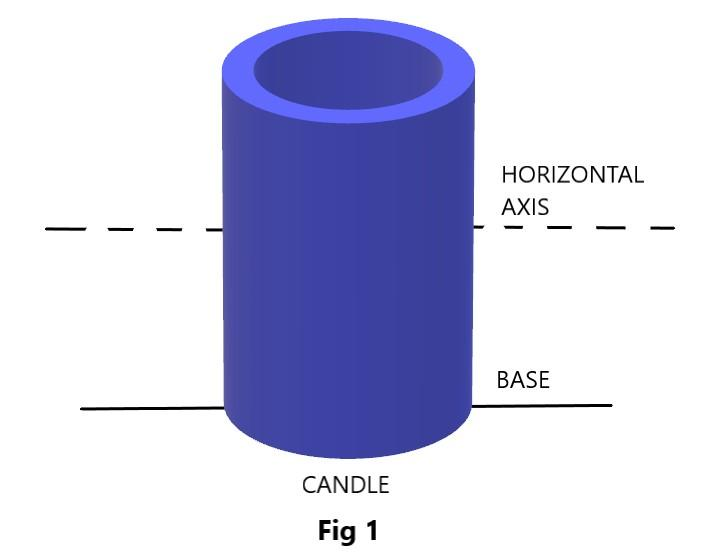
Now if we cut the candle horizontally as shown in the below figure (fig 1.), it will be parallel to the base hence we will get a circular shape.
Therefore, the correct answer is “Option C”.
Note:
A solid object can take on multiple shapes depending on how it is sliced; for example, when a cylinder is cut in the vertical axis, it produces a rectangle. Cross sections can help us understand the numerous qualities of the inside of an object as well as how it is put together since they lend themselves to the study of shapes and because these shapes are all around us.
Complete step by step answer:
A cross section is a representation of an object's intersection with a plane along its axis. When a solid is crossed by a plane, it yields a shape called a cross-section. When a cylinder-shaped item is split in half with a plane parallel to its base, the resultant cross-section is a circle. An area is projected onto the plane when a plane cuts a solid object. The plane becomes perpendicular to the symmetry axis. The cross-sectional area is the projection of the cross-sectional area.
When a plane cuts a solid shape in the horizontal direction, it creates a parallel line with the base, and when a plane cuts the solid shape in the vertical direction, it makes a perpendicular line with the base. A candle, as we all know, is a cylindrical item with a circular cross section and considerable height. When a solid shape is cut in the vertical direction, which is perpendicular to the base, the vertical cross section is obtained.
There are two types of cross section:
1. Horizontal Cross Section
2. Vertical Cross Section
Horizontal Cross Section: A plane cuts a solid shape in the horizontal direction that is parallel to the base to produce a parallel cross-section.
Vertical Cross Section: A plane cuts the solid shape in the vertical direction that is perpendicular to the base to create a perpendicular cross-section in perpendicular cross-section.
Now in this question we have to cut the candle horizontally.
Now if we cut the candle horizontally as shown in the below figure (fig 1.), it will be parallel to the base hence we will get a circular shape.
Therefore, the correct answer is “Option C”.
Note:
A solid object can take on multiple shapes depending on how it is sliced; for example, when a cylinder is cut in the vertical axis, it produces a rectangle. Cross sections can help us understand the numerous qualities of the inside of an object as well as how it is put together since they lend themselves to the study of shapes and because these shapes are all around us.

Recently Updated Pages
Which will be the least stable resonating structure class 11 chemistry CBSE

Explain the structure of megasporangium class 12 biology CBSE
Differentiate between voluntary action and reflex class 10 biology CBSE
How many 5 digit telephone numbers can be construc-class-11-maths-CBSE
How do you find the angle of the resultant vector class 11 physics CBSE
Why is chloroform kept in dark coloured bottles class 12 chemistry CBSE
Trending doubts
How many sides does a circle have a 10 sides b 20 sides class 8 maths CBSE
What is BLO What is the full form of BLO class 8 social science CBSE
Citizens of India can vote at the age of A 18 years class 8 social science CBSE
Full form of STD, ISD and PCO
One cusec is equal to how many liters class 8 maths CBSE
10 slogans on organ donation class 8 english CBSE